
Have you ever found yourself suddenly back into porn after going without looking at it for awhile? You were doing well, but then fell flat your face again.
That doesn’t happen at random. There’s a reason it pulls again and you probably should have seen it coming, but thought you were “free” and shrugged it off.
A junk email that slips through the filters into your inbox—“Alexa wants to chat with you.”
You don’t open it, but something inside pulls.
A while later another one gets through. This time you open the email, but don’t click on any links. Or maybe you find yourself drawn to more elicit TV shows or movies. When an inappropriate ad comes on during a football game, you find it hard to pull away. Thoughts that you hadn’t heard in awhile start floating through your mind, arousing curiosity or fantasy.
Don't Have Time to Read? Here's the Gist:
Porn doesn't come back because you're broken or because your healing was fake. It comes back because life breaks you open and the old friend offers relief. Freedom isn't the permanent absence of struggle — it's knowing what to do when the struggle shows up again.
The Long game Toward Sexual Freedom
I used to think that freedom meant these things would never bother me again. In fact, I went the better part of a decade without them bothering me—without feeling much temptation at all. Which is why it surprised me when they started circling back again.
What’s going on? I thought I was free!?
If we’re not careful, we begin going down this self-sabotaging road of internalizing temptations. Trying to act like these things shouldn’t bother us anymore tends to only fuel the struggle.
That’s why when my counselor told me that “porn is like an old friend,” a significant paradigm shift began to open up a new level of “freedom.”
“Porn is like an old friend,” he told me. “It just sits in the corner and waits. Then when life breaks you open, it offers its services again.”
That’s what was happening. Life was “breaking me open.”
I was going through some of the darkest times mentally and emotionally that I had gone through as an adult. Without realizing it, my heart and mind were responding to those dark times in a similar way to how I responded to them in my youth—when I was addicted to porn.
Pornography doesn’t just offer pleasure; it offers relief. It offers a kind of numbness, power, and control that helps you feel on top of the world again. When life feels chaotic, porn feels predictable. When you feel unwanted, porn feels like attention.
When you feel ashamed, porn offers a way to escape.
It’s not real connection. But it imitates it.
It’s that old friend that you never actually make meaningful memories with because he tends to be hard to get along with long-term, but for whatever reason keeps showing up in your life. While other people come and go, he’s over there doing similar things you’re doing. He’s taking similar trips you’re taking.
Yes, I’ve heard of stories where someone is delivered of it and never again struggles. But I think it’s dangerous to assume that is what freedom always looks like. The vast majority of us will probably experience its subtle temptations again, and that doesn’t mean Jesus isn’t healing. It just means there’s more for Him to still touch.
As my counselor helped me identify what was going on, I learned something about failure. Failure isn’t a setback to healing; it’s information. If I feel temptation that I thought I was over, or if I fail again, it doesn’t necessarily mean the healing that had taken place before was all for naught. Rather, it provides information on areas of my soul that still need healed.
Sexual freedom isn’t the absence of future vulnerability. It is the ability to choose Jesus as comfort and life when that vulnerability hits.
The goal isn’t becoming temptation-proof. The goal is becoming truthful and responsive when temptation shows up. Here’s that that might look like:
Related Articles
First of all, get curious.
Are you familiar with the acronym HALT? It stands for Hungry, Angry, Lonely, Tired. When you bump into a behavior that feels as though you’re magnetically pulled to it, you can often tie it back to being either hungry, angry, lonely, or tired.
Ask yourself, “What am I longing for?” “Am I craving comfort, connection, control, reassurance, or something like that?” “What do I feel like I don’t have right now?”
Maybe the issues isn’t something you’re longing for, but something that has caused pain. Are you angry about something? We often view anger as the problem, but anger is merely pointing to something deeper. It doesn’t always stem from sin. You may have been wronged and your sense of justice was violated. It’s helpful to identify that and name it even when we know we don’t want to respond out of anger.
Other times, the unwanted behavior comes from lack of meaningful relationships. Maybe that’s because of something we did in pulling away from people or maybe it comes as the result of a stage of life we’re in. But we are relational beings designed for connection with others. When we go too long without meaningful connections, we inevitably find ourselves tempted to use coping mechanisms that ultimately cause more damage.
And yes, even simply being tired can be what lies at the bottom of it all. We can be tired physically, emotionally, or spiritually. Either of them create a vulnerable state where the old friend likes to show up and offer a way to relax. Rest and recovery matters; and it’s not just a self-help tip. God embedded within creation the value of rest and recovery. We are not God. We are creation. So we need to submit to the limits of our abilities. After all, God himself spent time resting.
There’s always a story behind sexual sin. Before implementing some strategy to try and discipline it out of your life, get curious about what that story might be.
“What shame just got triggered?” “What pain am I trying not to feel?”
If we are going to have deepening healing, we need to start identifying why the old friend’s offer feels so attractive to us. We know it doesn’t leave us feeling good. We know it’s wrong. So why do we keep returning? That’s why we first start by getting curious.
Second, make the pivot.
When the old friend shows up, it’s good to get curious. But if you’re like me, getting curious can make things worse for a time.
After I met with my counselor for several months and we had done a lot of digging, I found myself tempted even more than before. We had identified and dug up so much junk that I was keenly aware of the messages and pain I was avoiding. But now what was I supposed to do with all the emotions I was feeling. Getting curious doesn’t fix that. It simply helps me know why they’re there.
It helps to first of all name the moment. “Ah. The old friend is here.” Don’t panic. Don’t spiral into self-hatred. Just name it. That allows you to then intentionally choose where you’re going to go for comfort.
Yes, Jesus is who we want to run to for comfort, but what are we looking for comfort in? How do we know we’re not just going through some religious ritual emotionally detached from what we’re going through? And how do we ultimately begin to move toward connection, because isolation is fuel for a struggle with porn.
The opposite of porn isn’t willpower; it’s intimacy. It is hard to be intimate with people or with God without being emotionally healthy.
So how do we grow in emotional health so we can deepen intimacy with God and others?
That’s what we’re going to look at in the next article.
Porn will show up again like an old friend. Not because you’re hopeless or because everything God has done in you was fake. It will show up because you’re human and life has a way of breaking us humans open.
So when that junk email slips through or the ad lingers too long and your mind starts wandering down old trails…
Don’t just grit your teeth. Name it, get curious, and make the pivot toward connection.
Remember, freedom isn’t “I’ll never feel this again.” Freedom is learning what to do when I feel it again.
And if you want help with that—real help—here are a few simple steps I recommend:
Read the next article
In the next post, we’re going to talk about emotional health. I believe it is the often missing piece in a lot of porn recovery conversations. How do you actually learn to:
- sit with hard emotions without numbing
- identify the story underneath the pull
- build real intimacy with God and people
So if you don’t want to miss it… subscribe using the form below (or follow along wherever you read my work).
Don’t do this alone
If this article hit a nerve, here’s a challenge:
Pick one person. Today.
Not ten. One.
Text them something simple, like: “Hey, I’m in a vulnerable season.” “Can you check in with me this week?” “I don’t need you to fix me. I just need to be known.”
Secrecy is where the old friend gets loud. Connection is where he starts losing his voice.
Get practical guardrails in place
If you don’t have accountability software on your devices, start there. Not because software saves you, but because it creates friction when your brain is sprinting toward relief.
In my own life, I’ve found Accountable2You to be the most helpful (especially across devices and apps). If you want, I also wrote a step-by-step guide for individuals and families on how to set it up in a clean, realistic way.

And if you want deeper support
If you’re tired of a “try harder” or “pray more” approach, and you want a space that helps you grow in being:
- theologically anchored
- emotionally healthy
- able to love others well
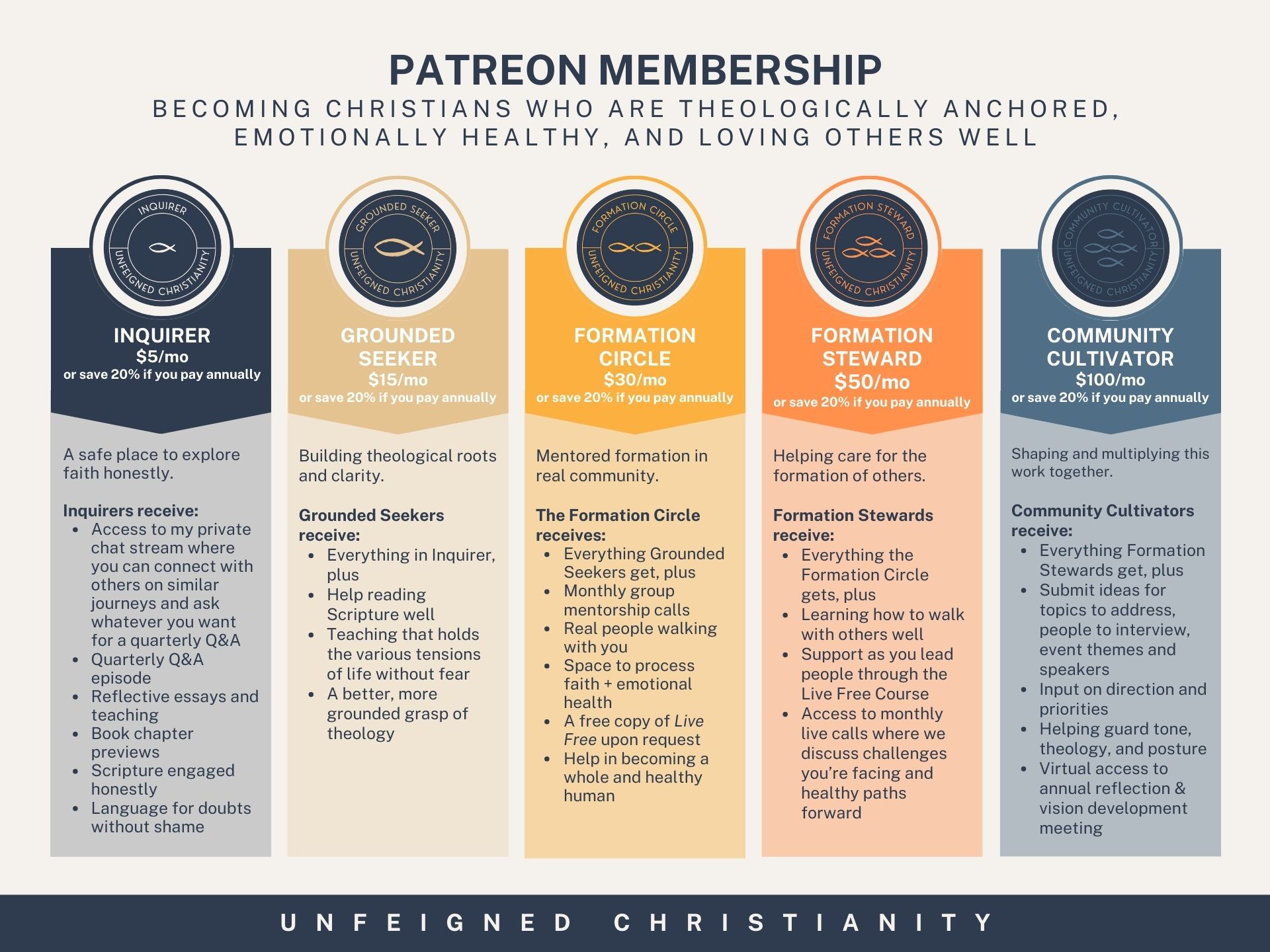
…that’s why I built the Formation Circle, an online mentorship community that helps you walk-out becoming a whole and healthy human. This community is nothing fancy. But it helps ordinary people practice honesty, connection, and healing—one choice at a time.
You’re not disqualified because the old friend came back. In fact, you’re invited to learn a new response. That’s where real freedom starts.
When the old friend showed up again, what was actually going on in your life at the time? You can share in the 0 Comments below.
Join Unfeigned Christianity on Patreon and Take Your Journey to the Next Level.
Become a paying member of Unfeigned Christianity for as little as $5/mo and access article, our community chat stream, and quarterly Q&A episodes.
Already a member? Login