
I have a colleague I've never met in person.
We've worked together for about six months. I've sat in on strategy calls with him, heard him give devotionals to our team, had scattered conversations about life and faith and work. And somewhere in the middle of all that, I found out he'd written a book about growing up in the San Fernando Valley in the 1980s.
I started reading it while my wife was in labor.
I know that says something about me. I'm not sure what. But it was a surprisingly good time to read it — sitting in a hospital room waiting for a baby, settling into a story about a community that formed a person before he had words for how.
That colleague is Keith Smith. And the book is The Magic of Montford Street: A Love Letter to the Valley in the '80s.
Don't Have Time to Read? Here's the Gist:
Keith Smith grew up in Pacoima — in what became the first African-American suburb in the United States. His grandfather was a Tuskegee Airman. His neighborhood was multigenerational, tight-knit, and genuinely magical. Then the crack epidemic arrived, the War on Drugs came with it, and a murder divided his childhood into before and after. His memoir is the origin story he had to tell before he could say anything else in public. And it quietly raised some questions I haven't been able to put down.
I Used to Drive Past That Street
Before we moved to Cañon City, Teresa and I lived in the San Fernando Valley for most of our adult life. I used to drive the 118 two or three times a week heading to Bible college in Simi Valley. I did handyman work in Pacoima — Paxton Street, Glen Oaks Boulevard. I knew the area.
Only, I didn't really know it. Not like Keith does.
He grew up on Montford Street. His grandfather was a Tuskegee Airman — one of the first African-American pilots, trained during a time when a lot of people were actively hoping they'd fail. After World War II, that grandfather and others like him needed somewhere to build a life. They settled in Pacoima, in what became known as the Joe Louis tract homes — a new housing development named after the famous Black boxer. A signal, really. These are for you.
Keith told me that Pacoima is considered the first African-American suburb in the United States. And listening to him describe what grew there — the multigenerational families, the teachers and actors and people connected to Motown, the church his grandparents helped build and served in until they died — I found myself a little stunned that I'd driven through that neighborhood dozens of times and had no idea what it was.
Related Articles
Keith Smith's Mom Taught Michael Jackson the Robot
Keith's mom and Michael Jackson were born one day apart. She was a huge fan. So when she was about 14, she and her friend rode their bikes from Pacoima to Encino — which is 14 miles, which I want to be clear is a very long bike ride — and showed up at the Jacksons' gate.
Katherine Jackson answered the intercom. Said no, we don't let fans in. And right at that moment, Keith's mom's friend asked which Kingdom Hall they attended. Her family were Jehovah's Witnesses. So was the Jacksons'.
The gate buzzed open. They walked down the driveway. Every single Jackson was home.
They ended up swimming. Michael didn't want to get his afro wet. Keith's mom convinced him to jump in anyway. Dancing Machine came on the radio. Keith's mom started doing the robot.
Michael stopped. Whoa. Do that again. Where did you learn that?
Keith grew up hearing that his mom is the reason Michael Jackson could do the robot. And his grandmother later hung up on Joe Jackson when he called to say the girls were on their way home — because she thought it was a prank.
I mean. That's the kind of neighborhood this was.
What the '80s Actually Were
Keith was born in 1976. He was raised partly by his grandparents because his parents were so young — his mom was a senior in high school when she had him, his dad was a junior. Which means he was raised, in a real sense, by the generation that raised baby boomers.
He thinks that's part of why his childhood had the texture it did. Kids still played in the streets until the streetlights came on. They drank from garden hoses. They showed up at each other's houses without calling first. But Atari 2600 had also just come out, so they weren't entirely strangers to the indoors.
He described it to me as a bridge generation. And I think that's right. Something happened somewhere in between, and the kids who grew up in that particular window seem to know it.
The uncles were a big piece of it too. Not just his uncles — the uncles in general. The generation just above Keith that was still present in the neighborhood. Playing all-time quarterback in the street. Drawing up plays on the palm of their hands. Checking in. Telling stories about college and jobs and what was possible.
It's the kind of thing that's hard to manufacture. It either grows naturally or it doesn't.
The Day the Magic Ended
The book opens with a murder.
Keith was 12 years old. Tracy Anderson was shot and killed in broad daylight on his street. Kids were outside playing. Neighbors were watering their lawns. It happened in front of everyone.
He didn't fully understand what it meant at the time. He knew something had shifted. He knew before and after had been divided. But he was 12. The words for childhood innocence being stolen came later.
And that's actually why the book is structured the way it is. He starts in the after — with the murder — and then goes backwards. Lets you feel the weight of what was lost before you understand what made it precious.
It's a good instinct. And it works.
The War on Drugs, Two Blocks Away
What happened to Pacoima in the mid-to-late '80s wasn't random. There was a shape to it.
The crack epidemic arrived. Some original families moved out. People renting moved in. And then the drug enforcement response came — not as how do we help people who are struggling with addiction but as we are declaring war.
The first time the LAPD ever deployed a battering ram on a civilian home happened two blocks from Keith's house in Pacoima. The news was there. The chief of police came. They broke down the door.
Wrong house. Just a family inside. Children.
Keith was a kid. He didn't know the policy details — the sentencing disparities that gave harder time to crack cocaine in Black communities than powder cocaine in white ones, the way felony records made employment nearly impossible, the way the math of that kept compounding. He didn't understand any of it yet.
He just saw baggies on the ground on the way to the bus stop where he'd never seen them before.
And a few years later, just down the road on Glen Oaks and Osborne near Hansen Dam — a neighborhood I knew, a road I'd driven on — a man named Rodney King was beaten by the LAPD. A guy across the street had just bought a camcorder and happened to put it out his window.
Pacoima kept finding itself at the center of things, Keith said. Remarkable things and terrible things alike.
What His Grandmother Left Behind
Keith's grandmother was a Southern woman — born and raised in Atlanta, transplanted to Southern California. She cooked full meals and always made enough for company. Every holiday went all out. The house was always open. Everyone felt like they belonged.
Keith and his wife have done the same thing in every house they've lived in since. Including a small house with one bathroom where they crammed people in anyway.
He told me that's how he pastors. How he leads. That a very high standard of what belonging and community look like got built into him before he knew it was happening, because he actually experienced it. It wasn't a value he adopted. It was something he absorbed.
That's the thing about formation. Most of it happens before we have language for it.
Why This Book, First
Keith has other books he wants to write. Theological ones. Ministry ones. He has notes and titles and chapters outlined.
But when it came time to actually sit down and write, he knew he couldn't do any of those yet.
This one had to come first. Because this is the origin story. And you can't introduce yourself as an author without first letting people know what made you.
I find that compelling. Not just as a publishing strategy but as a posture. There's a kind of honesty in saying: before I tell you what I think about God and the church and the kingdom, let me show you where I came from. Let me show you the street and the people and the decade that formed me, so you know what you're actually dealing with when I say what I believe.
I think that's a more truthful way to write. And probably a more truthful way to live.
What Stood Out To You?
Listen to the full episode on the Unfeigned Christianity Podcast.
Who are the people or places that formed you before you knew it was happening? You can share in the 0 Comments below.
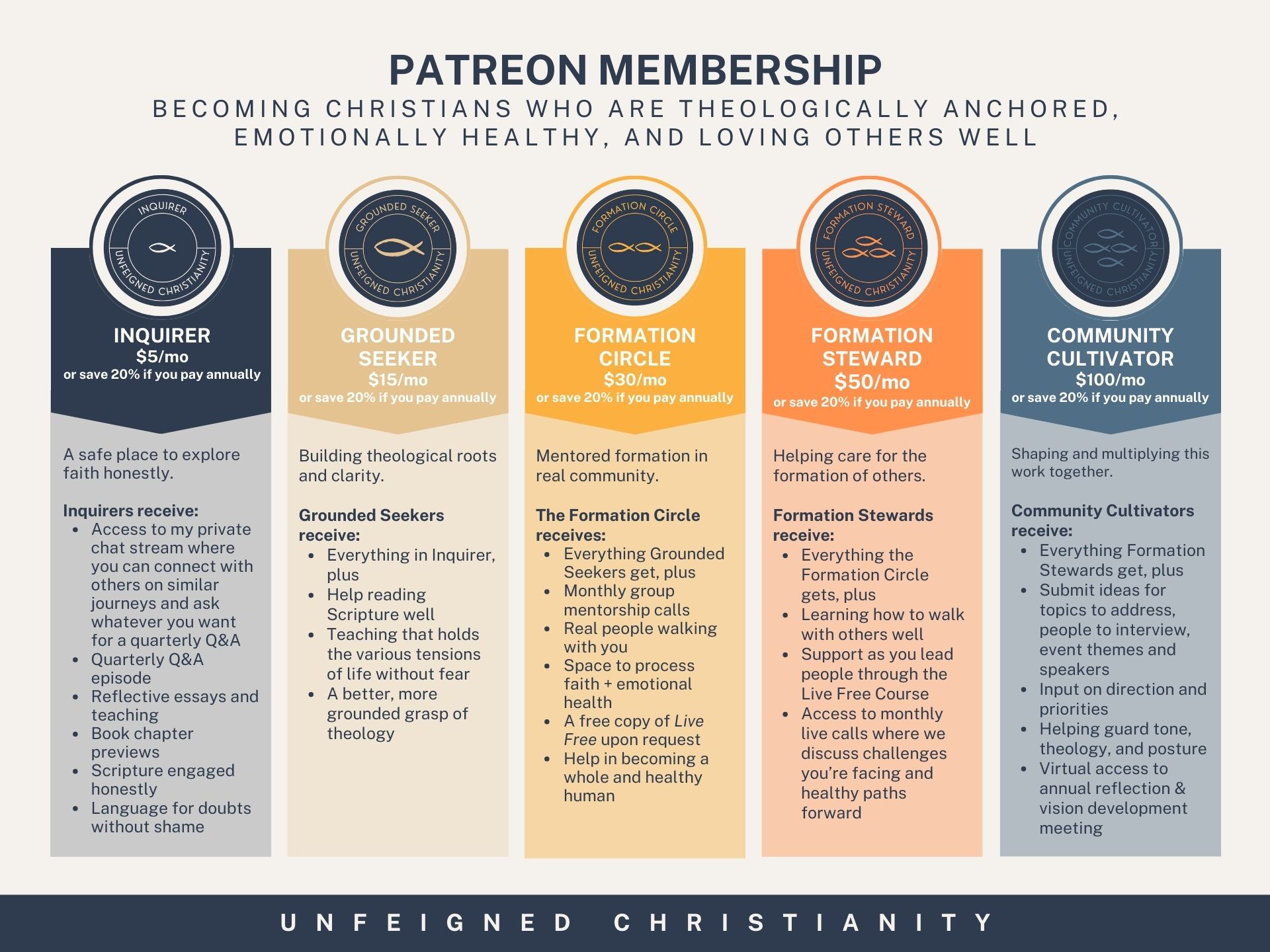
Join Unfeigned Christianity on Patreon and Take Your Journey to the Next Level.
Become a paying member of Unfeigned Christianity for as little as $5/mo and access article, our community chat stream, and quarterly Q&A episodes.
Already a member? Login