
A few years ago, my wife Teresa and I were caught in a season that I think a lot of couples know well. We had several kids. I was working full time and in school almost full time. We were deeply involved in local ministry. Life was loud and full and exhausting — and at the end of every day, we'd collapse into bed having barely spoken to each other about anything that mattered. Our conversations had become entirely logistical. Who's picking up which child. When's the meeting. What's for dinner. We were connected by schedule but disconnected at the soul.
That's not a marriage problem, exactly. It's a human problem. We long to be truly known by the people closest to us, but we don't always have the tools — or the energy — to get there.
That's what drew me to Pathos: The Emotional Card Game, and why I wanted to share it with you here. What follows is my honest take on what this game is, how it works, and — more importantly — why I think it points to something we all genuinely need.
Don't Have Time to Read? Here's the Gist:
Talking about emotions is hard, but often the biggest obstacle is simply not knowing what to ask. Pathos: The Emotional Card Game hands you the questions, making it easier to have the kinds of conversations that build real connection — with your spouse, your kids, or your community.
The Real Obstacle to Deep Connection
Here's something I've come to believe: the biggest barrier to meaningful conversation isn't unwillingness. It's not even busyness, though that certainly doesn't help. The biggest barrier is simply not knowing what to ask.
Think about the last time you sat across from someone you loved and wanted to go deeper — to move past the surface, past the weather and the news and the latest thing the kids did — and you just... didn't know how to start. So you stuck to small talk. Not because you didn't care. Because you didn't have a way in.
Games like Pathos solve exactly that problem. They hand you the question. They do the hard work of knowing what to ask so that all you have to do is ask it — and then listen.
I've played similar games before. Practicing the Way has a set called Table Conversations that does a beautiful job of helping people get to know one another. There's also the Tales series — Tales for Couples, Tales for Families — which follows a similar spirit. What I find remarkable about all of these games, every single time, is this: no matter how well you think you know someone, they will say something that surprises you. And that surprise opens a door. Suddenly you're not playing a card game anymore. You're having the kind of conversation you've been meaning to have for months.
Related Articles
What Makes Pathos Different
What sets Pathos apart from its siblings on the shelf is its specific focus: emotions.
The deck is organized around five core emotional experiences — love, sadness, anxiety, anger, and happiness — each color-coded so you can see at a glance what emotional territory a card is exploring. Pink for love. Blue for sadness. Orange for anxiety. Red for anger. Green for happiness. Within each category, there are a variety of prompts:
- "Share a time when you felt sad."
- "My body reacts to anxiety by..."
- "What is one positive of sadness?"
- "Describe happiness as a house."
That last one caught my attention when I turned it over during our family game night. We had recently seen another house come on the market, and Teresa had found it intriguing for reasons I was still trying to understand. I'd asked her about it directly. We'd talked around it. But when I drew that card — Describe happiness as a house — something clicked. This was a different angle into the same territory. Not "what do you think about that house?" but "what does happiness look like when it has walls and windows and a front porch?" And I realized that's actually what I wanted to know. Not the square footage. What she pictured when she imagined feeling at home.
That's what a good question can do. It doesn't just gather information. It opens a window into someone's inner world.
Emotions Are Hard to Talk About — That's Exactly Why We Need To
There's a reason the game is focused on emotions specifically, and it's worth naming. Emotions are hard to talk about. We feel them in our bodies before we can name them in words. We've often been taught — implicitly or explicitly — that strong emotions are something to manage or suppress, not explore. Men especially are handed this cultural script that says feeling deeply is weakness, that naming your emotions is somehow indulgent.
In our family, we've found the opposite to be true. We're a fairly emotional household — highs and lows, all of it. Our boys feel things just as deeply as our girls. Teresa and I are both wired with a lot of emotional intensity. And what we've learned, slowly and sometimes painfully, is that emotions don't go away when you ignore them. They just go underground. They come out sideways — in irritability, in withdrawal, in conflicts that seem to be about one thing but are actually about something else entirely.
Learning to name what you're feeling — to put words to it, to say it out loud to someone who is listening — is one of the most important skills a human being can develop. And it turns out it's a skill, like any other. You can practice it. You can get better at it. And you can start by being asked the right question at the right moment.
Pathos is built for exactly this kind of practice.

How We Actually Played It
I'll be honest: we didn't follow the official rules to the letter. The game is designed for two to ten players, ages eight and up. You shuffle the deck, deal six cards each, and take turns playing a card that matches either the color or the symbol of the top discard pile card — similar in structure to Uno. When you play a card, you respond to whatever prompt is on it. There are also question cards you can play out of turn, which I like — it means that if someone shares something and you want to follow up before the conversation moves on, you have a mechanism to do exactly that.
But we played it more loosely, weaving it into our existing family tradition. For a couple of years now, we've had what we call the "family conversation" — a weekly rhythm where we gather and ask each other real questions, usually a rotating group so it doesn't go too long. Pathos slid right into that groove. I picked several cards and we went around the table answering them. Four or five questions. Enough to get people talking, not so many that the littler ones checked out.
For our family, at these ages, a full game might be a stretch. But even as a conversation starter — even just pulling a handful of cards before dinner or on a road trip — it's genuinely useful. And for couples, I can easily imagine bringing this on a date night or an anniversary getaway. The gameplay mechanics designed for larger groups would just shift a little, but the heart of it — the questions, the prompts, the emotional territory it covers — would be just as rich.
What Lasting Connection Actually Requires
Here's where I want to push a little further, because I think there's something underneath all of this that's worth naming.
Games like Pathos are wonderful. They lower the barrier to real conversation. They make it easier to talk about the things that matter. But they're a doorway, not a destination. Real, sustained emotional health — the kind that lets you love people well over the long haul, through conflict and disappointment and grief and joy — requires more than a good card game. It requires practice, and honesty, and often some support.
One of the things I've come to believe deeply is that emotional maturity and spiritual maturity are not two separate tracks. They're intertwined. You cannot become truly spiritually grounded while remaining emotionally stuck. Our unprocessed emotions shape how we read Scripture, how we relate to God, how we treat the people around us. And in the other direction, being theologically anchored — having a real, rooted understanding of who God is and what he has done — provides exactly the kind of security that allows us to face our emotions honestly rather than running from them.
A card game can start a conversation. But the real work is what happens after — the willingness to keep showing up, to keep asking, to keep listening. To be the kind of person and community where it's safe to say, "I'm struggling," or "I don't know," or "here's what's going on inside of me."
A Simple Tool for a Deeply Human Need
Pathos won't fix a broken relationship. It won't replace good counseling or deep friendship or the slow work of becoming emotionally honest over years. But it will give you a question when you don't have one. It will pull you and the people you love into a conversation you might not have found on your own.
And sometimes, that's exactly what we need.
If talking about your emotions feels unfamiliar or even a little scary, that's okay. Most of us weren't taught how. But it's a skill — and you can learn it, one question at a time.
Play the game for yourself!
You can find Pathos on Amazon for around $30, or purchase it directly at their website for $24. Listen to the full episode on the Unfeigned Christianity Podcast.
What's one emotion you find hardest to talk about — and who in your life would you most want to explore it with? You can share in the 0 Comments below.
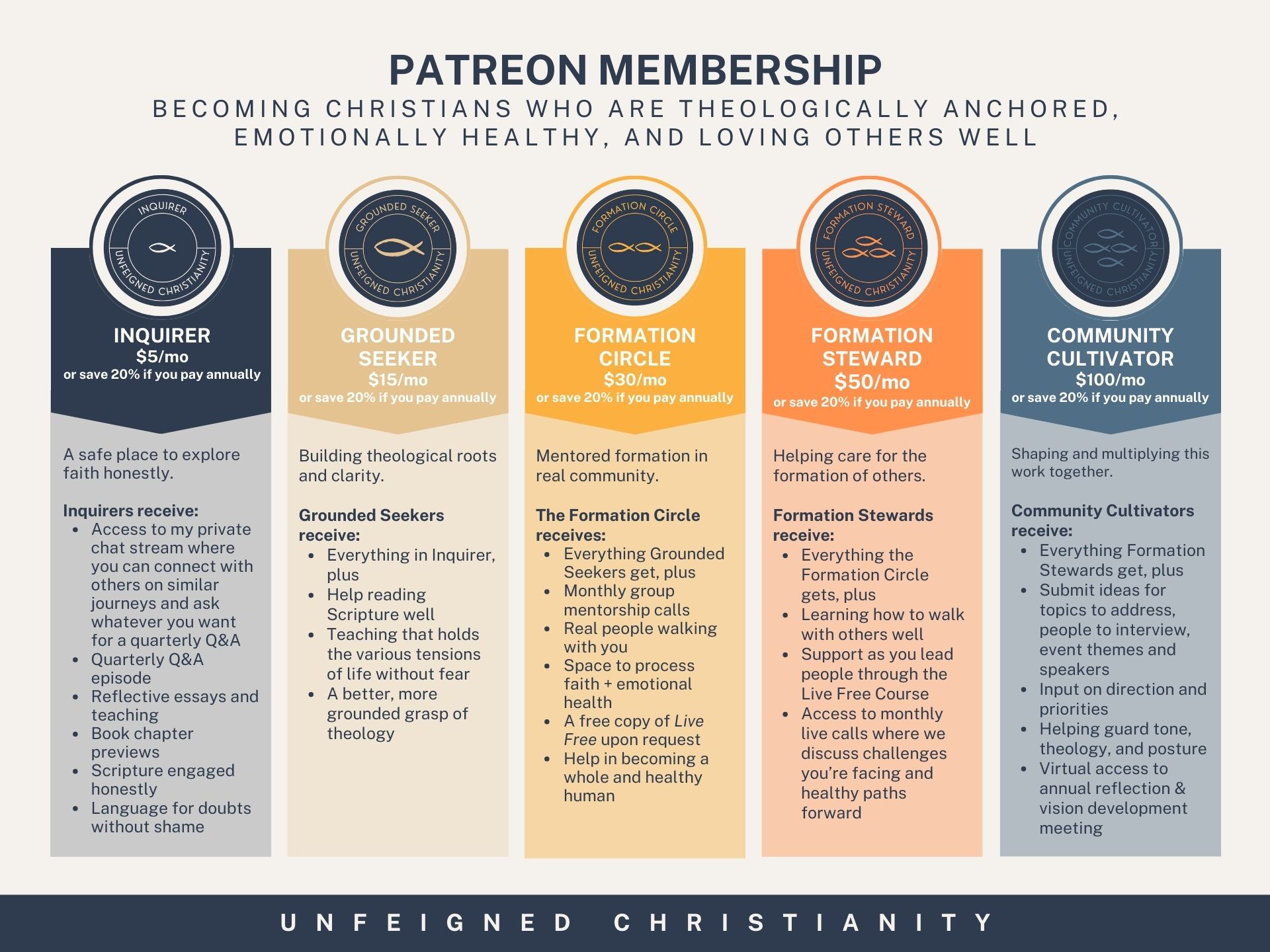
Join Unfeigned Christianity on Patreon and Take Your Journey to the Next Level.
Become a paying member of Unfeigned Christianity for as little as $5/mo and access article, our community chat stream, and quarterly Q&A episodes.
Already a member? Login