
Somebody raises their hand about a problem, and before long the conversation is about them. We see it in marriages, in business meetings, and in church leadership. When the concern is abuse, that reflex turns into a way of not knowing.
In this solo episode, I talk about:
- Why we instinctively turn on the person raising a concern, and why that's unhealthy
- "Awareness fatigue," and the fair critique of outrage from a distance
- Why abuse stories spread like wildfire in the church (hint: a history of cover-up)
- A petition asking the BMA for a third-party investigation, and why I'm sharing it
- What it looks like for men who lead to lead in confession and repentance
I also announce my two workshops at the Anabaptist Awareness Symposium on Sexual Abuse (Oct. 15–17, Gospel Haven Mennonite Church, Millersburg, Ohio): one on healthy masculinity, and one called "What Shame Hides: Finding Healing in Our Broken Stories."
Don't Have Time to Listen? Here's the Gist:
When someone raises their hand about a problem, our instinct is to find the problem in them. That's human, but when it shows up in church leadership, especially around abuse, it becomes a way of not knowing. Yes, some of the loudest voices are unhealthy. That doesn't make them wrong. There's a reason these stories spread like wildfire: a long history of cover-up. If we say men should lead, then let's lead in confession and repentance, even when it costs us our reputation. Otherwise we aren't making disciples. We're cultivating contempt for Jesus.
Links referenced in the episode:
[00:00:00] Hello friends. Welcome back to Unfeigned Christianity where we are on a journey of becoming a people who are theologically anchored in Jesus and emotionally healthy so we can love and disciple others. Well, I hope you've been enjoying the recent episodes that I've released. It's been exciting to see you guys responding to it. And the clearest way that I know is by looking at the analytics on YouTube. The last four episodes have increased in views, but it's been just the last two episodes where it's almost doubled from one to the next. And so that's a sign you guys are engaging with it. You're watching it. This is on YouTube on the podcast version. I've seen those analytics going strong as well. So thank you for listening and I hope you have found it helpful and not just encouragement, but even provoking in this journey of loving well. And we've specifically highlighted some some ways that people are activ loving well and whether it's through going to the war zone, my last interview with my sister, or discussing AI and how do we be human with each other in an age of AI and giving money to poor in so many various ways that we have looked at recently.
[00:01:24] Today I want to highlight. I'm going to do a solo episode and specifically want to highlight couple things. I have an announcement that I'm going to be speaking at the Anabaptist Awareness, the symposium on Sexual abuse.
[00:01:42] Goodness, I am blundering this up. The Anabaptist Symposium on Awareness of Sexual Abuse or something like that.
[00:01:54] Let me see if I can pull it up properly.
[00:01:58] That's kind of embarrassing. I'm speaking at that event. I've got two workshops there.
[00:02:04] Anabaptist Sexual Abuse Awareness is what it's listed at Facebook then Anabaptist Awareness Symposium on Sexual Abuse. So I guess it's it's titled differently depending on where you're looking at it. But that event is coming up on October 15 through 17.
[00:02:26] I will be speaking on Friday and Saturday, that's the 16th and the 17th and have two workshops there. I'll link to the website where you can get a brochure of the event, see everybody who's speaking. It is happening at Gospel Haven Mennonite Church in Millersburg, Ohio. So if you're local in the area, I'd love to see you there, love to meet you, interact with you and you can come out and check check out the event. It's a fairly large event. There's a lot of speakers. I'm looking forward to taking in the event myself.
[00:03:00] They've asked me. I think this was the third time number of years ago they asked me. And we've always had something big going on. We were moving or I was dealing with some health issues and I turned them down. And this year I did not have a reason to turn them down. But it is also something that's close to my heart now, I think, just for some context, I believe the event started specifically about, kind of focused on sexual abuse. And it's evolved into something to help equip churches and yeah, the Anabaptist community in becoming healthy people.
[00:03:44] And so they have several different tracks. And yes, one is sexual abuse one, but I'm going to specifically be sharing about developing healthy masculinity. And I look forward to.
[00:04:00] I was trying to decide if I share some of that material here on the podcast at some point, but I'm going to be looking at some myths about masculinity and what masculinity is, and then kind of, I guess you could say busting those myths and, and looking at scripture, like, what according to scripture, what is masculinity and what is healthy masculinity?
[00:04:26] And so we'll look into that as well as a session on what shame hides. Finding healing in our broken stories.
[00:04:38] And this one is.
[00:04:41] This is the one that I was specifically asked to do when I was first asked earlier this year.
[00:04:48] And it comes from. There's a few different angles.
[00:04:52] On one hand, shame has been used a lot almost as a weapon. And you, like, try to. I've noticed this even in helping men overcome unwanted sexual behavior, is there's a lot of approaches that take this, like, shame tactic, like, you don't want to be this gross, perverted man kind of approach. And that sort of mentality. It's like, man up and be strong. And that actually tends to just perpetuate the very behavior it's trying to solve. There are some personalities perhaps that are motivated by that.
[00:05:30] There is a level in which all of us, I think there are elements where we have enough dignity. We're going to do something just because we don't want the shame of being found out as having done something else. Right. And so kind of interacting with the way shame has been used as a motivator, or I would more bluntly say a weapon. So there's. There's that aspect, but then there's also just the. The internal aspect of shame and how, whether that's unwanted sexual behavior or even just thoughts and things that we're wrestling with, how we.
[00:06:09] It's tough to be vulnerable and share openly with someone. And our churches are kind of curated to be present perfect images of ourselves. And so how do we develop a culture of confession, a culture of regular repentance and just sharing our brokenness with each other and walking with each other, even in the shameful parts of our stories?
[00:06:36] And then there's the other element of the shame that sexual abuse brings. So thinking of those who are victims of sexual abuse or any kind of abuse and living with that shame, while also this element in which when you raise awareness about abuse, there's a sense of shame that it brings to the community or the person who was the abuser, especially if that person, someone of stature.
[00:07:09] And so on one hand, a lot of people will kind of recoil, like, don't bring this shame on us by exposing all this. And that's actually a kind of shame that needs to be brought to the light, needs to be exposed.
[00:07:24] And so this session, I'm still work, I'm still workshopping the workshop. Um, I'm still.
[00:07:30] I'm still honing in exactly how I. Yeah. What I'm going to share in these sessions, but that's what I'll be speaking on. There's a lot of other good sessions, breakout sessions that will be happening as well. So take a look at the event through the link below.
[00:07:50] And that's something that's coming up again October 15 through 17. If you're in Ohio or around that area and you think you would like to, you've heard of the event, you thought it would be cool to check out sometime, I'd love to see you there.
[00:08:09] But I totally understand. If not, if it doesn't work out, I will probably share an episode, kind of reflecting on it as well on the event afterward.
[00:08:21] It's a fairly big event. I've heard that. I think it's about a thousand people.
[00:08:29] Maybe not.
[00:08:30] I've heard that number. As far as who all attends the event, I don't know if anybody's. If all a thousand people are there at one time or if it's just over the course of the three days there's a thousand people. But I was told for the workshops, the breakout sessions, to plan for 200 people. And so that was kind of like, man, that's a big crowd.
[00:08:54] I mean, when I preach at church on Sunday, that's usually 200 to 250. So I'm getting used to that. But to think of those being the breakout sessions, the main events are probably even significantly bigger, kind of in line with that I have two things that I would like to share to spend the rest of my time here in this episode. And you may have seen it if you read my blog. I published an article on when the person who raises their hand becomes the problem.
[00:09:33] And then I want to talk about a specific problem that people are raising their hand about right now.
[00:09:40] Before I get into that, I did just want to highlight. You may have heard the blurb here and there a couple of times, but I wanted to tell you about something that I've been building this year in 2026, and that is what I do for work is I work for a marketing agency. I'm wearing the shirt right now, LIFX Marketing. I had my boss, Cliff on earlier to talk about Team Pulse, and you'll probably hear a blurb about Team Pulse. I highly recommend checking that out as a way of, of being better in tune with your team and being able to lead them well.
[00:10:19] But something I've been building on the side, and it stems from having worked as a small business owner. I mean, it was for most of my time I was the only one in my business. And then part of the time I had a couple of employees as well. So kind of in that small business realm where you do good work and you enjoy the work, but you do have a level of anxiety of making sure the work stays lined up.
[00:10:51] And I've noticed as I've been working in marketing and as I work with more and more small businesses, that there's a group of people who often can't afford an agency, even though, you know, speaking of LIFX marketing, we do good quality work, but typically an agency retainer starts around $2,000 and that's for search engine optimization, something like that. And there's this group of people who are small, maybe they're startups, maybe they've been going for a while, but they have fairly limited budget and they need to scale their revenue, which means they need good quality marketing. Marketing done well. Marketing with people of integrity. Right.
[00:11:42] But they don't know. Either they don't have the resources to hire an agency or they don't know what they're doing.
[00:11:49] There's a lot of gurus out there that say you should do all these different things. And it's kind of built around fomo, which is a strong marketing tactic in a way, because when you have that fear of missing out, it gets people to close in a sense. But the reality is a lot of these business owners could do the marketing themselves if they had a clear order of operations.
[00:12:15] And so I've been developing a coaching program that guides small business owners through the order of operations and even provides tutorials and at least direction to tools that they could use in order to do the marketing themselves. Or if they do get to the place where they can eventually hire someone to do the marketing, hire an agency and so forth. This coaching helps them think about the strategy and know what layer they should be working on and where those dollars should be pointed and helps them know if the marketing is good or not and if they're headed in the right direction. And so as of this week, I have opened a founding cohort of the marketing machine. Coaching is what I call it. And the marketing machine is just this idea of putting together a structure and a healthy system that can generate consistent lead flow, consistent business to scale your revenue. It's not a, it's not a quick get rich quick scheme.
[00:13:29] If you're looking for like overnight fixes and overnight success, that's not it. It's not going to happen. I don't think anything's really gonna get you there. Sometimes you can strike luck. But more this is just helping guide small businesses that are tight on budget and don't have a lot that they can invest in marketing, but they have some few hundred dollars a month.
[00:13:51] And it's a coaching, it's a group coaching experience. We get together once a month and we look specifically at your business and what you can work on in the next month to move the needle forward in marketing. There's a bunch of resources and so forth that I provide along with that as I'm looking for 10 small business owners and I'll give you offering a founder's rate. So it's almost 50% of the standard rate and I have several people interested at the moment. But if you are one of those people that fit into what I just described, go ahead and check out the marketing machine coaching. I've linked that below as well.
[00:14:30] And if you know someone who could benefit from them from this, send, send them my way as well.
[00:14:39] If you have the capacity you just need done for you marketing then I recommend LIFX Marketing because the team there which is in full transparency. I work for LIFX Marketing. We do a really good job with SEO with paid ads and so forth and with strategy as well. This is more targeting those that have the limited budget or but have capacity some time to invest in building out marketing on their own. So if you're interested, check that out. If you know of someone else, pass it along.
[00:15:14] And no Unfeigned Christianity is not turning into a marketing platform.
[00:15:19] You can follow the marketing machine on Facebook and Instagram. There's a YouTube channel there as well, a substack if you want to follow along with the content that I create there. I will just have blurbs every now and then about this program. I'm also going to be unrolling a course for creatives and craftsmen that would like to generate steady revenue from their skills. And so you can stay tuned for that as well. But just wanted to tell you about it, and if you're interested in that, you can check it out now. When the person who raises their hand becomes a problem, and I'm guessing most of you, the moment you hear this, you know exactly what I'm talking about, and that is that. Have you ever. Maybe you're sitting in a meeting and an organizational meeting. It doesn't have to be a church or ministry, but you've probably seen this happen. Or maybe it happens in your home, like in family.
[00:16:23] Somebody raised their hand and they take issue with something that's going on, and before you know it, the person in charge has pointed out a problem with the person raising their hand.
[00:16:38] Or maybe I've been privy to this as someone who's been a part of church leadership, that people bring complaints to church or concerns to the church leadership.
[00:16:49] And in our meetings at a leadership level, we're talking about the issues, and if we're not careful, we can end up starting to talk about the problems in the person's life who brought the concerns forward.
[00:17:07] And there's several things going on. First of all, this is very natural.
[00:17:11] My wife and I face this all the time, right? When there is a mutual honor and respect for each other. We're going to call each other out at times when we are responding in a way that is not appropriate to our kids or whatever the case. And there's this fleshly tendency to rise up. It's like, well, you were just doing it the other day.
[00:17:36] We immediately start thinking of the problems in the person who's confronting us.
[00:17:42] That's human.
[00:17:43] It happens in interpersonal relationships all the time. It's not healthy, but. But it's a human tendency that happens. And part of maturation and growth is learning humility in receiving that. That is true. You're right. I am way too intense for what the moment requires for my kids.
[00:18:09] I'm just sharing what the things my wife is calling out me, what tends to be the matter.
[00:18:22] And so we have to learn to hear that even. Even if it's also true that the person calling that out just did it themselves a while ago or whatever.
[00:18:33] And here's the reality is like every human being is going to have faults. And so there's like.
[00:18:46] I mean, any. Anybody who has taught or preached knows when they go to. At least I hope we know where, where, when we go to share something like how woefully we so often fall short.
[00:19:01] And to teach the word of God is not to teach something we have mastered, but rather it's to look face to face in this, this mirror, this, this word, this written text that is dividing my own heart and pointing out things where I have still to grow.
[00:19:24] And so when we get up to teach, we're not acting as though we have it all together. At least I hope not.
[00:19:35] I'm sure when it comes to the practicality of how our demeanor and how we present, maybe there's things we can constantly be learning in how we come across and so forth. But I think in reality we know that we have a lot to learn.
[00:19:54] And so if somebody were to confront us for teaching or presenting or in a sort of leadership role, it's like, why do you think you have it all together?
[00:20:07] That wouldn't feel fair, right? Because we don't think we have it all together. We've just been asked to teach, or we've been asked to lead, or we've been commissioned to lead, whatever.
[00:20:20] The same is true when somebody raises their hand and says, there's a problem here, right? Just because somebody raises their hand doesn't mean they think their life is completely in order.
[00:20:31] Now Jesus warns us, it says, be sure to have taken out the log in your eye so that you can see more clearly when you're trying to confront the speck in your brother's eye.
[00:20:42] And so there's that warning for us to take that into account. And as we're critiquing or evaluating other people and as a concern continues to rise, like to have self awareness and self evaluation, what are things we need to be learning, but to have a default posture that just because somebody raises their hand means that we have license to critique them.
[00:21:15] You have all these issues, you have all this level of unhealth that is itself unhealthy.
[00:21:26] We ought to be able to receive the concern even when it's wrong.
[00:21:32] I really believe that something I have tried to embrace more and more in my own life, period, is to hear people out, even when I sit back and listen and analyze and even maybe get some other input and feedback into what the concern was and I conclude, you know, I don't think think they were right.
[00:21:56] I think they were off base. Like even when that's true, my posture in the moment ought to be to receive it and to hear it.
[00:22:10] But when it comes to matters of abuse, like, I don't know, like there's, there's this and I wrote about it in the article and I'm not going to go through everything in the article just so I don't repeat myself. I'll link the article here.
[00:22:29] But on one sense I, I can understand the fatigue.
[00:22:34] I don't know if it's okay to call it an awareness fatigue.
[00:22:38] So somebody recently worded it this way. It, it seems like social media makes it easy for us to feel like we're doing something.
[00:22:50] And so if you find out about some injustice that was committed to, like let's say there was a missionary to Afghanistan, I'm just going to pull a country out of my hat and I'm not even wearing a hat. Just pull a country out of memory off the globe.
[00:23:09] There's a missionary to Afghanistan and that missionary does something to people there and you find out about it and all of a sudden it's being spread around on Facebook and Twitter. And where there's this sense in which some of us who never cared about the people of Afghanistan, like we haven't done anything to help the poverty stricken folks of Afghanistan who are suppressed by their Muslim dictators, whatever.
[00:23:42] I haven't even kept up with Afghani news, so pardon me if I'm like way off base.
[00:23:51] But it's easy for us to hop on that bandwagon and become awareness advocates. And it feels like we're doing something in the grand scheme of raising the awareness. We are doing something right. Like there's an issue and people back home need to find out about it. When you hit share on Facebook, you're participating in raising that awareness. But there is this element which we all ought to check our hearts and ask what we've done.
[00:24:21] Like, are we fooling ourselves?
[00:24:27] And here's the other thing is like, let's say there's the ministry in Afghanistan is helping orphaned kids and you discover that there's an injustice happening about those orphan kids.
[00:24:48] And you're circulating this on social media and it's very easy for the energy to be targeted toward condemnation of the mission organization.
[00:25:01] And there's an element which that's fully appropriate, especially if the organization is refusing to take account and to participate in true genuine restitution, which may mean completely withdrawing from that country and facing whatever legal and governmental that is, legal consequences that are there.
[00:25:31] But there's an element in which those of us who are so distant, we channel our energy and our anger and our frustration at that organization, even though we're still not doing anything for the orphaned kids in Afghanistan who are having an injustice committed against them.
[00:25:51] And I guess the question that I've been pondering is like, when does that become.
[00:25:56] When does that become akin to someone who was in the organization who turned a blind eye to the abuse that was happening?
[00:26:08] And so there's this element, I'm just throwing that out there, kind of talking about things that I'm processing, an element in which people raise their hands, they make a commotion.
[00:26:22] In some ways, you almost sense an energy and an anger that's like, I didn't know this was so close to your heart, like, but it's really kind of stemming from they had a bad experience in missions or a bad experience with church or something. And so now that anger is being unleashed through this avenue.
[00:26:44] And in a sense, it's wholly appropriate to be angry over the injustice that's committed here. But the people who are loudest on social media are kind of unhealthy themselves.
[00:26:58] And so church leaders and ministry leaders look at that and just like, dismiss it.
[00:27:05] Okay, they're unhealthy people. They're a group of unhealthy folks.
[00:27:11] Or there's another kind of little more pious twist that comes to it sometimes that is like, you need to focus on redemption. As though, like, raising awareness is not a part of redemption. Like, focus on, you know, trusting God and the redeeming story and quit shining the light onto the dark things in life.
[00:27:33] I've seen that happen. I've seen that happening, and I get the frustration.
[00:27:40] There's lots of folks who are attempting to participate or find out something that is just blatantly like, it's a first guess. This is injustice, it's wrong, right?
[00:27:56] And there's a lot of folks who are doing that and doing it in a flawed way and maybe even in a bad attitude, whatever. I get the concern, the frustration, but what I don't get is this posture towards all of a sudden them becoming the bad ones.
[00:28:18] Why would we not? If we are a people of integrity and we're committed to following Jesus, why would we not? Okay, maybe there's a lot of noise going on, maybe there's even inaccuracies about what's actually happening, what steps have been taken or not taken, so forth, but why would we not do what we can to get to the bottom of the issue, especially if we're in a position of power and authority to influence.
[00:28:47] That's what I don't get. And here's the reason.
[00:28:51] This is the state of the world that we're at, even within the Christian church. No, it's not because people are becoming secularized, right?
[00:29:01] Yes.
[00:29:02] There is an element in which the MeToo movement of Hollywood gave permission for women within the church to start expressing. Like, wait, this stuff is happening in here too? It's not just in Hollywood.
[00:29:16] And it's doubly concerning because Hollywood never professed to be anything moral.
[00:29:23] Right now I'm not condemning Christians who are in the movie industry or in the entertainment sphere.
[00:29:35] They know first and foremost how perverse the Hollywood culture is.
[00:29:41] But Hollywood's not claimed to be anything superior or moral. The Church of Jesus has conservative Anabaptist churches have.
[00:29:54] And so that's why it's doubly concerning. When there's issues that are going on, we ought to lean into that and to chase down the story to get to the bottom, what's actually going on there?
[00:30:11] Because we want to know that we're walking in righteousness and there's such a history of COVID up instead.
[00:30:22] That's why things take off like wildfire.
[00:30:27] It's not just because people are unhealthy.
[00:30:31] Yes, people are unhealthy, bro. You're unhealthy. Okay, like there's a reason this stuff takes off on social media because there's a lot of history of COVID up.
[00:30:50] And it's time we take.
[00:30:54] It's time we become men.
[00:30:57] As Paul said, act like men in a faction of the church that prioritizes male leadership, that says men should be the leaders.
[00:31:11] Then let's stand up and lead.
[00:31:15] Let's stand up and lead in confession and repentance.
[00:31:19] Let's stand up and lead in calling spades spades.
[00:31:25] Let's stand up and lead and say, this is evil what's going on. And it's not going to go any further on my watch.
[00:31:35] Even when it means taking a big hit to our reputation.
[00:31:41] There's a lot of people who are longing for that, who will follow that.
[00:31:49] They just want someone to be courageous enough to pursue that.
[00:31:57] I was made aware of something recently and I think it's twofold. Probably one because I'm one of the speakers at the symposium here, but also because I think some of the people who sent it to me thought I was still a part of the bma.
[00:32:19] I'm not anymore. I used to be, but I'm not anymore. There are friends of mine who are people I have a lot of respect for.
[00:32:36] And so this is not a matter of trying to take down the bma. I don't even, I don't even know all the details of the story. I was asked if I could help share. There's a petition, a request for transparency from the BMA and I'll link it below as well. A friend of mine drafted it and this has been going on, it's been developing for, I mean actively at the ministerial level for all of 26 so far. But as far as people trying to bring it to the higher leadership within the BMA and the BMA public, it's been a two year journey and for some more like five years.
[00:33:30] And I was totally clueless about it. I know the orphanage, I'm familiar with the orphanage that it's talking about and.
[00:33:45] I was blown away. I did not know that this was happening.
[00:33:51] So there's a little background on this link. Request for transparency.
[00:33:56] And then when I was asked if I would help share it, spread it, I wanted to know more context. This was new to me. I wasn't familiar with the story.
[00:34:07] And so I was sent a document.
[00:34:11] It's 91 pages long and that document had been sent to the ministers within the bma and yet it seems to be being held from people within these churches, from the congregants of the bma.
[00:34:33] I don't know that for sure. Maybe some of y' all who are a part of BMA churches, you might have a better grasp. I do know that there's a fairly significant push within ministers of BMA to keep this quiet. And there was even just an email sent this afternoon that said.
[00:34:59] Let me just read it. Thank you for taking. This was an email sent to the people who signed the petition so far. Thank you for taking the time and consideration to sign the petition. This takes courage and for some of you comes at personal cost. I believe that we will look back on this moment years from now with conviction that this was the right thing to do. BMA leadership has formally announced that they are discouraging an investigation. So the petition is for a third party investigation. Because of some things that have gone on, somebody outside of the bma, there's, there's a lot of stunning and evil things that have gone on.
[00:35:43] In a statement to BMA pastors, they have communicated that an investigation is unpopular and unhelpful. If you attend a BMA church, you should understand that this is the message that your pastor is receiving. If you feel differently, it may be helpful for your pastor if you would communicate your perspective with him.
[00:36:03] This would allow him to make a decision at MEW in January with a more complete perspective. Again, I greatly appreciate the support of each one of you.
[00:36:11] If you know of others that would be impacted or have concern about this situation, consider letting them know about this petition.
[00:36:19] And so this is an example right now. It's not the only one. It's not BMA is not the only people who have these kinds of issues to deal with, to give account for, but it is one that I've been increasingly more have been made aware of and learning more and more about in the process. And the purpose of a petition like this or the purpose of raising awareness about abuse is not to get a finger pointing game going on of like so and so is an evil person. So and so is whatever.
[00:37:04] I mean, I guess, yeah, when you know someone has done something evil, that's different.
[00:37:13] But the purpose of this, especially at an organizational level, is because I believe the BMA people want to walk in righteousness.
[00:37:26] I believe Christians generally, if you're in the church of Jesus, you want to walk with Jesus.
[00:37:35] Christianity isn't, doesn't make sense for someone who's looking for an easy life. I mean, there, there are elements in which it's, it's kind of a social plus here in America. But if you're going to church every Sunday, you want Jesus.
[00:37:58] If you're giving tithe, you want to see the poor cared for, you want to see the orphans cared for.
[00:38:08] And I think people would want to know what was in that 91 page document.
[00:38:15] I think people would want to know what's going on, where they're sending money.
[00:38:23] And so that's why sharing. The purpose of it is to grow as a people in becoming theologically anchored and emotionally healthy so that we can love and disciple. Well, because when in actuality we're doing something, even if we're presenting and teaching something else over here, if what we're actually doing doesn't match what Jesus looks like, we're going to cultivate contempt.
[00:38:59] Let me rephrase that.
[00:39:01] If what we're doing doesn't match Jesus and yet we see, say it's Jesus, we're going to cultivate contempt for Jesus.
[00:39:11] We're not making disciples, we're making antichrists, people who have contempt for him.
[00:39:20] I wasn't trying to make any sort of eschatological claim by using that phrase. I was more just saying we're cultivating people who are Antichrist. They're against Christ.
[00:39:33] And so we want. We want to become a people who not just present according to what we think Jesus looks like, but who actually embody what the scripture says.
[00:39:50] So I'll leave that with you. That's enough for today.
[00:39:55] I have a fun interview with another friend of mine coming out a couple weeks from now and some more interviews that I'm getting lined up as well. So stay tuned for more.
[00:40:08] And if I don't see you at the symposium, and maybe someday I'll see you somewhere. Grace and peace, Sam.
What About You?
When was the last time someone raised their hand about something in your life, your family, or your church, and your first move was to find the problem in them? What would it look like to receive it instead? And if you're in a position to influence something like this, what's keeping you from leaning in? You can share in the 0 Comments below.
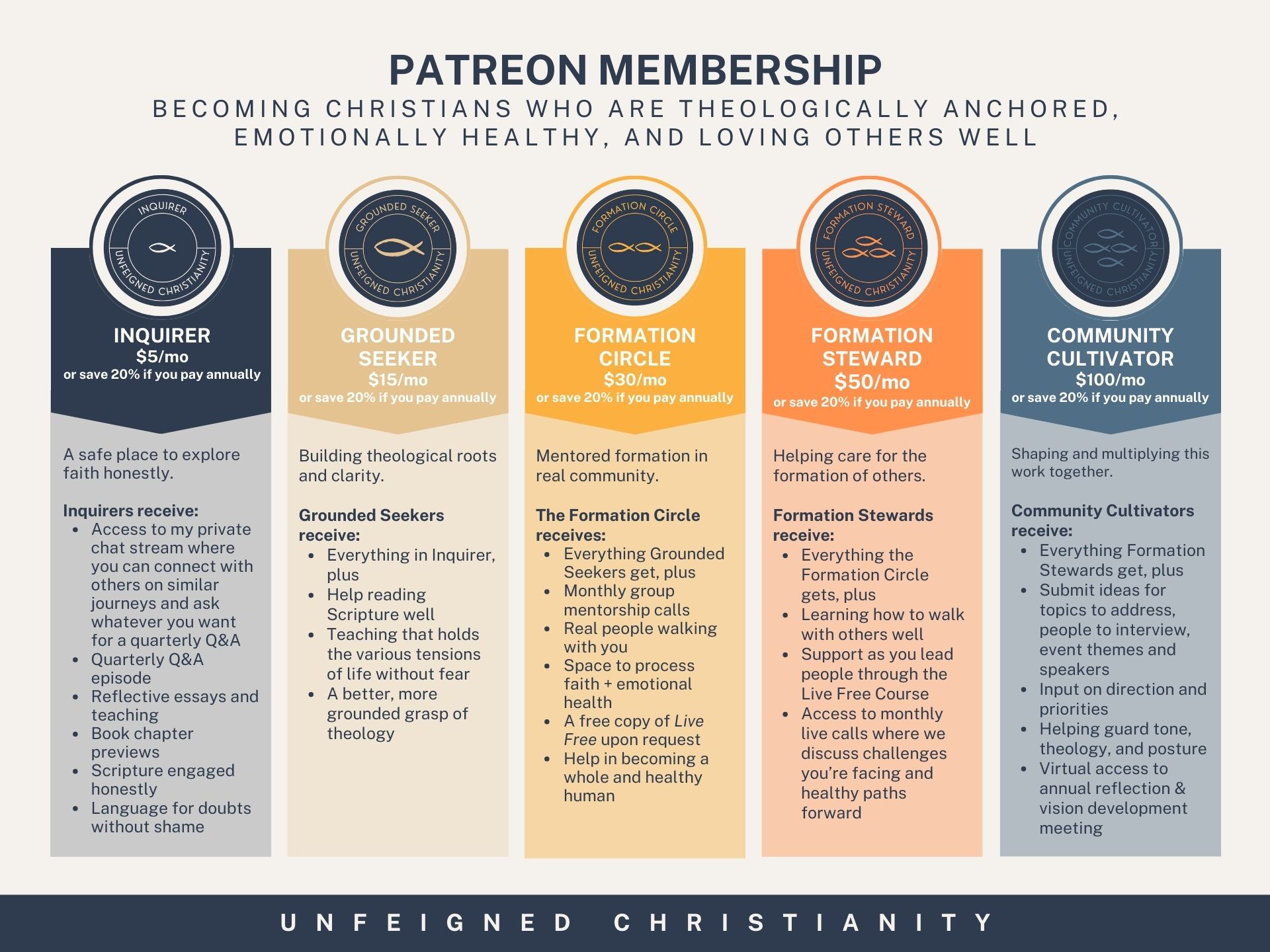
Join Unfeigned Christianity on Patreon and Take Your Journey to the Next Level.
Become a paying member of Unfeigned Christianity for as little as $5/mo and access article, our community chat stream, and quarterly Q&A episodes.
Already a member? Login