
A couple of summers ago, our peach trees went wild. We were still new to growing peaches in Colorado, still learning how to care for the trees, but that year we had more fruit than we knew what to do with. So I grabbed a box, rounded up some of the kids, and headed out the door.
Behind me, my wife hollered, "Be sure not to pick any green ones!"
It hit me instantly. What, do you think I'm an idiot? Why would I pick green peaches?
It infuriated me. I didn't actually do this, but what I felt like doing was throwing the box down, walking back to my office, and doing work I know how to do. Work where nobody would criticize me.
I know. It's silly. I knew in the moment that Teresa wasn't trying to shame me. It came during a season when I was pretty low emotionally, which didn't help. But the reminder landed on an old bruise, a message I've carried since childhood: You don't know what you're doing. You don't have what it takes. You don't have anything of value to offer.
So instead of hearing my wife wanting to partner with me in cultivating our peaches, I heard a verdict on my worth.
That's what shame does. It takes simple questions and ordinary observations and turns them into statements about who we are. And while the peaches are a small, almost funny example, shame also sits underneath the heaviest stories people carry, including the stories of those who have survived abuse. If that's you, I'm writing with you in mind, too.
Don't Have Time to Read? Here's the Gist:
Shame shows up in small, everyday moments long before it shows up in the big ones. When we live from shame, we reach for fig leaves: reputations, skills, well-behaved families, tidy church images. But the healthy response to shame isn't looking whole. It's brokenness, bringing what's hidden into the light where Jesus can meet it. Churches become safe when their people go first, sharing today's failures instead of only yesterday's victories. And for those carrying shame someone else put on them, it was never yours to carry.
The Chair in the Garage
To understand why a comment about peaches could set me off, you have to go back to a garage.
When I was a boy, I built a wooden chair for Mom. I remember it sitting in the garage while Dad and I were out there together, and I told him how excited I was to give it to her. He was looking for something on the shelves. Without looking at me or the chair, he said, "That's nice, son."
That was it.
A couple years later, when we moved out of that house, I found the chair. In my memory it was sitting in the exact same spot. I doubt it actually was, but it was still in the garage. And the message I took from that moment was simple and painful: He's not interested. You're not good enough. You don't have anything of value.
If you're a parent, you know that isn't necessarily what was in Dad's heart. He was a pastor. He owned a construction company. He had five kids. Our family also ran an adult foster care business out of our home for much of my childhood. There were all kinds of things on his shoulders, and in that moment he was just looking for something. There was nothing malicious in it.
But it sent a painful message, and I began to live out of that message. For years, I remember thinking I could never tell anybody about that story. I didn't even know why. It just hurt too much.
Then, as a young teenager, I got into pornography. I don't have language for why. It was just something I had gotten into, and now it had a hold on me I couldn't seem to break. So I was carrying two secrets I felt I could never tell: the wound from that moment with Dad, and a sin I was ashamed of.
That's the difference between the two kinds of shame most of us carry. There's the shame that comes from wounds, things done to us. And there's the shame that comes from things we did that we know were wrong. They feel different, but they push us toward the same place: hiding.
What story in your life can't you imagine telling anybody? When it surfaces, what are you afraid of? That you'd be rejected? Blamed? That people wouldn't believe you, or wouldn't take seriously how deeply it affected you?
Related Articles
The Fig Leaves We Wear
Before sin entered the world, Scripture says Adam and Eve were naked and felt no shame. After they sinned, their eyes were opened and they saw that they were naked. The text doesn't say "and they felt shame," but we can tell something had changed by what they did next. They sewed fig leaves together to cover themselves.
Only, the fig leaves didn't fix anything. When they heard God walking in the garden, they still ran and hid. When God asked, "Where are you?" Adam answered, "I was afraid."
Adam and Eve's story is our story. We still reach for fig leaves, hoping that if we look good enough, people won't see what we know to be true about ourselves.
My fig leaf was proving I had something of value to offer. Working construction with Dad, I became frustrating to work with because I always wanted to finish faster than he'd planned. My older brother, who is more methodical and careful, did not enjoy that, and it caused conflict between us. In sports, I pushed to be the best. I don't think a competitive nature is always born out of insecurity. Some of us just enjoy the struggle. But when competitiveness gets married to shame, being the best becomes a necessity, and falling short brings a flood of self-loathing.
Communities wear fig leaves, too.
I'm grateful to be part of a family and community with generations of faithful discipleship. Walking alongside first-generation believers has shown me how hard it is to learn a whole new way of life with no one modeling it for you. Many of us were handed faith in Jesus by our parents and grandparents, and that's worth remembering with gratitude.
But when we're deeply enmeshed in a Christian community, it can be hard to see the ways we present something that isn't real. Looking broadly at conservative Anabaptist churches, I notice how badly we want to look like we have life together. It's amazing to me how quiet our sharing times can be when we know people in the room are going through hell. A couple whose marriage is hanging by a thread can walk in on Sunday morning dressed and put together, looking like everything is just fine.
Maybe your community's fig leaf is well-behaved families. The kids sit still in church, and that's a good thing. But what happens when a family comes whose kids don't sit still? What happens when someone from outside, who doesn't know our unspoken norms, stands up and shares what they're actually struggling with? Usually one of two things. Either we rally around them in a "you're our project now" kind of way, or the room goes silent and they walk away thinking, That was awkward. I'm never sharing again.
We want to be welcoming, loving, gracious people. But when we're busy wearing fig leaves, we become a people where others can't fit in and can't feel safe.
The Opposite of Shame
This might surprise you, but I believe the opposite of shame is brokenness.
We might expect the opposite to be wholeness or security. But healthy, secure people still feel shame. As long as we live in this broken world, we will. The question isn't whether we'll feel it. The question is what we do with it.
There's a difference between feeling shame and living from shame. When we live from shame, we hide and mask. We manage appearances and protect our reputation, whether or not the image is true. That duplicity is exhausting. And because we aren't being truthful with ourselves at the core, we become more and more open to compromise. Shame can produce right behavior for a while, but it's behavior driven by guilt, not by transformation from the inside.
Brokenness goes the other direction. It brings the wound or the sin into the light, because only in the light can Jesus meet us in our deepest need. It owns the reality, naming the pain honestly if we've been wounded, or accepting the consequences and making restitution if we've done wrong. It lets us heal in community instead of withering in isolation. And it leads to real repentance, not just a behavior swapped out because we feel guilty.
Paul puts it this way in 2 Corinthians 7:10–11: "Godly sorrow brings repentance that leads to salvation and leaves no regret, but worldly sorrow brings death. See what this godly sorrow has produced in you: what earnestness, what eagerness to clear yourselves, what indignation, what alarm, what longing, what concern, what readiness to see justice done."
That phrase, "eagerness to clear yourselves," is worth slowing down on. We're familiar with a certain eagerness to clear ourselves. It usually looks like getting a statement out quickly and deflecting attention. That's not what Paul means. He means making things right, so no hidden sin or hidden injustice remains in the dark.
Building a Safer Culture
I don't think a community can deal with shame together if its people aren't dealing with it personally.
That starts at home. What phrases do you reach for when you're correcting your kids? How could you do that? What were you thinking?
I'm not speaking as someone who has this figured out. Far too often I reach for exactly those words. Then I see the shame on my child's face, and I feel guilty because I know better. In that moment, the question is whether I'll be broken and repent, or double down and justify it.
Shaming gets quick results. Shepherding takes longer. When I take the time to help my child understand why we humans do things without thinking that hurt others, it costs me more time and energy. But it actually reaches their heart. The same is true in marriage and leadership. Pointing out someone's failures keeps shame on them. Saying, "When you do this, here's what happens in me," opens a window into each other's hearts.
It also takes going first. When was the last time you told someone about a real struggle?
I'm 35 years old. My wife and I have six kids. I've written a book about my journey toward sexual wholeness and freedom, and I've become something of a mentor to other men. And within the last few weeks, I needed to confess something to a brother. The kind of thing that made me wonder, Why am I still struggling with this?
I had all the same thoughts anyone has. What's he going to think of me? I'll just deal with it myself. Maybe I'll ask for prayer and keep it vague. You don't always have to share every detail. It depends on who you're talking to. But I was reminded again of the value of simply saying, "Here's what I'm struggling with." No victory attached. Kind of embarrassing.
That's how authenticity grows in a relationship. And the more relationships like that we build, the more it becomes the culture of the place we call home.
So in your church, is it safer to look like you have it all together than to admit where you don't? What happens when someone shares a failure? When a preacher tells a story about a life that's falling apart, do people recoil? Who is teaching us that a clean image is better than a real one? And are we teaching it ourselves?

Get the Free 7-Day Porn Recovery Journal:
When Abuse Comes to Light
All of this matters most when abuse surfaces in a community.
When someone exposes sin among us, what's our first instinct? Do we start wondering if they're being divisive, slanderous, or unsubmissive? What would it look like to see exposure as obedience to Ephesians 5:11, which tells us to expose the fruitless deeds of darkness, rather than as a threat to our peace?
Exposure will divide. Paul says in 1 Corinthians 11:19 that there must be divisions among you so that those who are approved may be recognized. When sin comes into the light, it doesn't feel good, but it's right. The question is whether we, and especially those in power, are more concerned about the division or about being broken over the sin in our midst.
For survivors, there's a kind of shame others don't know.
There's the shame of admitting you were abused at all. Abuse has a twisted way of making the victim feel like the reason it happened. But the shame belongs to the one who did it. It's not your fault.
There's the shame that comes when you finally speak up and people doubt you. Can you imagine telling something so gut-wrenching that its very existence fills you with shame, and then having someone question whether it's true? Or call you divisive? You aren't tearing someone down. You're telling what happened and who did it. That's usually what makes it abuse: someone with power over you used that position to violate you.
And there's the shame of standing with a survivor, of becoming an advocate and suddenly being treated as the enemy.
None of that is shame God asks you to carry.
There is a shame we ought to feel when we sin, the kind that leads to godly sorrow and repentance. But shame someone else put on you by violating you is not yours. Hebrews tells us Jesus endured the cross and scorned its shame. The cross is where you can lay it down.

An Invitation to Brokenness
I think about that afternoon with the box of peaches sometimes. I didn't throw the box. But I carried that sting out into the orchard, and it came from a boy standing in a garage decades earlier.
Brokenness, in that moment, might have looked as small as finding a way to tell my wife, "That hit a sore spot. Can I tell you why?"
That's the invitation. Not just back when we first came to Christ, but today. I'm a father of six, a husband of going on fourteen years, a church leader, and someone who writes publicly about these things. I need Jesus every single day. At any moment, I could start building my own kingdom out of fig leaves and sandcastles.
But when we come broken, Jesus takes up residence and begins crafting something new, whole, and beautiful.
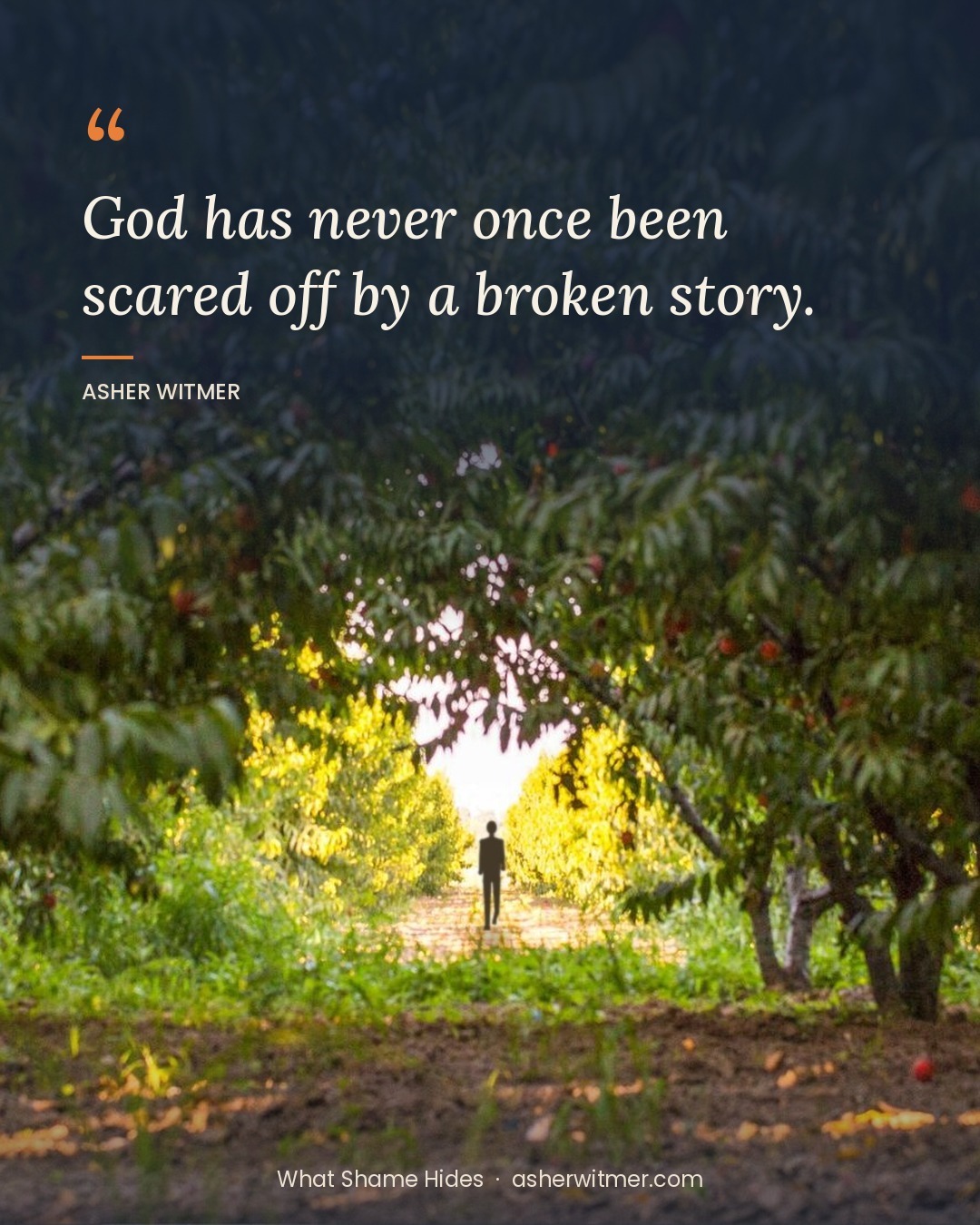
God has never once been scared off by a broken story. Scripture is basically a long record of Him walking into the ashes and making something beautiful. He's not done doing that.
What story have you never told because you're sure it would change how people see you? What fig leaf are you holding onto right now? And who is one person you could bring it into the light with this week? If you’d like, you can respond in the comments below.
Grace and peace,
Asher
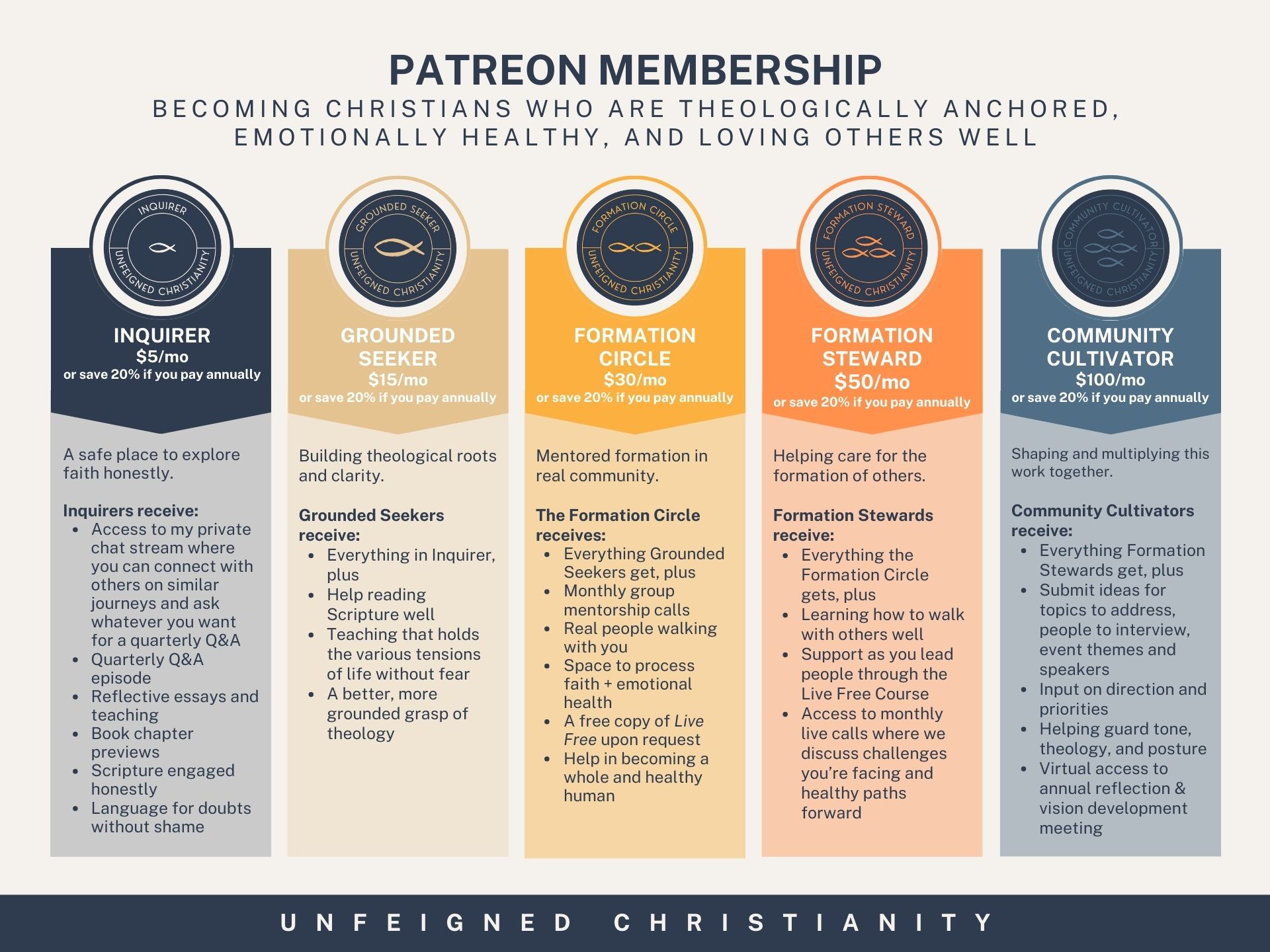
Join Unfeigned Christianity on Patreon and Take Your Journey to the Next Level.
Become a paying member of Unfeigned Christianity for as little as $5/mo and access article, our community chat stream, and quarterly Q&A episodes.
Already a member? Login