
I turned down the Anabaptist Awareness Symposium twice. The first time, in 2022, we were packing up to move to Colorado. The second time, in 2024, I was in the middle of health problems nobody could explain yet. This year I didn't have a good reason to say no, so I went. Then I came home, caught up on sleep, and watched the country vote.
Most of the commentary has called the 2026 midterms a referendum on Trump and the MAGA movement. I think that's true. But I also think they were a referendum on Christian voters, and on what we've been willing to excuse.
In this solo episode, I talk about:
- What encouraged me about a very conservative room being willing to talk openly about abuse, church health, emotional health, and same-sex attraction
- How shame gets weaponized against the people who bring abuse to light
- Why I'm still not convinced voting is the best way to steward my voice as a disciple of Jesus, and why I'm not judgmental of friends who vote
- The "blue wave," the shrinking share of white evangelical voters, and the rising share of the "nones"
- James Talarico, Donald Trump, and the double standard in how we scrutinize a politician's theology
- Why theology comes out in how you live, not just in what you say you believe
- Grace for brothers and sisters who regret who they supported, and Justin Giboney's exhortation to Christian voters
I also share about the two workshops I gave at the Anabaptist Awareness Symposium on Sexual Abuse (October 15–17, Gospel Haven Mennonite Church, Millersburg, Ohio): one on healthy masculinity, and one called "What Shame Hides."
Don't Have Time to Listen? Here's the Gist:
The midterms weren't only a referendum on Trump; they were a referendum on the church's political witness. White evangelicals shrank from 23% of the electorate in 2024 to 17% this year, while the religiously unaffiliated grew and voted more Democratic. But the deeper issue is a double standard: for a decade many Christians excused a leader's character by saying "we're not voting in a pastor," and now scrutinize the theology of a Democrat who professes Christ. Theology comes out in how you live. Jesus said we'd know people by their fruit. The invitation is to examine where we've compromised until we look more like the beast than the Lamb, to extend grace to those who regret their vote, and to hold the people we support accountable rather than signing over our voice. And I still lean toward not voting, not because voters have failed, but because I'd rather spend my voice standing with a neighbor today than waiting four years on a law.
Links referenced in the episode:
[00:00:00] Hey friends, welcome back to Unfeigned Christianity, where we are on a journey of becoming a people who are theologically anchored in Jesus, emotionally healthy so we can love and disciple others. Well, and tell you what, I'm recording this a few days after the midterms of 2026.
And not only were the midterms a referendum on the MAGA movement and on Trump, I think the midterms were a referendum on Christian voters and voting trends of those within the church. Now, you might be wondering, Asher, do you vote? Haven't you been outspoken about not voting? I'll get into that and why. I think this is worth a look and worth us understanding as Christians when it comes to how do we love and disciple others. Well, before I dive into that, though, I want to give you an update on my time at the Anabaptist Awareness Symposium.
If you remember from my last podcast, I was getting ready to go there and October has been a very full month for me. I did not I expected to do more podcasting and writing than I have. I haven't done anything. In fact, I have an interview with a friend of mine that I'm hoping to release here soon. Was planning to, but I never got it finished, edited and the intro developed and so forth just because October was so full. One of the things that took my attention in October was the Anabaptist Awareness Symposium on Sexual Abuse and that ran October 15 through 17.
I was able to go in and take it in.
I spoke, gave two workshop lectures and then I was able to take in a couple of workshops as well and really enjoyed my time. It was the first time I'd ever been there and just some reflections on it. They had asked me back in 2022, the year that we were moving to Colorado. And so for the sake of everything that was going on that year, I appreciated them asking me and said don't hesitate to ask again, and declined because I just didn't want to have that commitment. We were moving in July, we'd still be settling in. Come whenever. I do guard this stage of family life. One of the reasons I like to blog and podcast is because it's a way that I can offer teaching and offer resources without necessarily leaving home. And so I appreciate being able to do this in this stage of life.
I do enjoy speaking. I enjoy going to events. I've enjoyed the ones that I've gotten been privileged to participate in and but I just in 22 I just didn't feel like it was it was wise to to do it.
So I Declined. They asked again in 24. In 24 I was going through health issues and when they asked, we still didn't really know what was wrong with me. And so that was kind of a decline. And then they asked again this year and there wasn't really an excuse to give. And I also, it, it is something I care about. And so it's, it's not like I just don't want to be involved in this sort of event, but I. The other two times it just didn't work out super well. And so I consented this time. Ended up doing two workshops. I gave a workshop on healthy masculinity.
That was a smaller workshop, only Men, but that was, that was fun. That was.
It's similar.
I struggled with those workshops because both of the topics that I was discussing, it's like this is kind of a 10,000 foot view on this subject. We could, we could spend a whole conference diving into or a whole weekend diving into each of these, but really enjoyed it. Made some good connections afterward.
And then the second workshop I gave was on Saturday on shame and what shame hides. And basically trying to break the barrier. At least this was what was communicated to me when they asked me to speak on shame. Break the barrier of shame. Shame has been weaponized in many ways. And the subtitles. Finding Healing from the Our. The brokenness, the broken parts of our stories. I don't even remember exactly what I titled the subtitle, but the notion that it's okay to share the broken pieces of our stories and it's okay to share each other's shame and then also gave a little space of addressing how shame gets weaponized. And you know, even when it comes to. We were at the conference on sexual abuse.
And so shame gets weaponized there too. Because when you expose sexual abuse, people accuse you of shaming individuals.
And yet the reality is there's a. There's an even bigger shame that has happened. And yes, it is shaming to expose someone as an abuser, but that shame, like bringing it to light, is part of the path to healing. And even though we were grieved over the shame that this has brought, whether it's a community or God's name, it's part of the path to healing. And not to mention the shame that is brought on people who have suffered abuse, those who stand with victims, the workshop, what I shared in that is essentially what I wrote in my article the end of September, what Shame Hides. That's basically the same material. So if you want to check it out, you can Read that further. But some interesting reflections on this that I had is.
First of all, it was really interesting to me how the audience of the symposium was quite conservative, way more conservative than I am conservative Anabaptist. I consider myself conservative Anabaptist, but It felt like 50% of the audience was Amish or horse and buggy Mennonite of some kind. Like, I don't. I'm not super privy to all the nuances of the different Anabaptist communities, especially in Ohio, which is where this one was held.
But it was very more conservative than the world I have typically circled in.
Even so, two things stood out. First of all, the speakers were quite varied, even to the point of having non Anabaptist speakers participate, especially the plenary talks and some of the other more niche workshops that happened. They went and found experts, people with good credentials as well as credibility around the thing that they were addressing. And so I appreciated that.
The other thing is, we had conversation like there was just an openness to look honestly at things that I don't always sense, even in, even in less conservative communities.
And I found that really interesting.
Some of the conversations that were had, whether it's the thing the workshop speaker was addressing or just the Q and A portion afterward and where that conversation led, like nothing was off topic and we were able to discuss and there was good wise input given regarding abuse and even just health, church health, emotional health. There's a workshop on what to do when you realize you're same sex attracted and then how to walk with people who are same sex attracted. I just found it really encouraging to see that there's an event like this happening because these tend to be things that a lot of folks don't want to address. And sometimes it can come up in like, well, there's certain venues that they should be addressed in certain. And maybe, maybe a venue like this is appropriate. But what's really interesting to me is I don't see the kind of people that are saying it's for certain venues. I don't see them attending that conference, that symposium. And so it feels like a way of just not addressing it in our church.
And I'm just speaking generally. I've bumped into this in a variety of different settings.
One way to just not address it is to say, well, there's a certain venue for it. Well, then the question is, are you going to those venues? Because these are issues within our churches that we need to be willing to address in order to make our churches healthier. And so I found that intriguing and fascinating because I guess when I think of the boxes of like conservative versus liberal, I think more liberal side of things are more open to addressing the untouchable subjects.
And this symposium, and maybe this just exposes my naivety, but this symposium made me realize like, oh wow, these people are.
They're willing to go where we need to go. And that was encouraging. I was blessed to be a part of it.
And there's a few things that may be coming as a result of my time and experience there, and I can get into those details down the road. Are you a small business owner or startup who longs to have better stability in your lead flow and revenue from month to month, but can't afford to hire a marketing agency and aren't really sure what you should be doing to market your work most effectively? Then I invite you to check out the marketing machine coaching. I've linked it below. This is a coaching program that was born out of a desire to serve the group of people that need marketing because they need to stabilize revenue, maybe even scale a little bit, but they can't quite afford a $2,000 or $3,000 marketing retainer that a marketing agency would charge. And yet they also don't quite know what they should be focusing on at each turn when it comes to their marketing. There's so much out there about what you should be doing or need to be doing or should have started last week in order to be on top of it. And there's a lot of FOMO around marketing when it comes to small businesses. And I have a passion for helping provide clarity and just bring a sense of calm and direction, especially to the small to mid size businesses or startups that are just getting off the ground. Maybe you're even a creative and need help to know how to turn this into sustainable revenue. I've offered a course. It's not quite the coaching a little more affordable. A course is also available. You can check those out in the description below. Right now I'm just sitting here, it's Friday after the midterms and just reflecting on what it means and what it looks like to walk as a disciple. To walk to live faithfully with Jesus in America.
And I don't believe that the fact that we are citizens of another kingdom means that we should just be utterly disengaged from the culture we live in and are working in and as a part of that, the politics and the environment that we're dealing with.
I am not convinced that voting is necessarily the best way to steward my voice as a disciple of Jesus, but I'm also not against it. I have very good friends, people I admire, who vote, who disagree with me on that, and I'm sharpened and challenged by them. I think the biggest piece that has made me wonder should I be voting? Was living in a neighborhood where I realized there were certain laws on the ballots. They didn't really affect me, regardless of how they went, but they did affect my neighbors.
And should I be going to the ballot box? I don't even know. To the booth.
This is how unfamiliar I am with the whole process. I know there's ballots. What do you call it? To the voting booth? The voting box.
There's a term that is slipping my mind anyways, I'll let it just slide on by.
And that was. I don't know when that was 2018, that was maybe in 2018, 2019, somewhere in there where all of a sudden I realized, whoa, should Christians be voting? It was also around that time I read Thou Shalt Not Be a Jerk by Eugene Cho, which was a really good, really good read. Challenging read. I've appreciated Eugene Cho's work with Bread for the World. I think is the organization he's with.
Actually, I'm not sure if he's with them anymore. He used to be president, but he. He may have somebody else may be president now, but that. That all in just. Is this a way to love our neighbor by voting? That all really challenged me and continues to challenge me.
I have like, in that specific setting, I realized, like, I actually love my neighbor better. Like if voting makes me feel like I'm doing something, I could end up going. It could be, first of all, four years until the law that we voted for actually gets passed or actually gets implemented, whatever.
And my neighbor next to me may like, there are things I can do right now, regardless of whether or not I'm voting, that I can stand with and help and support my neighbor. And so that's been the challenge to me is like seeing Christians kind of give up their voice through voting as opposed to living it out through action and hands and feet. And can you do both? Perhaps. I see a lot of people where it seems like the system kind of turns them into products of the system. And so when you participate in Empire, you begin to think and take on the actions of Empire. And I don't know that that's always the case. There's actually at the very end of this, I'm going to share a video from Justin Giboney with the and campaign that I find challenging for myself, but then for all of us, even brothers and sisters who vote, and just a call to. Because he's. If you're familiar with the Ann campaign, he's very much engaged in politics, but also from a third way approach. We don't have to live in the binary of red and blue, but. But actually, what does it look like to faithfully represent the kingdom of God in these areas? And so there's, there's a lot of these kinds of influences that I absorb and am shaped by. And I also, just so I'm sharing all of that, that I'm unconvinced. Voting is the best way to steward my voice, but maybe it is a way I'm open to that. I'm not going to stand here and be like, oh, you should. If you're voting, then you are some failure of a Christian.
I don't believe that at all.
There are times where I wonder, am I failing as a Christian if I'm not voting?
And a lot of it kind of comes back to, it's like, man, if I would have voted in 2016, 2012, 2008, I think would have been when I was first eligible for voting, actually, I would not have been eligible for voting in 2008. So 2010 would have been the midterms I would have been eligible for voting.
And the way that I thought about things and perceived things, even I look at 2016, where it's like I was appalled to realize how many people in my community around me were supportive of Trump, but I was also personally genuinely afraid of Hillary. And so how I would have voted in 2016 or in some of those areas where I look at now, I would have regretted. I would regret.
And yeah, I don't look with regret on not having voted. I don't live within the regret of the choices that I've made around how I'm going to try to love my neighbors and attempt to disciple people.
There's more I wish I could have done, want to do, but the things that I want to be more involved in and do more of, voting's not really there. In fact, in many ways, I see voting as somewhat of a distraction because in order to cast an educated vote, I would have had to spend a lot of time absorbing and learning things that would have pulled attention away from other areas of life.
I very strongly lean not to vote, but I'm not judgmental of those who do vote.
And maybe it is a way of loving neighbor, but with that, here's the thing. So obviously on Tuesday, we see this Blue wave.
And it's been historic. Even here in Colorado specifically, there's several districts that have never been blue, or it's been decades, close to a century since it was blue. And now it's blue.
It's interesting observing this and obviously a lot of the national media is pointing out how it's a referendum on mega, on Trump.
The people have spoken. And I agree, people are tired of Trump. And it's fascinating to me how even folks who I would have heard speak favorably of Trump a few years ago, all of a sudden I don't hear them speaking about Trump a whole lot. And sometimes I'm surprised how they're speaking negatively about Trump. And so I think just the overall tenor of the American people and Christians and so forth has changed. Like, people are frustrated whether we're talking about the Iran war, the Epstein files, all of these. It's somewhat amusing to me sometimes, like what it is for different people. That was the straw that broke the camel's back, because I think the evidence was there early on.
And it's just interesting how there's different things and sometimes it literally feels like a straw that finally broke the camel back. There's so many bigger things that were there and present. And then there's this little thing that just for whatever reason, for people, that is the thing where now it's like they're done with Trump, whatever. And so, yeah, I think there's a referendum on Trump and people reacting to that.
But I also find it really interesting how this is in many ways a referendum on the church, on how Christians have voted. It's insightful as to what is changing in the landscape of Christians voting.
So here's an example of what I mean by that. James Talarico is. Maybe we'll use him as a classic example. He's not the only one. But the senator down in Texas, he is, was a pastor, as I understand, and he's a professing Christian. And typically we have thought of those or seen those as being Republicans and people who are Democratic senators and so forth don't have a very vocal connection to their faith. Even. Even folks like Kamala Harris and Joe Biden. Biden was Catholic. Harris has some Baptist background in her history, but they never pulled on that in their campaigns. And I think a lot of people just thought they weren't religious or didn't do anything. But Joe Biden is pretty faithful Catholic. And so now you have someone who's vocal about his faith and who's vote, who is putting forth and campaigning on certain things because it's shaped by his faith. And I'm going to get, I'm going to talk about James Talarico in a bit and just some of the criticism that evangelicals have of him. But that's an example of how we're seeing something shift in the political sphere of how Christians are voting. But here's, here's an example. When it comes to white evangelical voters, they have historically been Republican and that is, that is still true. Even as of Tuesday, white evangelicals or born again Christians favored Republican House candidates 82% to 16%, a 66 point gap.
But what's a bigger story is that white evangelicals used to, in 2024 they made up 23% of the voting populace. This year they only made up 17%. And so there, what this data is showing is there was a larger voting turnout and religiously unaffiliated voters, known as nuns, meaning they're religious, but they're not affiliate, they don't affiliate with evangelicalism anymore.
They don't fit, whatever. And I've, like I said, I've never voted, so I don't know exactly what all the options you have that you can put down, but they've, they accounted for 27% of the electorate on Tuesday compared with 24 in 2024. Their Democratic support climbed from 70% to, to 7 nones religiously unaffiliated.
What I mean by nones is N o n e s n. They don't identify as white evangelical, for instance. They are largely Democrats. And they climbed not only in how many of them turned out, but also how many of them voted Democrat. This is a very 10,000 foot view.
We don't know exactly the nuances of what different people believe. But one of the things that got explored between 2020 and 2024 was how unchristian evangelicals are, meaning that those who go to the box, the voting box, sign that they're an evangelical, a large percentage of them, if not a majority. I don't have that data right in front of me, so I'm not just going to say a large percentage of them.
Also in other research that was done demonstrated that they didn't even attend church on a weekly basis. It was maybe once a month or a couple times a year. And they did not regularly read their Bibles. So we can't go by oh we see evangelical vote. Evangelical has become this cultural title, not an identification of someone who's born again, filled with as the spirit of God and wanting to witness to the gospel, which is what evangelical originally had to do with is part of this outreach.
There's a reason it sounds like the word evangelism.
It's more than just a nominal Christian. It has a bent towards being an evangelistic Christian, someone who wants to tell people of the gospel. Well, that ship has long sailed. People who identify as evangelical are not that. And we could critique the evangelical movement from its very beginning and find things that we might wonder, how Christlike is that or whatever. That's not the point of what I want to get into here, but rather identify that not only has the evangelical grouping become less and less Christian, actually Christian, but there are others who identify as more and more Christian unaffiliated with evangelical, who are voting Democrat.
And so that's, that's an interesting observation, and I think that's insightful for us as a people.
The reason I think it's insightful is because there historically.
Well, what I mean by historically is in modern history, you know, if you think back to 2024, 2020 elections, there's a lot of conversation within Christian voters around how can you be a Christian and vote Democrat?
And we're seeing more and more Christians doing just that.
That's one of the things that we see in these midterms. Now, obviously, what's going to change if the next two years are really bad? Maybe they'll swing Republican again. But one of the things that I think has become increasingly evident, and this is a friend of mine pointed this out, that what Tuesday showed was that character matters.
And I think that's one of the things that disillusioned me the most about the 2016 elections. But then especially the 24 elections, obviously in 2020, Biden won, but I thought it was evident who Trump was going into 2016. And I didn't even know Trump that much, but I knew him enough to know he's this showman, he's immoral. He does not represent what we as Christians would want in a leader.
But then there were all these justifications for why he could make a good president. And a common one is, well, we are not voting in a pastor. We're voting in a president.
And so somehow there's justification for voting in Trump. Now, that was a puzzle to me because I can remember, I'm old enough to remember how when it came to Clinton, one of the reasons Christians, evangelical Christians, did not vote for him was because he was immoral.
Everything with Monica Lewinsky and so forth. Well, now here's a guy that has had multiple affairs, multiple marriages.
And we're finding ways to justify it.
And I think the reality is that what it boils down to, and I heard this in 2016, I heard it in the years since then from friends and observed it in conversations online and even participated in a survey in 2020 of conservative Anabaptists. It was a very kind of small scale survey. Just curious, what is motivating people to vote for or to support Trump even if they didn't vote him, why they supported him.
And there's this notion that came through quite frequently and that is that Trump is, well, so the rhetoric of draining the swamp, like he's not going to be your typical politician who says one thing and doesn't do another. He's not this toxic, he, but more he is this kind of bulldog. He's, he's doesn't care what people think. He's just going to come in and do, do what needs to be done. And more specific.
And I think we've seen this from some popular, even evangelical pastors at times. But the notion that Trump is an SOB who's gonna get things done right, he is the weapon perhaps for all the pent up frustration in people's feelings about politics and against their opponents and whatever.
And so here he is Republican, which is historically what Christians have supported in America. And yet he's also this, you know, kind of doesn't care what people think, he's going to come in and get it done sort of thing.
And we, what I think happened is we perhaps in a, in a lack of vision for what it looks like to live out the gospel of Jesus in everyday community life and societal life that participates in commerce, that participates in business, that helps to better the world around us, but embody the gospel and the teachings of Jesus, like because of a lack of vision, there's been a gravitation towards politics. And when we looked at the politics, we were frustrated by what we saw. And even Hillary herself in 2016 was not looking very good. Some of the things that she had come through, some of the email scandals and everything that.
And so here's Trump, who's going to be something different.
And he did really well at marketing a message to conservative people. And I still don't fully understand because there were more in 2016, there were more true evangelicals on the ballot in the primaries for Republicans than any other president before them.
And yet evangelical Christians still chose Trump to be the Republican representative. And the largest voting block for Trump was white evangelicals.
And so I still don't understand that why you had to me that indicates that people wanted someone to do their fighting, even if theologically they believed they shouldn't fight or engage. There was still, and obviously in the evangelical world, there were a lot of people who are okay with fighting. But what shocked me was the way Anabaptists supported Trump.
And he was kind of the antithesis of all things Anabaptist. If you're going to find somebody to support. Historically, Anabaptists have, have been a people who care about the vulnerable and the poor. And that's not Trump. It's not even really Republican. But all that to say you come fast forward to today and it is clear who Trump is and what the MAGA movement is willing to defy the rule of law.
Everything that's happened with ICE in the last year, this is not about just simply having a proper handling of documentation and removing true felons from among us and all of that. Like, no, this has gotten personal, it's gotten racist.
I think it was from the very beginning it was that, but it has evidenced itself to be that.
And everyone's looking at this and they're tired of it.
This is not the way of Jesus. And then you have someone like James Talarico, again, he's kind of the low fruit, the easy example to pull on who maybe theologically folks disagree on things with him, but he's embodying, he looks more like Jesus than Trump or some of these other politicians.
And I believe what this reveals, this blue wave and how there's an increase of Christian voters and then an increase of them voting Democrat. What this reveals is that ultimately everyday folks still care about character, and ultimately everyday folks, everyday Christians still care about following Jesus. And probably a bunch of my audience still leans supportive of the MAGA movement of Trump.
And maybe if you're still listening to me, maybe you're confused. And like, what is Asher saying?
Even when you hear me reference James Talarico as being Christian, you probably in your mind might have a whole bunch of reasons for why he's not actually a true Christian. And that's a common critique of him, is his theology and his whatever.
And that's exactly my point. Christians have spent a decade now of defending their support of Trump because they're not voting in a pastor. Well, then why does all of a sudden, when it comes to supporting someone like James Talarico, why does theology matter what his views of marriage and gender and all, why does that suddenly matter?
I mean, for a decade you weren't voting in a pastor, so now when it comes to the Texas Senate, it matters. People highlighting what Talarico's pastor said about Jesus and so forth is like this big fear mongering reason why you shouldn't let him in.
And I think what we have to come to grips with as Christians in America is that we have played this political game where we have compromised.
There is a large swath of the American church. There is a large swath of the conservative Anabaptist church that has supported an Antichrist, someone who embraced bodies, everything opposite of Jesus.
And why do we suddenly care about the theology of James Talarico when we didn't actually care about the theology of Donald Trump?
And dig down even more. Well, some, some of this conversation, I've heard some people talk about how people care about decency. And James Talarico is, is a decent person, a decent human, brash and disrespectful, dishonoring like Donald Trump is.
And I think that's true. But I think we need to dig a little bit further. And that is theology comes out in how you live. And so what gets really confusing is it's possible to say something and actually live another thing.
And that's part of what really burdens me, why I say unfeigned Christianity is about becoming a people who are theologically anchored.
My mind slipped for a second there. How do I say it?
I was going to say theologically grounded, theologically anchored in Jesus.
And that is because when I look at the circle of the church that I most frequent, I see a lack of theological anchoring.
And that is we have a bunch of mental ascents, like we adhere to a bunch of things mentally, we. But what we actually live out and embody is something different.
And what we've been okay supporting is something different. And Donald Trump has done well at marketing something verbally and mentally, even to the degree where there's people around him who, or politicians, I mean, who have chosen to support him, who might intellectually agree with some of us theologically.
And this is where things get really muddied. And it burdens me because I'm sure there's a lot of you listening who don't even like the word theological.
Because the people online who care about theology kind of act like jerks. They're all heady, they're all, they love debating, they're all whatever.
And what really burdens me about that is when someone's life embodies something that is not compassionate, that is not kind, that is not the way of Jesus, that's their theology, that is their theology.
Because what theology is, is it's the knowing of God. Study of God is what the word literally means. But we are coming to know God in this very personal way that it changes our life. In academia, there's historical theology, there's practical theology, and I have been blessed to have profs who help us gain proper perspective. So historical theology is just studying theological trends throughout history. Right.
But ultimately, all theology is going to get practical like it is. What we live out is what we believe and what we understand to be true of God. And so when somebody like Donald Trump gives a Christmas greeting and declares Jesus Christ as Lord, but then he goes out and lives his life as though he doesn't have to give account to Jesus for how he rules and reigns, for the way he talks about people, then he doesn't actually believe Jesus Christ is Lord. And we can definitively know that and observe that. That's why Jesus said, you will know them by their fruit. And we've lost that.
We've somehow participated in the compartmentalizing of an intellectual ascent, believing certain things as though that's all that matters, when the reality is our lives might testify that we actually believe something else. And I think part of what Tuesday revealed to us is that there are lots of Christians who still believe in Jesus and who still believe that Jesus is king and that it matters how we live and function.
And so they vote.
They went to the polls, the ballot boxes, and cast their vote in a declaration of what we're seeing is not what Jesus would have governing authorities do and how they would function. And I disagree fairly significantly with James Talarico on some things. Theologically, I think it's hypocritical to all of a sudden be concerned about James Talarico's theology, because we should have been with Donald Trump. We should have been with all of his minions in the MAGA movement. And not only that, but Donald Trump's primary spiritual advisor is an outright heretic.
She has clearly evidenced herself to not be walking under the lordship of Jesus Christ. And so that ought to inform us of the actual spiritual state of Donald Trump.
And so while some might be sitting in fear, how does James Talarico get to Senate? What if him or somebody like him becomes president?
You ought to have had that same fear already about Donald Trump. And one of the things that Talarico has that Trump does not is a lifestyle that is at least a little bit closer to that of Jesus of Nazareth.
And to me, it's an exhortation to us as Christians that we be rooted and grounded in Christ.
I Think that when you participate in Empire.
And what does that even mean, participate in Empire? I have a driver's license, so obviously I participating in Empire, to a certain degree, we're all participating in Empire. There's all kinds of ways that we have to live in and among Empire until Jesus returns. But when I go about trying to change things the way Empire wants to change things, there's a minefield of opportunities for compromise. And I guess I just think this is a good reckoning moment of where have we all compromised?
And are we living and walking faithfully? And are we embodying in the way that we talk about the issues of the world and the way that we talk about people from other nations, people of other ethnicities, in the way that we talk about family and values and what matters, in the way that we talk about the word of God and the way that we talk about each other, the way that we disagree, where have we compromised to where we actually look more like the beast instead of the lamb. I think this is a. If you haven't read Revelation recently, this is a great moment in time in history to read Revelation again. So that's why there's some reflections that I have from the midterms and I think it's valuable to share and to talk about. There's a lot of people who would like to say, well, if you're not voting, you shouldn't even talk about politics. No, actually it's like my non voting stance is specifically political stance. And so my faith absolutely shapes the way that I engage in business, in recreation, in politics, in every regard, every point of life.
And I think there's a lot of people who recognize that. I think that's part of what we see. So I wanted to just share some reflections. I'd be curious, I'd be curious to hear some of what you're processing as you think about it.
One of the things, one of my desires and prayers is that people can come to those who supported someone who they now realize is a tyrant or a deceiver, someone they now regret.
And obviously I think of Trump, but I'm talking about people even beyond that. Like that folks can come to acknowledge that was wrong, maybe even need to repent from it or just acknowledge, like, that's a mistake, that's a regret I have.
And I hope that within the church we have the capacity to extend grace to each other because it seems like we've gotten into a political environment where there's so much of, how could you do this?
And I actually myself personally have quit posting publicly about some of these things because I think that tenor was coming through. It's. It's really hard to communicate when you don't, when you can't sit down and have a conversation with, with folks.
I think that tenor of, like, judgment on. And maybe there's a level in which I, I needed to learn how to communicate better.
I think there's also just a very real sense in which we're swimming in that environment and we're all a little hostile and volatile and we kind of jump to conclusions as opposed to asking clarifying questions and so forth.
And so a mixture of everything.
And I just, maybe it took too long, but I came to realize that, you know, this isn't coming through in the intent that I have.
And what I would love for brothers and sisters who supported anybody that they now regret is to know that it's okay.
I hope that if in five or ten years I come to realize, like, man, I need to be voting, that people would, wouldn't be like, hey, welcome, that's fine, like, not sitting judgmentally like, you should have been doing this 10 years ago. And so I don't want to look at folks like, even though I thought there was things that were obvious in 2016, if someone's now in 2024, 2026, coming to realize, like, man, Trump is not good, welcome.
There's space here to acknowledge that, to acknowledge where and maybe even as a whole, like, I have friends on both sides of the aisle where I wonder, you know, they have come out of a family maybe that was more right leaning in their growing up years, and now they're hard left or Democrat. And I look at that sometimes and wonder how, like, are their children going to be frustrated by their dogmatic stance.
Their children will probably see the weaknesses and failures of whatever political position they take. And I hesitate to say that because it makes it sound like I've got the perfect perspective on things I don't like. It's actually kind of an easy thing, and that's actually part of why I abstain from voting, is it's easier to engage people when you're kind of in the middle.
And it's like, well, I don't vote. And so I can have conversations with people on the right here and ask questions and, like, try to understand where they're coming from and maybe posit some ideas and get them to think, well, I can kind of do the same with people on the left. And it doesn't mean that I have a proper and perfect perspective on Everything. And maybe I'm totally wrong for not voting. That's not what I'm trying to communicate.
Rather, I'm just trying to acknowledge that are we, or ask, are we aware of the ways we may be making mistakes as well? And do we have the grace for each other and the humility for those of us, you know, to look introspectively? Do we have the humility to acknowledge we made mistakes?
I saw a reel on Instagram from Justin Giboney that I found really challenging. I think it's great, especially for those. And a large part of my audience does vote and does engage. And so that's why I want to share it. I re shared it on Instagram, but I found it even challenging for myself in just how we like, these are gestures to go out and vote.
I have signed petitions.
I have participated in that way, shown my support, whether it's a raise of hand or a signature on something writing my senator and so forth, like that. Those are gestures.
But at the end of the day, like, we have to, we can't just back off and just assume that, like, oh, this gesture did good and now we're good to go. And this is specifically an exhortation when it comes to voting.
And now that things went may have gone your way, and he's obviously speaking to a crowd that has voted blue and so do you just sit back and just like, okay, everything's cool. We got our people in. Listen to this. This is Justin Giboney, an exhortation to Christian voters.
[00:51:00] Justin Giboney (video clip): What we saw last night is one of the biggest rebukes of an American president in modern history. The people said they wanted change and they changed the entire political landscape for years to come. They spoke out about how they felt about the Iran war, food and gas prices, corruption, about the terrible immigration enforcement that we've seen, and also gerrymandering. And so I want us to realize that that was democracy working. We have a lot of commentary, even myself, about the problems with our system. But I think we need to recognize that the system worked last night, that we need to give credit where credit is due. The system isn't completely broken. It did work last night. So that's the first thing I want to say next. I know there's a lot of Christians who are really excited about what happened last night. There are a lot of historic firsts, and some of you work very hard to get people out to vote, to organize and all those things. And you deserve your moment to celebrate that, to be happy about the folks that you put in office.
And so I don't want to take that from anybody. I think that's time that you can take to be excited about what just happened. But I will say this.
You have up until these people get sworn in to celebrate, which means you have about two months to celebrate once they get sworn in. You need to realize that these are elected officials.
They were not put in office primarily for you to be proud of them. They're not in office just to represent your party or to symbolically represent your identity group. They're not put in office Christians just to come to your church and receive praise and worship from you.
They were put in office to do a job. They were put in office to legislate and govern. And you have to make sure that they do that. Okay? You have to make sure that they are actually serving the people, that they are trying to make people's lives better. Because what happens a lot of times when we have these historic firsts and all that we spend our time defending and justifying the people we voted for instead of making sure that they do their jobs? Let me tell you this. A historic first means nothing if they don't go into office and act with character and also act with competency.
One of the main criticisms of people of Christians who supported MAGA was that they don't hold the president accountable, which was true. But now it's your turn.
Are you going to hold the people you voted for accountable, or are you just going to justify and defend everything they do?
They need to make people's lives better. If they ran on lowering prices, they need to lower prices. You cannot coddle them and protect them from all criticism. They are elected officials.
That is not how politics work. So let's make sure that we're holding people accountable. Again, I want you to run this back in about two months, because when that two months is over and they get sworn in, they have to do their job. If you like this kind of information, you got to listen to the Church Politics podcast with Justin Giboney.
[00:54:04] I agree.
I agree. I think we so quickly get into defending the way that we voted or defending the people we support, even if we don't vote. And we have to be real about whether or not they're doing their job, and we have to hold them accountable to do their job. Otherwise, our involvement isn't actually being a witness and it's not actually being our voice. We essentially signed over our voice, and now they get to do with it as they wish.
So, anyways, I will leave it at that. This has gotten long enough. And until next time, grace and peace.
What About You?
Where have you seen theology come out in how someone lives, for better or worse? If you voted this week, how will you hold the people you voted for accountable? And if you're processing regret about who you've supported in the past, what would it take for your church to be a safe place to say so? You can share in the 0 Comments below.
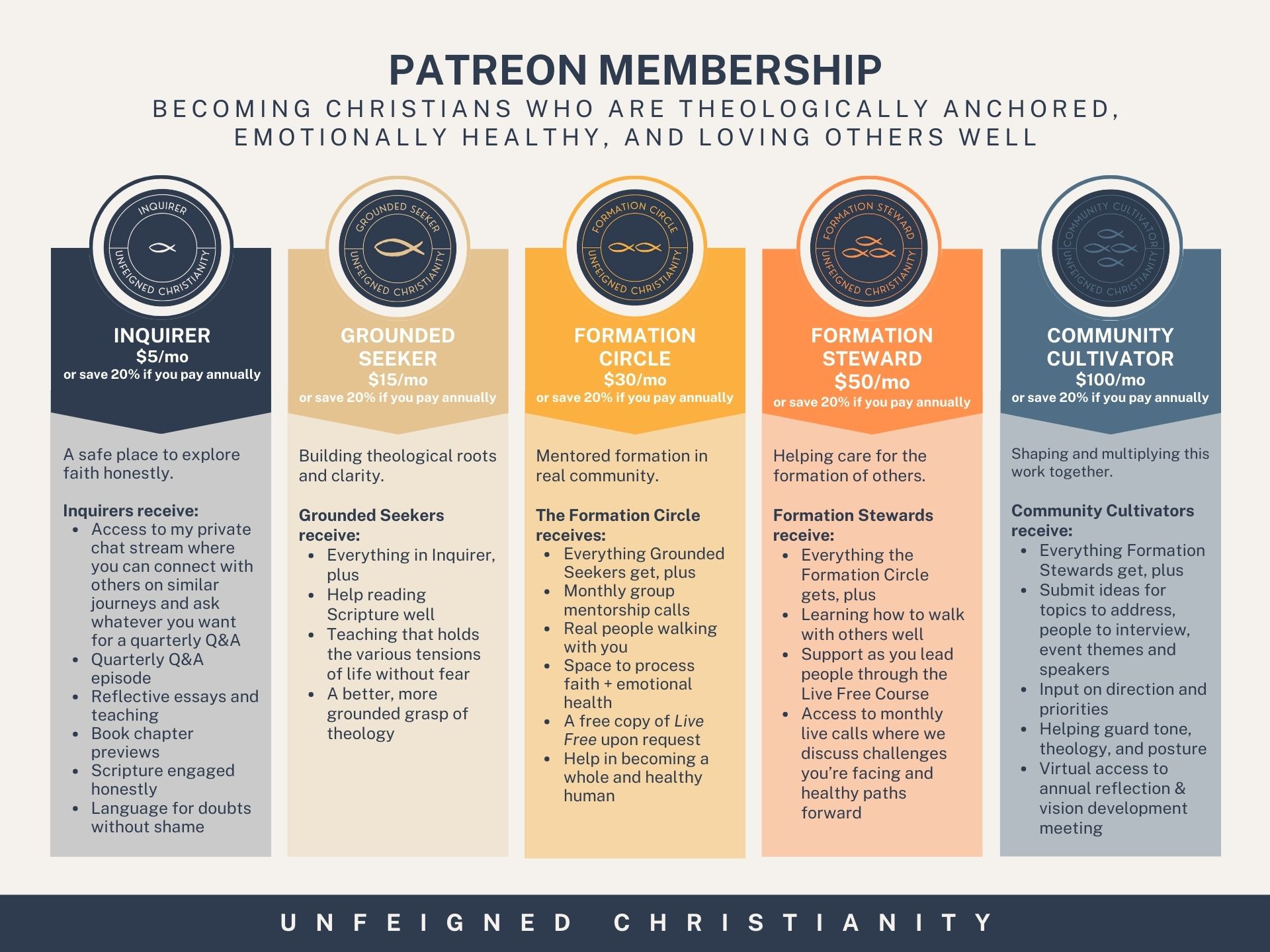
Join Unfeigned Christianity on Patreon and Take Your Journey to the Next Level.
Become a paying member of Unfeigned Christianity for as little as $5/mo and access article, our community chat stream, and quarterly Q&A episodes.
Already a member? Login