
Are you able to spot bad theology when you see it? When you’re listening to a sermon, having conversations with friends, or simply thinking your own thoughts are you theologically anchored enough to be able to tell when somethings off?
We live in a time when there is so much information at our fingertips. Even more, so many opinions can be accessed and viewed with one scroll of our screens.
Unfortunately, accessible information does not mean the quality of the information or opinions is improving. In fact, I’d suggest it’s decreasing.
One way we see this happening is by evaluating the ideology and beliefs we hold as Christians. Does it have grounding in scripture or is it simply another way we pontificate our own human preferences and frame them as being a “Christian worldview”?
In this article, I’d like to explore seven specific teachings I’ve encountered that have infiltrated many churches today. When measured against the Word of God we realize these teachings don’t actually have much grounding, if any.
I call them dangerous instead of false because I think “false teaching” gets used far too flippantly today. Some Christians like to put down other Christians by claiming what they preach is “false teaching.” This happens even for teaching that has not been officially condemned as false by any council in church history.
They’re not trying to be theologically faithful; they’re trying to discredit other in one fowl swoop.
I don’t want to claim something is false just because I don’t agree with it. When I use the phrase “false teaching,” I’d like to keep it to things that you could study in history as being condemned by church councils as “false teaching.”
At the same time, with each new era comes new iterations of theology that is not good or well grounded. I believe it’s important that we sort through our beliefs and make sure they are being developed with good theology.
What we believe about God and the world around us shapes how we think. How we think shapes the way we live our lives. And the way we live has profound impact on the people around us and our witness for Jesus.
You may have never put much thought into what you believe before and you may not feel overly energized to put much thought into it now. In fact, you may think this is a futile intellectual exercise. However, I suggest that if you care about the practical outworking of disciples of Christ, this is a crucial exercise. Whether you’re aware of it or not you are living from what you believe. The question is, are your beliefs theologically anchored in Jesus?
Two Critical Clarifications
Before diving into the seven different teachings, I want to clarify the purpose of this exercise. First of all, these are not the only dangerous teachings entering the church. We could discuss many. But I’ve selected seven that (a) I have personally encountered, (b) I’ve seen increasingly prevalent within the churches of the people I seek to serve through Unfeigned Christianity, and (c) I feel I can properly address in one article.
Secondly, I do not do this so you can become a watchdog within your local community. Do not take this and hold your pastor under its microscope. Don’t start emailing your friends who trumpet these teachings confronting them of how dangerous they are. Rather, I share these seven teachings to help anchor you theologically and help you be able to better navigate conversations with others as you bump into them. I’m not just trying to give you information on what to believe, but attempting to give you tools for studying scripture yourself and engaging in meaningful dialogue.
With that in mind, let’s dive in to the seven dangerous teachings that are infiltrating your church today:
Table of Contents:
- The United States Is a Christian Nation
- The Head Covering Is a Sign of Submission
- The Curse of Ham Myth
- The Jezebel Spirit
- That There’s Such a Thing as “Same-Sex Marriage”
- That Habitual Sexual Sins Are Dealt with Primarily Through Prayer
- Zionism
The United States Is a “Christian Nation”
I can’t remember when I first heard this teaching. It feels as though it has been embedded in my surroundings since early childhood.
In school, I studied A Beka Christian Academy curriculum. One of the clearest memories I have of someone teaching the idea that the United States is a “Christian nation” comes from one of my favorite teachers: Mr. McBride.
In my youth, I thought nothing of the notion that the United States is a “Christian nation.” After all, that’s what makes the U.S. so great, not? But as I grew older, learning both more theology and history, I began to wonder how anyone can say such a thing.
What part of the United States are we going to claim as stemming from Christianity? The idea that all men are created equal? What about the fact that the Constitution considered black men to be three fifths of a person? Perhaps the fact that Americans pledge allegiance “under God” or that American money states we trust in God. But neither of those were added until the mid-1900s.
What exactly is “Christian” about the USA?
If by “Christian nation” one means a country officially founded on Christian doctrine, that is historically and theologically inaccurate. But if one means a nation heavily influenced by Christian thought, that is more defensible.
The problem with claiming the U.S. as a “Christian nation,” however, is that it makes it sound as though there is something inherently good about the empire of the United States. This leads to a dangerously glossy view of history.
People want to “get back to our christian roots,” but there’s a lot in the United States’ past that is anti-Jesus. A lot of evil has been rewarded by the U.S. and many Christians have not taken that seriously because they deem it a “Christian nation.”
“But what about all the good that has been accomplished because of a strong USA?” they ask.
Yeah—God has been turning evil for good ever since creation. If there’s one thing we know for sure, it’s that God’s purposes will be accomplished regardless of how the empires of this world behave.
The reason the idea of the USA being a “Christian nation” is so dangerous is because it distorts what “Christian” actually means.
Christians were first called so because they acted like Jesus Christ. “Little Christ”—that’s what the word means. It was a derogatory name thrown on disciples of Jesus because they resembled—or at least attempted to resemble—their King. But when you look honestly at the story of America, there’s very little of it that resembles Jesus Christ. If anything, it more closely resembles the beast.
Throughout Scripture, nations and rulers become beast-like when they:
- Seek power through violence (Psalm 2:1–3).
- Exalt themselves as divine (Isaiah 14:13–14, referring to Babylon).
- Oppress the weak and disregard justice (Amos 1–2).
- Persecute God’s people (Exodus 1, Pharaoh as a dragon/serpent figure).
And isn’t that exactly what we see when we look at the arc of U.S. history?
Think about it:
- The U.S. was established through violent revolution, not peace (power through violence).
- American Christians have built a national mythology that treats America almost like a “city on a hill”—God’s chosen nation—bordering on self-deification (exalting itself as divine).
- Americans (including many Christians) enslaved African men and women, drove indigenous peoples from their lands, and even today, systemic injustice persists against the vulnerable (oppressing the weak).
- When Christians have resisted these systems in the name of Jesus—whether abolitionists, civil rights activists, or even peacemakers today—they have often been marginalized or labeled as “un-American” (persecuting God’s people).
Throughout Scripture, earthly kingdoms act like beasts. But Jesus establishes a radically different kind of kingdom—one ruled by righteousness, love, justice, humility, and self-sacrifice (Matthew 20:25–28). His reign confronts and exposes the oppressive nature of beastly nations.
There will not be a “Christian nation” where Jesus is not the King.
Just like Israel once begged for a king so they could be like the other nations, too often today the American church wants a king like the other nations. That’s what’s so dangerous about the myth of America as a Christian nation. It doesn’t pull us closer to Christ; it seduces us away from Christ and into the ways of the beast.
The Head Covering Is a Sign of Submission
Growing up in a conservative Anabaptist church, I heard this one all the time. The idea went like this: men should not cover their heads when praying as a sign of submission to Christ, and women should cover their heads as a sign of submission to men—especially their husbands. It was taught as a kind of spiritual dress code, with submission sewn into every stitch of the fabric.
You might think that after going to Bible college outside the Anabaptist world, I would’ve thrown this teaching out the window. Many do. Some claim Paul’s words in 1 Corinthians 11 don’t really apply anymore. Others say what matters today is simply “a heart of submission.”
But what if I told you this passage isn’t about submission at all?
If we’re not careful, we can read 1 Corinthians 11:3-5 as if Paul is putting women in their place—making the head covering a symbol of female subjection. But that’s not what the text says. Paul writes, “For this reason a woman should have a symbol of authority on her head, because of the angels” (v.10). Did you catch that? Not a symbol of submission. A symbol of authority.
And that distinction matters.
When we teach that the head covering is about submission, we not only misread the passage… we risk distorting the Gospel—shifting the focus from what Christ has accomplished to what we must perform.
Here’s why that’s a big deal:
- It redefines the symbol. Paul is not trying to put women beneath men. He’s affirming their spiritual agency. The head covering is a sign that women have the authority to speak—to pray and prophesy—as full participants in the body of Christ.
- It shifts the focus from Christ to control. The broader section of 1 Corinthians (chapters 9–14) is about unity, not hierarchy. Paul’s concern is honor within the community, not enforcing social rank. Teaching submission here replaces mutual respect with a power dynamic Paul wasn’t trying to create.
- It ignores Paul’s emphasis on interdependence. Verses 11–12 make it clear: man is not independent of woman, and woman is not independent of man. Both come from God. If submission were the point, suggesting that women were accountable to men, I think Paul would have suggested that they have their head uncovered to mirror the instruction for men in relation to Christ. Instead, he offers a different kind of symbolic reminder—one that invites men and women to recognize each other’s shared identity and role in God’s family, not a sign that women are under or accountable to men.
Also, let’s remember how Paul introduces this teaching: as a tradition (v.2). Biblical traditions are not prerequisites for salvation. They’re reminders of what God has done and what He promises to do. Like the Year of Jubilee or the Lord’s Supper, these practices point us to God’s grace—not to our performance.
When we make the head covering a rule for proving female submission, we do two dangerous things:
- We shift our trust from the finished work of Jesus to outward behavior.
- We turn a reminder of unity into a weapon of division.
That’s not just a minor interpretive error. It’s a distortion of the Gospel.
The truth is, Paul gives women authority—not restriction—in this passage. And when we get that wrong, we risk silencing key voices God is calling to speak.
We don’t need more badges of religious performance. We need reminders that, in Christ, we all stand equal—accountable to Him, empowered by His Spirit, and called to build each other up in love.
“What’s the Big Deal about the Head Covering?”
The tradition of men not covering their heads and women covering their heads serve as signs for remembering and showing honor of each other’s place in Christ, which helps us walk in unity.
The Curse of Ham Myth
There’s a lie that’s lived too long in the undercurrent of Western Christianity.
It goes something like this: Black people are descendants of Ham, Noah’s cursed son. Therefore, God destined them for servitude.
This myth isn’t just bad theology—it’s a distortion of God’s Word.
The curse of Ham was historically used to justify slavery, colonialism, and the racial hierarchies that shaped much of American church life. And while most of us would never say this out loud in 2025, remnants of the idea still linger in how we read Scripture, how we view justice, and how we handle race in our churches.
Let’s be clear:
- The curse wasn’t on Ham—it was on Canaan, one of his sons.
- The Bible never says Ham’s descendants became Africans. That’s a fabricated link created centuries later to rationalize slavery.
- Scripture never teaches that skin color has anything to do with God’s blessing or cursing.
So why did the curse of Ham myth catch on?
Because it conveniently supported the slave trade. It allowed Christians to baptize injustice and silence their conscience.
It’s kind of like twisting a parent’s punishment of one child into a permanent curse on the whole family… and then using that twisted logic to enslave people generations later.
Even worse? It was often preached from pulpits.
But the gospel flattens every human-made hierarchy. In Jesus, there is no Jew or Greek, slave or free (Gal. 3:28). No one is born into a spiritual caste system. We’re all image-bearers—made to reflect the character of God, not be dominated by those who think they do it better.
In his book, Urban Apologetics, Eric Mason brings out how the curse of Ham narrative can be used as a theological weapon of sorts—one historically aimed at African peoples to reinforce supremacy and suppress equality. It’s not just a bad interpretation. It’s spiritual malpractice.
Here’s what’s at stake if we let this myth fester:
- We raise kids in churches that never confront the roots of racial prejudice.
- We disciple people who confuse power with righteousness.
- We proclaim a gospel of freedom while protecting systems of bondage.
We can’t afford to teach a Jesus who saves souls but leaves us unchanged in how we love our neighbor, use power, or treat people made in God’s image.
It’s time to bury this myth. Not just for historical accuracy. But for the sake of the Church’s witness.
Because anytime we preach a gospel that favors one group over another, we’ve stopped preaching good news.
Ask Me Anything: “What Is Racism?”
In this article, I respond to this question and other related questions readers have asked over the last few months as it concerns the racial conflicts of our day.
The “Jezebel Spirit”
If you’ve spent time in certain circles, specifically more charismatic circles, chances are you’ve heard someone accused of having a “Jezebel spirit.” Usually it’s a woman. Often it’s someone who challenges authority. Sometimes it’s just a person with strong opinions.
The problem?
There’s no actual “Jezebel spirit” in Scripture.
Yes, there was a Jezebel in the Old Testament—Queen of Israel, infamous for her idolatry, persecution of prophets, and manipulation of power. She was a destructive force in Ahab’s kingdom.
And yes, Revelation 2:20 warns about a woman in the church at Thyatira who “calls herself a prophetess” and leads people into sexual sin and idolatry—just like the original Jezebel.
But here’s what Revelation doesn’t say: that this woman was possessed by a unique demonic entity named Jezebel. The text uses her name. Perhaps symbolically. It could be a callback. A warning about toxic patterns. Or it could be an actual lady in Thyatira also named Jezebel who incidentally resembles the Jezebel of the Old Testament. Scholars find both plausible. I leant toward Revelation speaking symbolically of Jezebel.
Unfortunately, modern teaching has taken that symbolic reference and turned it into a full-blown doctrine. The “Jezebel spirit” is now talked about like it’s a specific demon with a personality profile:
- manipulates leadership
- controls people behind the scenes
- seduces or spiritually deceives
- targets men in power
Teaching a “Jezebel spirit” isn’t just unbiblical—it’s dangerous.
Because once someone is labeled with a “Jezebel spirit,” dialogue usually stops. You’re no longer confronting a person—you’re casting out a spirit. And But here’s what’s rarely talked about:
Control and manipulation are human struggles. Both men and women wrestle with them. It’s part of our brokenness—not a spirit we can pin on someone else.
And ironically? The people most likely to accuse others of having a “Jezebel spirit”… are often themselves controlling, manipulative, and unwilling to be questioned.
Take Robert Morris, for example—one of the pastors who helped popularize this teaching. He preached for years about the Jezebel spirit’s threat to church leadership. But it’s now coming to light that he had sexually abused a young girl years ago. All while warning others about seductive spirits.
That’s the fruit of this teaching:
- It shifts focus away from actual sin.
- It silences people asking hard questions.
- It creates a culture where accountability is framed as rebellion.
- It protect unchecked authority.
- It short-circuits accountability.
- It replaces discernment with suspicion.
- It cultivates fear—especially in churches where disagreement is seen as rebellion.
I’m not saying sin doesn’t happen in the church.
It does. And people can absolutely influence others in destructive ways. But instead of naming those behaviors and calling for repentance, this teaching externalizes the problem. It makes the issue them—or worse, the demon in them.
We never see sin confronted this way in Scripture. Jesus never says, “You have a Jezebel spirit.” Paul doesn’t tell Timothy to rebuke the ‘spirit of Absalom’ or the ‘spirit of Korah.’ They call out specific behaviors. They confront actual people. And they point toward repentance, not labels.
If we want to be a people of truth and grace, let’s confront sin like Jesus did—with clarity, with compassion, and with the courage to look in the mirror first. Let’s leave Jezebel in the text where she belongs… and be careful not to create a theology that turns disagreement into demonization.
That There’s Such a Thing As “Same-Sex Marriage”
Let’s just be honest: we didn’t used to have this conversation. It wasn’t even on the table for most of church history. Now it’s everywhere. Books. Podcasts. Pulpits. Church websites trying to “be inclusive.” And slowly, the line gets blurry.
The problem isn’t that we’re talking about it. The problem is we’ve started redefining words God already defined.
We talk about “same-sex marriage” like it’s a real thing. But according to Scripture, it isn’t.
Here’s why: Marriage is not just about love.
It’s about a covenant union between male and female.
Genesis 2 doesn’t just give us the first marriage—it gives us the definition of marriage. It’s not a case study in ancient romance. It’s a theological foundation. A blueprint.
When God creates Eve, He says she will be a helper suitable for Adam. The Hebrew phrase is ezer kenegdo—and it’s not as soft as we sometimes make it sound.
Preston Sprinkle unpacks this well. The word ezer is used elsewhere in the Old Testament to describe God Himself as our helper—strong, capable, life-sustaining. So this isn’t about Eve being a silent assistant. It’s about her being equal in value and essential in purpose.
The second part, kenegdo, is even more fascinating. It means “corresponding to” or “like opposite him.” In other words, Eve is like Adam in that she is human, made in God’s image. But she is also different—sexually, physically, and functionally distinct.
That difference isn’t an accident. It’s the very thing that makes one-flesh union possible.
Marriage, as designed by God, is a union of difference and sameness:
- Same in worth, dignity, image-bearing
- Different in form, function, and design
- Joined in a covenant that reflects God’s own nature—unity in diversity
So when we act like marriage is just about mutual love, we miss the point entirely.
The Bible doesn’t reduce marriage to emotion. It roots it in embodiment. In male and female coming together to become one flesh—a reality that can’t be replicated in same-sex relationships, no matter how deep the affection.
When we lose that framework, everything unravels.
Sexual difference isn’t random. It’s part of the design. Male and female, becoming one flesh. Creating life. Reflecting the image of God through unity in difference.
Jesus affirms this design. In Matthew 19, when asked about divorce, He doesn’t throw out a vague ethic of love. He points back to male and female. Back to Genesis. Back to creation.
This is why theologians like Sprinkle say we have to start with what marriage is. Because once you redefine marriage, everything else shifts with it—sexual ethics, discipleship, even what it means to be human.
Theologians who affirm “same-sex marriage,” such as Matthew Vines, argue that same-sex unions can still reflect God’s love. They emphasize mutuality, faithfulness, covenant. But as we’ve already looked at, if you remove male and female from the picture, you’re no longer talking about marriage. You’re talking about something else entirely.
Though our culture blurs these lines, when it comes to a definition of marriage, scripture is pretty clear. Sexual behavior between people of the same gender is sin, even if they have consensual affection for each other. Not because God’s a prude. But because He’s a loving Creator who knows what’s best for us as humans.
But just so we also understand: this isn’t about being mean to gay people. In fact, it’s the opposite.
Redefining marriage may feel loving in the short run. But it leaves people building their lives on something that won’t provide what they’re ultimately looking for.
Real love tells the truth. Even when it’s hard. But it also walks gently with people, particularly those wrestling with complex internal struggles.
So no, same-sex marriage isn’t a thing. To teach that same-sex marriage is a thing is incredibly dangerous because anytime we create a narrative for ourselves that evades what God designed, chances are we don’t trust that Jesus can meet our deepest needs. We want the benefits of God’s family without actually being one with God.
And that ends in deeper heartache and pain. We end up completely missing out on who we were made to be.
Is Deconstruction Destructive?
The part vividly etched into my memory is the overwhelming feeling that if I actually went down the road of my questions, if I actually began to listen to these other Christians and embrace the faith they held so beautifully, it would completely unravel the life that had been created around the kind of faith I currently embraced.
That Habitual Sexual Sins Are Dealt with Primarily Through Prayer
You’ve confessed the same sin for the hundredth time. Your pastor prays with you. You go home feeling hopeful… again. But a few days later, you fall back into the same pattern. Lust. Porn. Fantasy. You cry out to God for forgiveness. Promise to do better. And the cycle repeats.
Sound familiar?
Somewhere along the way, many churches began teaching that habitual sin—especially sexual sin—can be overcome through prayer alone.
That if you just repent and pray healing and through things more fully, you’ll finally be free.
It sounds spiritual, but it’s quietly destroying people.
The Drift
This teaching takes something true—our need for prayer—and twists it into a shortcut for discipleship. It assumes that sin only lives in the spiritual realm. That if we can just “get right with God,” our compulsions will vanish.
But humans aren’t disembodied spirits. We’re whole beings—spiritual, emotional, physical. Since sin has lodged itself deep in our habits, memories, and nervous systems, it isn’t exorcised by prayer alone.
Jesus heals holistically.
He touched lepers, listened to outcasts, and restored dignity to the shamed.
Prayer was part of it—but so was presence.
When we tell someone stuck in sexual addiction to “just pray more,” we’re not offering the way of Jesus. We’re offering a spiritual bypass dressed up in church clothes.
What the Bible Actually Teaches
The Bible never says prayer replaces healing work.
James writes, “Confess your sins to one another and pray for one another, that you may be healed” (James 5:16).
Did you catch that? To one another.
Healing happens in relationship, not isolation.
Paul calls us to be “transformed by the renewing of your mind” (Romans 12:2).
That’s not instant. That’s formation over time—learning new patterns of thought and emotion.
Sometimes, that work happens best in the office of a wise, trauma-informed counselor who helps us untangle baggage in our life. Prayer is a part of that process. But there’s so much more that Jesus wants to do in us. If we’re not careful, prayer can be a deflection of addressing the root issues of habitual sexual sin.
The Fruit of Bad Teaching
When churches teach that prayer is the only path to freedom from porn or unwanted sexual behavior, they often end up:
- Shaming people into secrecy instead of helping them process their stories.
- Spiritualizing psychological wounds that need informed care, not condemnation.
- Neglecting embodied discipleship—forgetting that our bodies and brains are part of God’s good creation.
- Blaming the struggler for lacking “enough faith” or not being surrendered when what they really lack is safe community or help from trained counselors.
I’ve met men and women who’ve prayed for decades to stop looking at porn.
What they really needed wasn’t more willpower.
They needed to be known.
To unpack their shame.
To learn how their behavior was reenacting deeper pain.
And that doesn’t always happen in a time of prayer.
It happens through patient, Spirit-led formation.
The Redemptive Way
Don’t get me wrong—prayer matters.
Deeply.
It’s where all healing begins.
But prayer was never meant to replace the healing process. It was meant to anchor it.
Sometimes prayer sounds like crying out to God in desperation.
Other times, it sounds like telling your therapist what you’ve never told anyone before and together bringing that to the Cross.
Both are holy.
God designed us as integrated beings. Our brains can form new neural pathways, our bodies can learn new responses, and our souls can rediscover peace.
But these things take time—and God is not impatient with your process.
If you’re stuck in habitual sin:
- Keep praying.
- Confess to a trusted friend.
- Seek a counselor who is grounded theologically and understands trauma.
- Let grace retrain your mind and body as you unravel patterns of behavior in your life.
Because grace doesn’t just forgive your sin—it reshapes your story.
“Let’s pray about it” sounds spiritual.
But when it replaces repentance, relationship, and renewal—it become dangerous.
It keeps people trapped in cycles Jesus came to free them from.
The gospel is not just about forgiveness.
It’s about formation.
And formation takes more than a prayer.
It takes people. Process. Patience.
And a God who isn’t afraid of your mess.
Zionism
We’ll wrap up by looking at a topic that’s become nearly untouchable in some corners of the church: Zionism.
For many Christians, especially in the West, supporting modern-day Israel has almost become a litmus test for faithfulness. You’re either “for Israel” or you’re against God. But what if the way we’ve adopted Zionism into Christian theology is doing more harm than good?
I’m not against Jewish people. Nor am I denying the deep historical and spiritual connection between Jews and the land of Israel.
But Zionism is a political ideology—not a biblical mandate.
It started in the late 1800s when Theodor Herzl and others envisioned a homeland for the Jewish people, primarily in response to centuries of antisemitism. That movement gained momentum after the Holocaust, eventually leading to the establishment of the State of Israel in 1948.
That’s some of the history. Here’s the issue:
Zionism is not synonymous with the Gospel.
Yet many churches today treat it like it is.
Evangelical leaders will quote Genesis 12:3 (“I will bless those who bless you…”) or Psalm 122:6 (Pray for the peace of Jerusalem!) as if they are policy memos from God to support any and every action the Israeli government takes. But that promise of blessing was given to Abraham and fulfilled in Jesus. The New Testament makes it clear that the people of God are no longer defined by ethnicity or geography.
“If you belong to Christ, then you are Abraham’s seed.” – Galatians 3:29
Furthermore, praying in David’s day, praying for the peace of Jerusalem was about the city as the spiritual and political center of Israel. Peace in Jerusalem meant stability for the whole nation.
In Christian tradition, Jerusalem has symbolic meaning as the dwelling place of God, the center of worship, and—eventually in Revelation—as a metaphor for the heavenly city of God.
So when someone quotes “pray for the peace of Jerusalem” today, it’s important to ask:
Which Jerusalem are we praying for?
The ancient city? The modern political state? Or the peace that only Christ can bring—to all nations and peoples?
In light of the gospel, the call to pray for peace extends far beyond one city. It becomes a prayer for the shalom of God to reign in every heart and land.
Still, the teaching persists. And it shows up in ways that distort the message of Jesus:
- It conflates the kingdom of God with a modern nation-state.
- It promotes a selective justice—defending Israel’s right to exist while ignoring Palestinian suffering.
- It confuses political loyalty with spiritual faithfulness.
While Christian Zionists believe Zionism fulfills end-times prophecy, the early church wasn’t unified on that. Some expected Jesus to reign from Jerusalem in a literal, visible kingdom. Others believed His rule was spiritual and “not of this world.” And while many Messianic Jews support Israel as a place of Jewish people to call home, their views on Zionism and prophecy vary widely.
So why do many Christians keep preaching a gospel that sounds more like it was written in Tel Aviv than in the upper room?
When Jesus came, He didn’t point people to a piece of land. He pointed them to a cross.
To a new way of being human.
To a kingdom that breaks down barriers—not one that reinforces national borders and ethnic hierarchies.
The church’s allegiance must not be to Zionism.
It must be to Christ.
Because the minute we mix the two, we lose sight of the radical, border-breaking, enemy-loving way of Jesus.
When Theology Drifts, So Do Our Lives
These seven teachings may seem unrelated on the surface—politics, race, gender, sexuality, theology. But underneath, they all have one thing in common: they distract us from Jesus.
They twist the gospel into something more manageable, more palatable, more like us.
But we don’t get to reshape truth. Jesus is the truth. And following Him means continually unlearning false frameworks, returning to His Word, and becoming people who don’t look like ourselves anymore but look like Him.
My hope is that this article stirs something in you—not fear or criticism, but hunger… to be theologically anchored, emotionally and spiritually healthy, and deeply grounded in the kind of love that actually looks like Christ.
Question: When you hear something that sounds “biblical,” how do you discern whether it actually reflects Jesus—or just our cultural assumptions? You can share in the comments below.
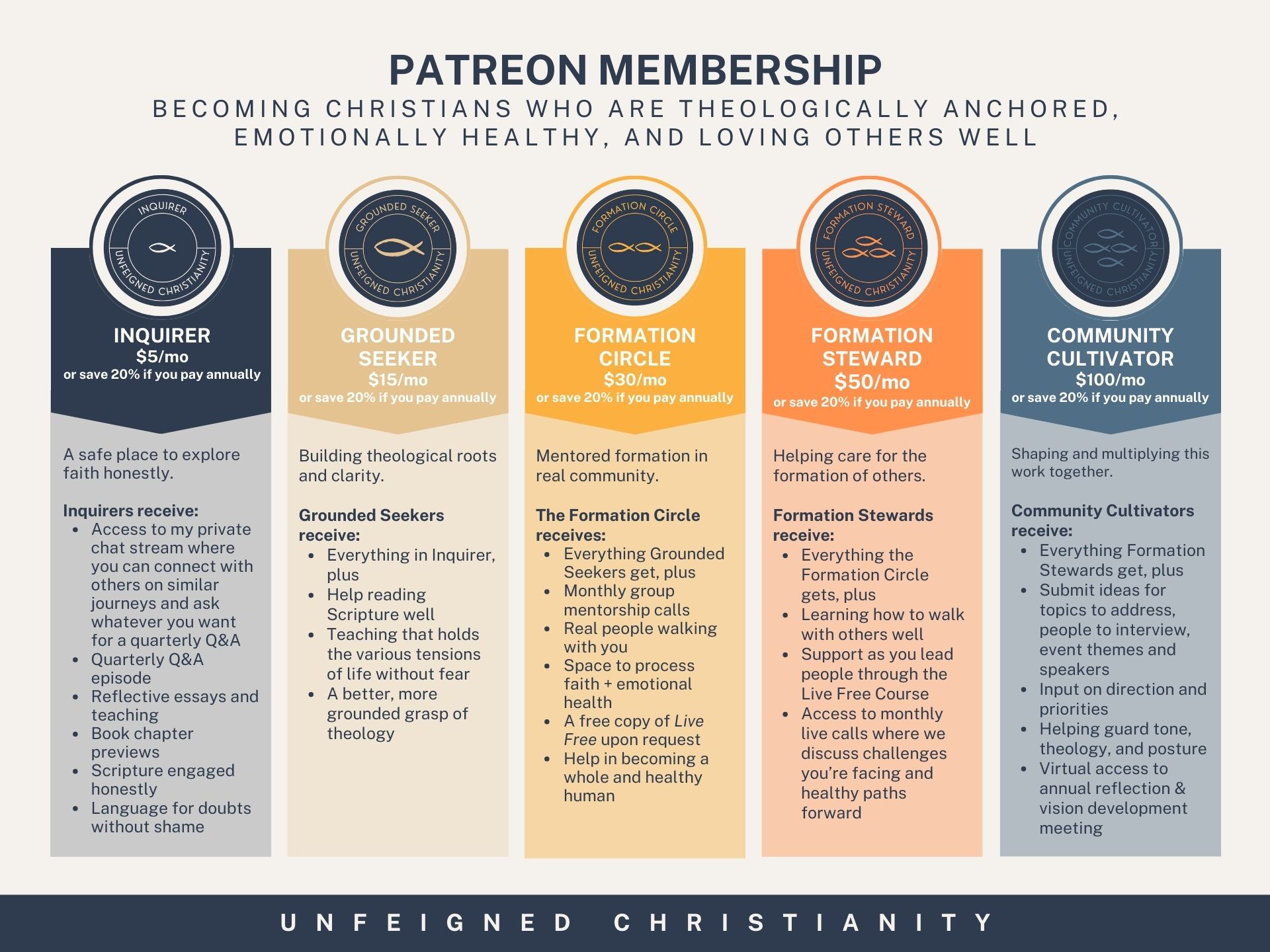
Join Unfeigned Christianity on Patreon and Take Your Journey to the Next Level.
Become a paying member of Unfeigned Christianity for as little as $5/mo and access article, our community chat stream, and quarterly Q&A episodes.
Already a member? Login