
What if the behavior you hate most about yourself wasn't an enemy to crush, but a part of you trying, in a broken way, to help?
In this conversation, I sit down with Rick Manabat, a licensed therapist and the founder of Pneuma Counseling, who has walked with me through my own healing over the last two years.
Don't Have Time to Listen? Here's the Gist:
I wrote a book about overcoming pornography before I ever asked the most important question about it: what is the part of me that keeps going back actually trying to do? Internal Family Systems, or parts work, taught me to stop treating my struggle like an enemy to crush and start getting curious about it. Underneath the behavior is almost always a wounded part and a younger story. Condemnation never reached that place. Compassion did. Healing starts when we stop acting out the story and finally turn toward it. I discuss all this and more today with my personal therapist, Rick Manabat.
Rick's practice: Pneuma Counseling.
The next Live Free Mentorship cohort is now open. Details and the link here.
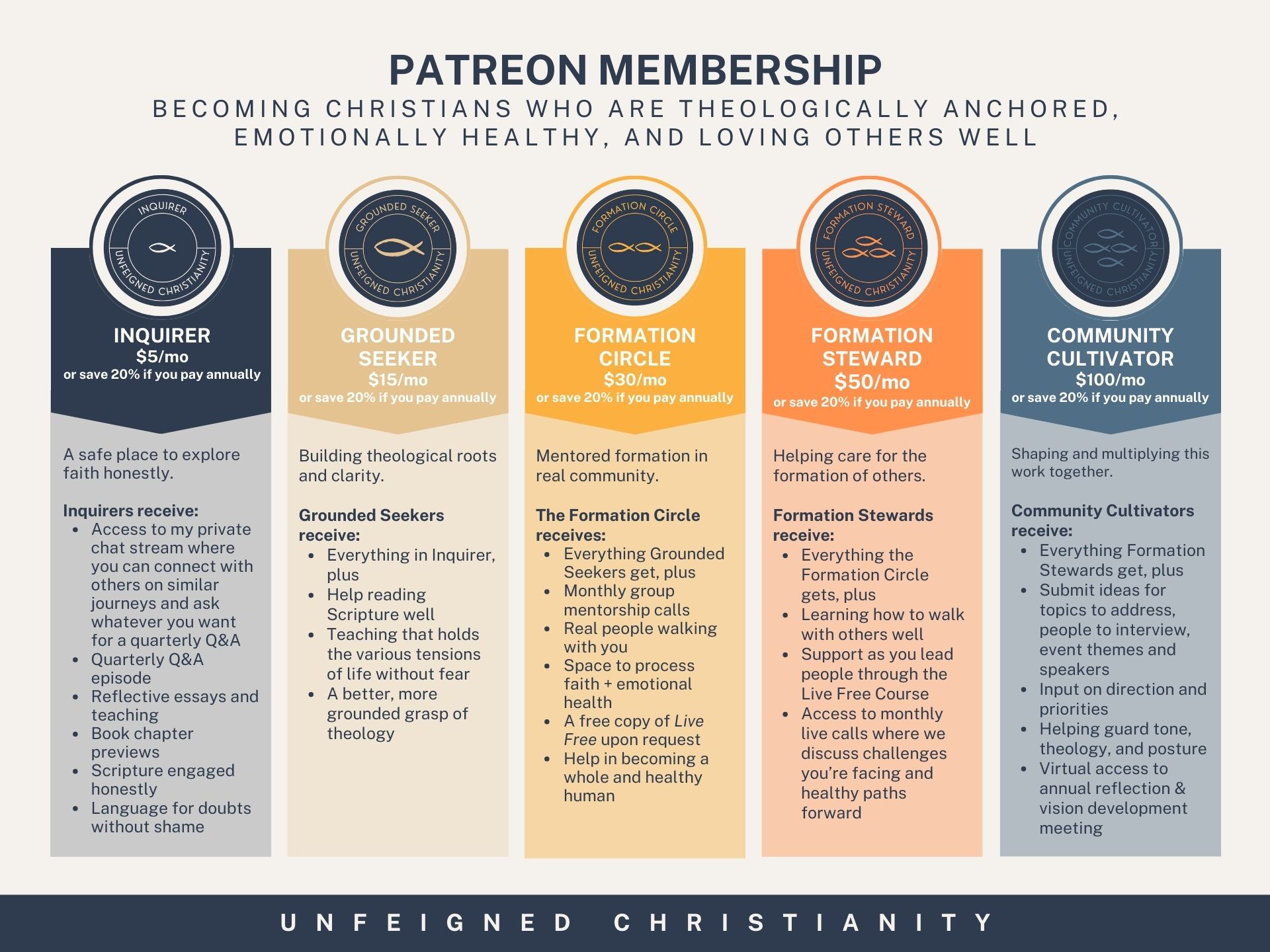
Learn more about the Unfeigned Christianity Membership program at asherwitmer.com/member.
Rick Manabat (00:00)
out of wounds we learn to survive and we come up with all these ways to like just survive and those become our protective parts When it comes to protective parts
two types of protective parts. There's one that we call a manager, and then there's one that we call a firefighter. Think of the two protective parts as one proactive and one reactive. So a manager will always be looking at the exile and knowing that the exile maybe was rejected. So that manager protector, since that part is kind of leading,
it will always kind of be like, I don't ever want to feel rejected pointing at the exile. So we're going to do this to not be rejected. This is the thing we're going to do because I don't want to I don't want the exile to feel that
Asher (00:50)
Hello friends, welcome back to Unfeigned Christianity, where we are on a journey of becoming a people who are theologically anchored in Jesus and emotionally healthy so that we can love and disciple others well.
Before we get into this conversation, I wanted to let you know that the doors to the live free mentorship community are now
This is the five month journey towards sexual wholeness that I've been talking about in my last several
And the whole point is that you don't walk it alone.
You walk it with other people who get
If you've been feeling the pull to finally do this work, I'd love for you to join us.
You'll find the link in the description of wherever you're hearing this from.
Now I'm really glad that today you get to hear from my own personal therapist, Rick Manabat. He is located in Colorado Springs, and we've been meeting together for two years now, I believe it is. And we're gonna dive into parts work, internal family systems, and a whole lot more when it comes to understanding ourselves and exploring our own stories and the role that that plays into
just general emotional health, but especially as per the conversation of the last several weeks, sexual wholeness as well. So without further ado, here's my conversation with Rick.
Asher Witmer (02:18)
Alright, welcome Rick.
Rick Manabat (02:20)
Thank you. Honor to be here.
Asher Witmer (02:23)
Good to have you on the podcast. You've heard me talk about it some here and there and now you're actually on it.
Rick Manabat (02:25)
Mm-hmm
Live.
Asher Witmer (02:33)
You, I've been blessed to be able to meet with you. What is it going on close to two years? I think it was summer of 24 when we started. And yeah, you've been really helpful, particularly in parts work and understanding myself from that angle. And that's kind of what I'd love to dive into here in our conversation today. But.
Rick Manabat (02:44)
Maybe, yeah, yeah.
Asher Witmer (03:02)
Maybe to get us started, share how, yeah, how did you, where are you from for my audience that's not familiar with you and then how did you get into therapy?
Rick Manabat (03:08)
Hmm.
Yeah, I currently reside in Colorado Springs. We moved here in 21, right? Right around COVID. And we moved from Chicago.
and ⁓ I lived in the city. Sometimes you meet people and they say they're from Chicago and they're not really from Chicago. They're from Rockford, which is not Chicago. ⁓ But I lived in the city. I grew up there my whole life. I lived in the northwest side of the city. ⁓ You know, as far as therapy, ⁓ I would say I felt called to it for...
I look back at my life, I felt like a calling to it. I I remember as a kid, I was raised by a single mother and our house was just chaotic and she's like, we can't do this anymore. And so she took us all into family therapy. And I remember at first just kind of being like, what is this? But after like being there for, I think we stayed for like a year, I remember being like, wow, that was a really cool experience. So that was my first exposure to that. And then when
When I graduated high school, I remember talking to other students and I remember this one student, name was Denise Rosado, and I said, hey, what are you gonna do? And she's like, I'm gonna be a social worker. I'm like, what is that? Like, I never even heard of that before. She's like, ⁓ you help people and you care for them and you, you know, and I was like, that sounds kinda cool. ⁓ then, you know, after high school, I didn't go,
I started a community college, but honestly, I had no idea what I was doing. I didn't even know what college was. I'm like, what am I doing here? And even the classes I was taking, I was taking photography and figure drawing and like no one told me, take your general education, get your English and your math and your science. No one said any of that. And so.
I ended up doing community college for about two years and then I just left. was like, I don't know what I'm doing. And so then I started working and when I was working in a restaurant and I remember a server, her name was Beth.
and she was attending Jane Addams School of Social Work for school in her master's program. And I remember like, social work, I know what that is. And we would talk about it and she'd tell me about her classes. And I remember thinking, ⁓ this sounds really cool. And then ⁓ not to spend too much time on this, but I went through a divorce.
and ⁓ while I was married for that short amount of time, I was trying to go back to finish my bachelor's and I was taking my gen eds and I took a psychology class and I remember loving it being like, ⁓ this is awesome. But then I went through the divorce and I kind of fell away from the Lord, stopped going to school. ⁓ Two years after that, the Lord brought me back and
One of his directives for my life was, he's like, I want you to go back to school and finish what you're doing. So I remember coming back to Lord and being like, okay, I need to finish my bachelor's. So I went back to school, got a degree in psychology, bachelor's, and I loved it. And then after that, I didn't wanna do any school. So it took a break, but then I started thinking about like, what do I wanna do? And counseling just kept coming up.
Asher Witmer (06:26)
Hmm.
Rick Manabat (06:49)
And when I look back at that...
I noticed that people would always want to talk to me. They would always start off the conversation saying, hey Rick, what I'm about to tell you, I've never told anyone. And I remember thinking, why does this keep happening? And so that kind of made me just start thinking of it. And then I had a friend who was a psychologist and just the way he would talk about things and just the way he would explain things, I remember being like, man, I want to be like this guy.
Asher Witmer (06:56)
Hmm.
Hmm.
Rick Manabat (07:19)
And then ⁓ I started looking at grad schools and ⁓ I was still a little nervous about it. No one had ever gone to grad school. My family, I didn't think I was smart enough. I was afraid of the financial impact and I remember being at a party with my church. This church I used to go to, it was like a church of like 200 people and whenever someone would have a birthday, like everyone would come and be like the whole church is there. And I remember being at a party and telling one of my pastors about, I was thinking about doing it and he just
to me he said, Rick just do it man. And for whatever reason that just went right out of my heart. I'm like, all right, I'm gonna do it. And then I got into Trinity International University in Deerfield, Illinois and did my master's in clinical, it's like clinical counseling, that's what it was called. So that's the story. And here I am. Yep, here I am. ⁓
Asher Witmer (08:07)
Yeah. Yeah.
That's cool to hear that background. It's interesting because some of my siblings have had kind of from early on a vision of what they wanted to do and they went to college for it and now they're doing it. And my life has been a little different. I hated school, never wanted to go to college. And then after getting married, it was like,
Actually, maybe I want to go to Bible college. That was kind of, it was like, why am I doing this now that I'm raising a family and all of that? But it sounds like your journey was kind of around and about too and kind of piecing it together as you.
Rick Manabat (08:50)
Yeah.
Yeah, funny
piece to the story. When I was looking at schools, I was actually looking at PsyD programs, all doctorate. And I was looking at schools in California. I was looking at schools in Illinois. And I remember
going through the whole process and like maybe the second or third school, I don't remember which one it was, but I remember them asking me like, hey, what do you want to do with this degree? And I was like, oh, I want to sit with clients and just like sit in a room and counsel. And I remember she's like, you don't need a doctorate for that. I was like, I don't. And so once I learned that, I was like, oh, I don't want to do the doctorate. I didn't want to go for five years. And so I ended up doing the masters and she was right. I didn't need a doctorate to do what I do.
Asher Witmer (09:19)
Hmm.
Yeah.
Rick Manabat (09:40)
⁓ And so, yeah, I didn't like to go, I didn't want to be in school either. Like, at least a lot of time in the classroom. I just want to get out of here. So, yeah.
Asher Witmer (09:44)
Interesting, yeah.
Yeah.
Yeah, yeah. When would you have started Pneuma? Pneuma counseling? Is that the name of it? Yeah.
Rick Manabat (09:57)
Yeah, it's
Numa Therapeutic Services, but Numa Counseling. So I, ⁓ in 2020, right before COVID, ⁓ I was working in private practice and I started thinking of like, man, I think I want to start a practice, you know, just open up one. And so the vision I had was I wanted to open up a practice that ⁓
Asher Witmer (10:06)
⁓ okay.
Rick Manabat (10:25)
we would see everything. We would see grief, we'd see depression, we'd see, you know, anxiety. ⁓ But we would have a... we would specialize in two things. One was trauma and the other was sex addiction. ⁓ That is what I'm very passionate about. ⁓ And so when we started... ⁓
My first therapist that worked for me was actually one of the pastors at the church that I went to, the one where they told me, just do it, go to grad school. ⁓ And that church had ⁓ gotten a new leader and the new leader wanted a whole new staff. So he had asked that pastor to step down and leave. And so I was actually working at Moody Bible Institute at the time, ⁓ as well as private practice. And he had reached out to me wanting a job at Moody. And I said, well, actually,
I'm thinking of opening up a practice. I if you join me there? And so he ended up talking to his wife and he said, I'll pray about it. And he came back and he joined us or joined me. It was just he and I. And then he, you know, his caseload filled up really fast and then COVID hit and we lost like, I don't know, 15 clients and we were kind of like, oh my gosh, how are you going to pay the rent? This is crazy. And the whole, you know, the whole world was affected. But as you all know, COVID
shut everything down and people got really depressed and anxious and people were like I don't care if it's not in person I'll do telehealth because that was a new thing too and then that's how Pneuma started to grow. so that's kind of the story of Pneuma.
Asher Witmer (12:03)
Hmm. Yeah.
Yeah. And you are still based. I mean, you're here in the Springs, but you have a team in Chicago still, correct? Yeah.
Rick Manabat (12:13)
We do, yeah. It's a
bigger practice. ⁓ get, you know, I lived there my whole life. I knew so many churches, so many pastors. And so they all trust us. And ⁓ I wanna do that here in Colorado. want the same kind of relate, I want the same setup where NUMA is the place where a lot of the churches will refer to for their members. Cause we love the church, all our therapists are believers. They all have a faith background.
Asher Witmer (12:22)
Hmm.
Rick Manabat (12:42)
⁓ And that's who I love to work with. love the church and I love men who struggle, Christian men who struggle with porn and I want to help them with that. so, ⁓ yeah, I want to duplicate it here in Colorado too. It's just not as, you know, I've only been here five years so I haven't been here my whole life. So I'm still getting to know people and my name's starting to get around a little, but not like Chicago, yeah.
Asher Witmer (13:00)
Yeah.
Yeah, yeah, well I so two years ago this month basically I went through some health stuff that at first we weren't really sure what it was and After after looking into all the physical stuff The question was naturally kind of was this not physical is it something emotional and and so forth and I had a call with a friend once who
Rick Manabat (13:29)
Yeah.
Asher Witmer (13:33)
really encouraged me to take a year to step back and I mean I don't remember what all he talked about but offloading different things just to the schedule and pace of life was not healthy. But he specifically encouraged me to go get counseling and to find look for someone who's trained in IFS, internal family system and
Rick Manabat (13:59)
Yeah. Yeah.
Asher Witmer (14:01)
So that's when I started, I just was Googling because I had never done any counseling. I have connections with counselors in other states, but not here in Colorado. And I think it was through the focus on the family network thing. Maybe I found you and one other guy, there were a couple others, but they looked about my age and I kind of wanted somebody older than me. And I reached out to both of you at the same time. You were the
Rick Manabat (14:25)
Yeah.
Asher Witmer (14:32)
the fastest response and just seemed even through email and over the phone initially had a good connection and tried you out and have been very, yeah, I mean the rest is history I guess. It's been very helpful, helpful journey.
Rick Manabat (14:48)
Yeah.
Yeah.
Asher Witmer (14:51)
Specifically the, don't, I'm not sure always what all you're pulling from that is internal family systems or parts or whatever. Sometimes you'll kind of step back and draw diagrams or whatever. Is internal family systems essentially parts work or are they kind of separate pieces?
Rick Manabat (15:00)
Yeah.
No, it's a
different name, same thing. Parts work and internal family systems are pretty much the same. There's other variations of internal family systems. Ego state is another one. But yeah, internal family systems is known as parts work.
Asher Witmer (15:19)
Okay.
Yeah, yeah. How did you get into parts work and then maybe just kind of with that explain for our audience what parts work is?
Rick Manabat (15:45)
Yeah, so when you become a therapist, ⁓
there's this organization, I don't know how they find you, but they will start sending you stuff. It's called PESI, P-E-S-I. And PESI puts on all these trainings. they're not like certifications, they're more, ⁓ they wanna expose you to certain things. And so ⁓ I remember I got something from PESI and this one coworker of mine said, hey, there's this thing called Internal Family Systems, ⁓ this guy named
Dick Schwartz is gonna be presenting, a one day training. She's like, we should do it. I was like, all right, let's do it. So we went to this training and Dick Schwartz is the guy who created this whole model. And so we went to this one day training and he explained to us what this was and then showed us actual sessions of him using it with clients. And I mean, I was blown away. I was like, what in the world is happening?
This is incredible. was like, holy cow. And so just seeing it, that was it for me. was like, this is good. This is really good stuff. Yeah.
Asher Witmer (17:00)
Mm-hmm.
Yeah. Yeah, and so the the basic gist of it is that we as humans are not just single entities, but there's parts of us that
Rick Manabat (17:13)
Yeah, Dick Schwartz would say parts, you know, when we talk about our parts, they're like personalities. ⁓ So we, the parts nomenclature, I guess you'd say.
It comes from just the way we talk all the time. You know, Hey, what do you guys want to do tonight? I don't know. Part of me feels like a movie. Part of me feels like, all right, well, what movie you want? What do you want to watch for a movie? I don't know. Part of me feels like a sci-fi movie. Part of me feels like a comedy. All right. Well, let's order some food. What do you want to eat? Part of me feels like Mexican. Part of me feels like Chinese. So we use that language all the time. And that's what Dick Schwartz in his sessions, he noticed that with his clients. They would always talk like that. He's like, you know, there's a part of me that's
like feeling like this and then he just kind of followed the client where where the client took him and he's like tell me about this part and they would talk about this part and then and so that that's where it all began he just noticed the clients talking that way and he just started to be curious about those parts and so he would say they're they're like personalities ⁓ not not
Asher Witmer (18:05)
interesting.
Rick Manabat (18:22)
not on the level of multiple personality, where someone has like, you're Asher and then there's a part of you that's called Frank, and then there's a little boy called Johnny, not like that, but they have personalities and they have roles. Dick Schwartz, well, parts work. When you think of it,
Asher Witmer (18:31)
Hmm.
Rick Manabat (18:45)
There's parts to us that ⁓ we all have. ⁓ One part of us is what he would call the exile. Think of the exile as the wounded part. If you grew up with abuse, if you grew up with neglect, if you got bullied as a kid, if you... ⁓
Yeah, if you had an older brother that would always talk down to you. All that wounding would be on that part. And they called it the exile because we don't ever want, we don't like feeling that stuff. We don't want to feel that neglect. We don't want to feel that rejection. We don't want to feel that abuse. So we exile it to a part of us. And I always like to say we put it on an island and give it a, you know, a daiquiri and keep it really happy. ⁓
Asher Witmer (19:23)
Hmm.
Rick Manabat (19:38)
Because we all have an exile or a wounded part there are other parts of us that protect the exile and so we call these our protective parts another way to think of a protective part is a survivor part So like out of our wounds we learn to survive and we come up with all these ways to like just survive and those become our protective parts ⁓ When it comes to protective parts
there are basically two types of protective parts. There's one that we call a manager, and then there's one that we call a firefighter. Think of the two protective parts as one proactive and one reactive. So a manager will always be looking at the exile and knowing that the exile maybe was rejected. So that manager protector, since that part is kind of leading,
it will always kind of be like, I don't ever want to feel rejected pointing at the exile. So we're going to do this to not be rejected. This is the thing we're going to do because I don't want to I don't want the exile to feel that sometimes the exile does feel rejected. So then the firefighter protector comes in and basically puts out the fire. It's reacting to the feeling of being rejected and it comes in and does something. So think of addiction as a firefighter. You know, I'm feeling
Asher Witmer (21:06)
Hmm.
Rick Manabat (21:06)
this
I want to go get drunk I don't want to feel this that's coming up I don't want to feel this so I want to put out the fire or I want to go look at porn I don't want to feel this I'm gonna numb out so addictive when you when you have an addiction you I would typically look at that as as a firefighter protector I not confuse people really just protectors is an easy way to just look at them ⁓
Asher Witmer (21:27)
Hmm.
Rick Manabat (21:34)
The thing I would say about protectors is they always have good intentions. know, they, like, if you think of rejection, so a manager will say, I just don't want to feel this way. I don't ever want to feel rejected. So I'm going to do these things that that's a good intention. You know, it's trying to help that. That's another thing. Protective parts feel like they're helping.
Asher Witmer (21:41)
Hmm.
Rick Manabat (22:00)
And another thing is ⁓ protective parts typically operate out of fear. Like, you know, I don't want to feel this. What if they reject me? So I'm going to do this instead. That's like a fear response, fear of being rejected. ⁓ Now, to kind of bring this full circle, ⁓ there's also the self.
Asher Witmer (22:07)
Hmm.
Rick Manabat (22:22)
And I don't know if Dick Schwartz would call the self a part. The self is like the true you. I would say it's like the soul of who you are. It's the spirit led part of who you are. And...
You always know when you're operating from the self and not operating from a protective part who's a manager. The self will always exhibit what we call the seven C's of the self. So think of every C word that is good. Calm, curious, courageous.
Asher Witmer (22:52)
Hmm.
Rick Manabat (23:00)
⁓ You'll have clarity. You won't be confused. Everything will be clear minded. You're connected. You're creative. You're compassionate. So again, protective parts are fearful. So whenever there's, sense fear, that's not the self. The self would be calm. The self would be very connected. ⁓ And so the model believes that like,
Asher Witmer (23:20)
Mm-hmm.
Rick Manabat (23:29)
Because we possess all these C's, like calm, courageous, compassionate, clarity, we have enough to help heal the parts, basically. ⁓ One thing I would say too is a rule in parts work is all parts are welcome. We're not getting rid of any. I remember working with a client.
and
We were working with a part of him that ⁓ was very tough. I was asking him to, let's engage this part. Let's try to understand it. Let's try to get to know it. And as we were doing that... ⁓
I was asking him questions like, is this part trying to do? How do you think it might be trying to help you? What's its intention? Or what do you understand about this part? And at some point, the client thought I was asking to get rid of it, and he reacted. He's like, he kind of shut everything down. He's like, I don't wanna do this. And I was just like, hey, what's happening? And he's like, this part of me has helped.
me so much and that that's why we don't ever get rid of parts because they played such a good role.
helpful role in some respects in a person's life. And so what we're really asking is, the way I like to frame it is we're trying to give these parts, especially the protective parts, a new job description, you know, to kind of paint a better picture. I took a
Asher Witmer (25:02)
Hmm.
Mm-hmm.
Rick Manabat (25:24)
I was part of a training in parts work with this therapist ⁓ and she was telling us her story. said when she was a little girl, her dad was in the military and they would have to move every two to three years. And she said, just imagine having to start a new school every two to three years. She's like, I never felt noticed.
never felt included, always was on the outside. And she said, so that wound was my exile. This little girl who felt invisible, not included, not wanted, not seen. And she said, as I grew up, I didn't want to feel that. So what I decided was I was going to be perfect. That is a manager.
Asher Witmer (26:19)
Hmm.
Rick Manabat (26:22)
If you let me hear that I don't pointing at the eggs out. I don't want to feel that. So what I'm going to do to not feel that is perfection. And she said I was I was everything was perfect. My grades were perfect. My makeup was perfect. My hair was perfect. I dressed perfect. I walked perfect. She said but this is what this is what happened as I grew older. I started working and she said that ⁓ she ⁓ in this company she was working with they would have these events.
where they would go to like a hotel and there would be workshops and all that stuff and there'd be all these new faces that she never met before. And it was a trigger for her because it would remind her of a new classroom. I'd walk into a new classroom to see all these new people I never saw before. And then she would feel that fear of, oh my gosh, I'm not gonna be seen anymore. I'm not gonna be noticed. They're gonna reject me. And then Miss Perfect would show up.
And she said, and let me ask everyone in this room, who here wants to get to know someone who thinks they're perfect? She said, no one would ever approach me. And she said, ⁓ I think she said, then I would feel that rejection because no one would ever want to get to know me. And then I would turn to alcohol.
Asher Witmer (27:39)
Hmm.
Rick Manabat (27:39)
And
that was the relationship she had with herself. She kept doing this over and over, thinking perfection was the way to heal the wounds of her childhood of not being seen, not being noticed. And she said, then she got into therapy and she started working with a parts therapist and the therapist helped her to unpack the parts and understand the parts. And then things started making sense. And then she started to negotiate with this part of her who wanted to be perfect. And she would be like, hey, maybe.
this one time we don't have to be perfect. And so she started to try to not have to be perfect and then she noticed that people would approach her and they would want to get to know her and she started to heal those wounds and those parts of her that tried to fix the wound. And so I love that story because it really kind of puts in the perspective what parts looks like. ⁓
Asher Witmer (28:33)
Mm-hmm.
Rick Manabat (28:34)
And so yeah, and that's why love it. And I'll say one more thing, what I love about parts work is because of the way it looks at dysfunction, because it sees the protective parts not as enemies, but as these parts of us that are trying to help.
Asher Witmer (28:35)
Yeah. Yeah.
Rick Manabat (28:54)
What that does is one, if you introduce this model to someone, it makes total sense. It's like things start clicking in your brain, like, oh my gosh, this is what's going on. And then you develop a lot of compassion for yourself. Like, oh, the person who I attended at training, when you think of it, she tried to be perfect.
Asher Witmer (29:06)
Mm-hmm.
Hmm.
Rick Manabat (29:19)
But the reason behind it was she thought, ⁓ maybe if I'm perfect, then people will like me. You know, like how do you get angry at a part when that's the undergirding reason?
Asher Witmer (29:27)
Mm-hmm.
Rick Manabat (29:36)
for the perfection, you know? And so parts work really helps you to understand yourself and then it gives you such a compassion for the reasons why you do the things you do. But then again, then you understand those reasons and then you kind of like, okay, maybe we could try something different. We don't have to be perfect. So, yeah.
Asher Witmer (29:37)
Mm-hmm.
Mm-hmm.
Yeah, no, that's good. When it comes to, mentioned, I mean, you kind of got into it with the story with this lady who turned to addiction. Is it safe to say that addictions are the result of discovering the manager can't manage the pain? Can't, it won't.
Rick Manabat (30:22)
it's
just a person's way to, you know, the addiction is putting out the fire. It's the client's way to feel better.
Asher Witmer (30:28)
Mm-hmm.
Rick Manabat (30:30)
to not feel what you're feeling. I don't want to feel this, which is why we exiled those parts of us. We don't want to feel sad. We don't want to feel rejected. We don't want to feel shame. And so we, you know, I mean, if you think of what addiction is in a nutshell, it's about numbing and escape. And so it's a part of us that teaches us like, here's how we numb, here's how we feel better. Yeah.
Asher Witmer (30:30)
Hmm.
Yeah.
Yeah, yeah.
So when it comes to sexual addictions or even just unwanted sexual behavior, ⁓ sometimes it's hard to classify like what is ⁓ an addiction or not, but we can do behaviors that when we do them, we feel shame and guilt and wish we could stop. Like a lot of people who,
Rick Manabat (31:02)
No.
Asher Witmer (31:25)
who have these.
unwanted behaviors Feel like it's innate like their sexuality for instance like they have too strong of a sex drive or something like it's that's the problem ⁓ What do you say to that or like how did yeah, how do you How do you use parts work to help people explore what's going on?
Rick Manabat (31:34)
Yeah, I've heard it. Yeah, yeah.
Well,
just to back up, just for your audience, to kind of help define addiction, in a very general sense, all addictions have very similar features.
Asher Witmer (31:54)
Mm-hmm.
Rick Manabat (32:01)
you know, preoccupation, ritual, the actual behavior, the addictive behavior, and then you feel the guilt and shame and despair. And then it's just wash, rinse, repeat. ⁓ Two questions that you could always ask if someone has an addiction is ⁓ one, have you tried to stop this behavior and failed?
So take drinking, gambling, drugs, porn, whatever. Have you tried to stop and fail? And then you're doing it again. And the other question is, does your behavior, whatever you're doing, have negative consequences? And if it's yeses to both, that's what we would define as an addiction. let's just define that. ⁓ So your question is, ⁓ you know, the person is like,
Asher Witmer (32:44)
Interesting,
Rick Manabat (32:52)
you know, I just have a high sex drive. You know, I wouldn't, to me, there's so many hats I'm wearing with what I do. Like I have my sex addiction hat, I have my parts work hat. ⁓ To me that, when I hear that...
Asher Witmer (33:02)
Yeah.
Rick Manabat (33:08)
Whenever you work with addiction, you're gonna deal with a lot of denial. Like, they're gonna, like, it's not that bad, I'm not hurting anyone. And so when I hear that, like, I just have a high sex drive. That's part of the denial. ⁓ If a person's coming in and they are not, like, their denial is a little low. Like, they're actually like, I have a problem, I need help. And they're really like...
motivated to work on this and we use parts work, ⁓ it's really getting to know ⁓ the part. you know, you would just say, let's get to understand what's going on here. You know, let's get in touch with the part of you that wants to look at this stuff. And so, ⁓
you know, there are certain kind of questions we go through, really, we're really trying to understand. And you want to ask questions. I always try to ask questions that help the client to understand how this part might be trying to fix something or help you with something or even protect you from something. Hence the word protective parts. And so it's like, you know, what do you think this part is trying to do for you?
Asher Witmer (34:27)
Mm-hmm.
Rick Manabat (34:28)
How do you think this part is helping you in some way? know? Once we understand it, then we want to help the part out. What do you want that part to know about this? You know, sometimes they'll say, well, the parts try to help, but then it makes me feel like this. I'm like, okay. So do you think we can help that part out to find?
Asher Witmer (34:33)
Yeah.
Rick Manabat (34:51)
Again, a new job description. Do think we could we could help that part to find a new way to to make you feel this way? And so you really want to understand the park first. You you want that part to feel very validated, like it's very understood ⁓ before you start changing it because you want it to make sense. Like, that makes total sense. Well, it does make sense. But let's try it. You know, then the clients think, well, can we do something different?
And then that's when some of the change starts to take place.
Asher Witmer (35:24)
Hmm. Mm-hmm.
That whole, I mean for me, excuse me, I mean just for, my audience is familiar with it, but I wrote a book on my journey getting into pornography and then finding healing. And you know, that's been what, eight years ago? I mean 10 years ago since I wrote it. But the thing, like I,
I was familiar with the concept of pain ⁓ motivating that kind of behavior, know, trying to trying to feel better and numb. But they're still lacked not only in the book, but just in the way I interacted with myself or with others, the curiosity behind like just that whole concept. What is it trying to help or what is it trying to do?
Rick Manabat (36:17)
Yeah, and if you
think of it, curious is one of the C's of the song. Yeah, just being curious.
Asher Witmer (36:22)
Yeah.
Yeah. How do you have you found when you're working with people? Is that hard for people to? Especially like like you mentioned, maybe there's a sense of denial and that's maybe a bit of a different stage, but when someone is really desperate for help, but they just can't get they can't stop the behavior, they can't get out of it. Does there tend to be a sense of contempt for?
that part of them or that ⁓
Rick Manabat (36:54)
Yeah,
yeah, yeah. A question we would always ask is like, how do you feel towards this part? And you know, when I ask that question, I'm trying to gauge. Like if you really understand the part, you kind of...
Don't, you're not angry at it. You're like, well, I care for this part, you know? That's a very calm response. If there's a lot of anger towards that part, that tells me the client doesn't really understand what that part is trying to do to help them.
Asher Witmer (37:15)
Hmm.
Hmm.
Rick Manabat (37:29)
And so even the angry part of them is a part of them. It's not the self, because the self's not. The self's calm. The self's compassionate. And so it gives you clues as to what...
Asher Witmer (37:35)
Mm-hmm.
Rick Manabat (37:41)
what you're kinda, are you talking to the soul of who that person is or are these other parts? ⁓ Usually when a client's angry, I would just ask that part to just, hey, could you step aside a little? And really, I'm trying to get the client to be more compassionate. And really, again, they can't be compassionate until they really understand, like, ⁓
this part of me is trying to help me in this way. And that develops the passion. And so, yeah, you'll encounter people being very angry at parts, which is understandable because they don't understand that part and what it's really trying to do to help.
Asher Witmer (38:12)
Hmm.
Yeah. Yeah.
And what do you do, I'm sure you've bumped into this, but maybe not like, you're the counselor, so people are obviously willing to go to counseling. But there's plenty of people, especially within the faith community among Christians who...
It's like it's too much work to do all that like to understand what this part is trying to do and it's to to go into your past story and rather just do what Paul says to to let go of what's in the past and strive for what lies ahead and ⁓ The Bible says we're gonna have to crucify our flesh. So just crucify flesh flesh. Like how do you kind of navigate that?
Rick Manabat (39:05)
Yeah.
Yeah, yeah.
That's a good question. You know, ⁓ I would say, that's a good question. Let me think about that for a sec. So you're saying that the client who comes in and who is taking the word of God and doesn't want to look in the past, ⁓
Yeah, I- yeah, I- I-
Asher Witmer (39:39)
Or like,
maybe they feel it makes things worse to like bring up stuff from the past or revisit.
Rick Manabat (39:45)
You know,
I mean, ⁓ in mental health kind of sort of response, we always say ⁓ in therapy, things will get worse before they get better. Because we're kind of, we're digging into the stuff that our wounds, know, oftentimes that's what we're doing. We're looking at our wounds and we're...
we are, and that's painful. You know, I always love the story of the woman at the wharf. And you your listeners probably are very familiar with that story. And you know, Jesus encounters this woman and he, know, he's like, hey, do you have some water?
Or can I get a drink? And she's like, you know, how are gonna draw water? And he's like, well, if you knew the water that I would give you, you would ask me for water and I would give you living water. And then he goes on to say, hey, go call your husband. She's like, I don't have a husband.
He's like, you're right, you don't, you've had four and the one you're with now is not your husband. So he dug into her past, but the thing he did was it was filled with grace and truth. And to me, that's what therapy is. We wanna create a space where a person can talk about their stuff and...
and we're gonna be honest about it, but there's not judgment. We're not here to judge. We're here to provide grace and truth, you know? And then the truth is, he says, you're right, the one you're with now is not your husband, and you've had five. It's like what you said is true. ⁓ But that whole encounter changes her, obviously. ⁓ And so I love that story because... ⁓
because of the, I mean there's so many things to it, but the grace and truth piece, like that's what I love about it. And I feel like that's what therapy is.
There's a saying in therapy I always say is, ⁓ I got it from a calendar on my wall and it's a quote and I can't remember the person who quoted it, but it says this, mental health is a commitment to reality at all costs. And I think you've seen it in my email signature. Mental health is a commitment to reality. We have to embrace the truth. ⁓ And part of that truth can be.
Asher Witmer (42:27)
Hmm.
Rick Manabat (42:38)
our past. know, like the truth that I had a father who never showed me any affection and what that did to me.
the truth that I struggle with pornography, the truth that it's destroying my relationships, the truth that I feel this way about myself, that I feel shame about myself. Mental health is a commitment to reality at all costs, embracing the reality. And to me, when you embrace the reality, that's when you can start to change it. If you don't see it, if you don't believe it, how do you change it? But it's until you see
Asher Witmer (43:12)
Hmm.
Mm-hmm.
Rick Manabat (43:17)
it and you name it and you embrace it it's like okay now what can we do about this then it's like okay let's start working on this i know that was a big diversion from parts but yeah yeah
Asher Witmer (43:24)
Yeah.
Yeah.
Yeah, no, thanks for that answer. And that kind of kind of with that was the question of how how do you integrate your faith in with therapy work? And and I don't know if you bump into this a lot. Kind of I I come from conservative Anabaptist background. And so there's there's kind of a
skepticism maybe toward psychology and mental health work and yeah and and yet I have and and there are it's not just me but there are others who who see tremendous value in just like obviously doctors have discovered things about the body that we now know it wasn't in scripture necessarily there's also things about
Rick Manabat (43:57)
Mental health.
Yeah.
Hmm? Yeah.
Asher Witmer (44:25)
our personhood and mind and stuff. But yeah, how do you, how does parts work integrate with your faith?
Rick Manabat (44:30)
You know, yeah, well,
I would say this first to your audience that is a little skeptical about psychology. And I get that. And I think part of that is because of Freud. And Freud had all these just crazy beliefs about things and... ⁓
And one, I would say we have evolved so far from Freud. mean, I don't know many therapists who use psychoanalytic theory, which is what Freud introduced to the world. ⁓ It's evolved so much. The other thing I would say to those people who are skeptical, ⁓
Asher Witmer (44:55)
Hmm.
Rick Manabat (45:18)
You know, whenever I get a new client in ⁓ and they've never had therapy before, I always want to kind of define what it is. And I'll say something to the effect of this. I'll say, listen, ⁓ sometimes people think therapy is I have all the answers and I'm going to give them to you. And I would say that's not therapy. Sometimes people think you're just going to talk and I'm going to listen to you and I'm a paid listener. And I'd say that's not.
That's not therapy or counseling. Sometimes people will think, you give advice. And I'd say that's not therapy either. Therapy, I like to describe it in three ways. One, therapy is like you coming in.
And I have a mirror. And as you share more about your life, I'm just going to pull up my mirror and reflect back to you what I'm seeing or what the mirror is showing me so I can help you to see yourself better. So that's one way therapy is. Another way is therapy is like you and I walking around in the dark in the forest, but I'm the one holding the flashlight. And I'm just going to...
Hey, what do think about this? You want to go there? You might be like, let's do it. And so we shine and we keep going. Or I might point over here and you're like, nah, that's not relevant. Okay, let's keep going. What about that over here? Yes. And so, um, therapy is like that. And then, and then the third way I like to describe therapy is, you know, in Colorado, we have 14ers, right? Um, I had a friend who did Mount Kilimanjaro. I think that's in the East somewhere. Uh, and that, that mountain is not 14. It's like,
23 or something it's like ridiculously high. When you climb a mountain like that you get a sherpa and a sherpa is a guide they know how to get you from base camp to base camp to base camp all the way up the mountain and sometimes they carry your gear they'll carry you know your backpack your all your stuff
But ultimately, you're the one who has to climb the mountain, not the sherpa. And so therapy is like that. I'm like a sherpa. I'll get you from base camp to base camp, but you're the one who's gotta get there. I'm not doing the climbing. You're doing the climbing. You do the hard work. I'm not doing the hard work. I might carry your gear, you know?
but ultimately you gotta climb the mountain. So to me that's what therapy is. I'd like to just share that to clear up any preconceived notions about what it is. To your other question about parts work, you know, I've thought about that, how does this work with our faith? And if you think of it, the Trinity, now each part of the Trinity is not a part, it's equally God, but one God.
Asher Witmer (47:49)
Yeah.
Yeah.
Rick Manabat (48:10)
similarly us these are parts of us they're still us you know the bible talks about soul spirit body three parts ⁓ they're all us ⁓ and and it it does align in that respect somewhat but but really think of it as more of a framework like a lens
Asher Witmer (48:24)
Mm.
Rick Manabat (48:37)
to view something through. It's not saying your multiple personality, you know, ⁓ although there are parts of us that have different roles and they think a certain way and then there's other parts that don't think that way. And so in essence, they are like these little personalities. But it's really a framework. And to me, what it achieves again is it achieves a lot of self-compassion.
Asher Witmer (48:39)
Hmm.
Rick Manabat (49:03)
⁓ I don't think God calls us to hate ourselves. ⁓ mean, love is the economy of God. ⁓ Compassion is the economy of God. ⁓ And so if that helps your listeners, ⁓ but I can understand how that, like some people can be very hesitant. Like, what is this? Is this some sort of witchcraft or something? And it's not.
Asher Witmer (49:20)
Hmm.
Yeah,
yeah. What is, with that as a framework, what is healing look like? You mentioned it's not about eliminating a part. Would you say healing is just kind of having compassion for your parts or?
Rick Manabat (49:45)
Yeah, ⁓
you know, to use parts work, ⁓ kind of a rule is you want to work, you want to get to know the protective parts first. And you want to get to understand them, you want to get permissions for them to allow you to go to the exile.
and that's where the healing begins. ⁓ I had a guy I worked with recently and we were talking about, he came in struggling with sex addiction and ⁓ this guy grew up on the mission field in an Asian-speaking culture and he didn't...
learned the language fully. So he was made fun of by the natives. ⁓ He was homeschooled. So he never got like plugged into the cultural, you know, his peers, like he would, he would meet him on the maybe the soccer field or something like that. ⁓ And so he was also bullied for other stuff. But because of that, those are wounds, right? That's an example.
Asher Witmer (50:43)
Hmm.
Rick Manabat (50:59)
There was a part of him that started to like lie. This part of him would embellish, but the good intention was because he wanted to find acceptance. Like if I tell a cooler story, they'll like me.
And it comes from his wound. And I remember the session, we started to uncover this and I said, let's get in touch with this part of you that lies. And he told, he just started getting in touch with it. And he started to understand why he lied. And as he did, like his tears just started to pour out. And... ⁓
And then I moved him towards the part, the wounded part, which is like a younger kid, you know, the younger part because that's where it all happened.
Asher Witmer (51:48)
Hmm.
Rick Manabat (51:51)
And I asked him how he felt towards that part of him and he just gushed. And after the session, I was like, hey, how are you feeling? And he's like, I feel so amazing right now. It all made sense. Like he thought it was really bad that he lied. But once he understood, oh my gosh, I was just trying to get acceptance from people.
Asher Witmer (52:03)
Hmm.
Rick Manabat (52:13)
And he connected it to him being rejected for not speaking the language, for him not being cool enough, him, it would make fun of him for other things. That's the healing. That's the healing. Is there more healing to be done? Absolutely. But that, like that right there to realize, my gosh, I just, I was just lying to fit in. I was just lying because I wanted to be accepted. Think about how tender that is.
Asher Witmer (52:29)
Hmm.
Hmm.
Hmm.
Rick Manabat (52:43)
Like the tenderness of just wanting to be accepted by my friends, the tenderness of wanting to feel seen, you know? And so once he connected that, that he wasn't just like this liar and this deceiver, it was out of survival, which is what protective parts are doing, they're survivor parts, that all clicked for him and he started to feel better. Yeah.
Asher Witmer (52:51)
Mm.
Hmm.
Yeah, yeah.
You started out by saying that you your vision for Numa counseling is to connect with local churches. You have that in Chicago. You want more of that here in Colorado. What is one thing that you wish more people and maybe specifically more pastors understood about what's actually driving people in their sex addiction or or
Rick Manabat (53:24)
Yeah.
Asher Witmer (53:39)
other kinds of struggles they might be dealing with.
Rick Manabat (53:42)
Yeah, I mean to the pastors, you know, I feel it's become way more, ⁓ not accepting, but way more, there's way more understanding because of how many men struggle with it. So I feel churches are better at like not moving quick to judgment, but to understanding. But, ⁓
Asher Witmer (54:09)
Mm.
Rick Manabat (54:12)
I would say to the pastor, ⁓ this would probably have to be a separate podcast, but ⁓ sex addiction is a person acting out a story in their behavior. And as a therapist, it's my job to help that client.
Asher Witmer (54:30)
Hmm.
Rick Manabat (54:36)
understand the story and unpack the story and start talking about the story instead of acting out the story. ⁓ To give you an example, ⁓
you know we we have we kind of approach understanding the story by looking at a few things well one we look at like what what are they doing you know what's the acting out behavior ⁓ if they're only into porn we would ask like hey when you're when you're looking at porn what are you searching for
Asher Witmer (55:10)
Mm-hmm.
Rick Manabat (55:10)
And
every guy has something unique about what they're into. And that uniqueness, though it might be shameful, it has meaning. And so, you know...
One guy might be into skinny girls, one guy might not be into skinny girls. One guy might be into older women, one guy might be into younger women. So all of that has meaning and it connects somehow to their story. I'll give you an example. I had a client, ⁓ he came in, this was a while back, ⁓ and I started to kind of ask him, hey, what do you...
you know, how did you first discover porn? He said, ⁓ some of my friends told me about it. They told me about a website. I came home, typed it in, and he's like, whoa, what is this? And ⁓ he said I was instantly hooked.
And then he said, but I ended up finding something within that world that I really liked. I was like, oh, what's that? He said, I webcams. I was like, okay. And so when he said that, I thought, you like watching people have sex live? Is that what you're saying? He's like, no, no, no, no guy. I was like, oh, good, unique to him. So I said, what is it about that? And he's like, oh man, I love watching a woman.
pleasure herself. I was like, okay. And then he said this, he said, he said, but what really turns me on? He's like, you could be in this like chat room, I guess. And then she'll call on you and she'll tell you she'll say, Hey, what do want me to do? He's like, when when that happens, he's like, that's the best. And so as I was listening to him describe his acting out behavior,
I just kind of thought about it a little and I said, hey, let me ask you a question. said, where in your story have you felt like a burden? And his eyes got real big and he's like, I've always felt like a burden. I'm like, me. He's like, well, I was adopted.
I was like, okay. He's like, but you know what? I ended up finding my biological mother. I met her. She was a drug addict. She was linked to prostitution. So her giving me up for adoption. ⁓
was a very loving thing to do. And so I don't carry that as much as I used to. He's like, but the home that I grew up in, the family that adopted me, I had a lot of issues. And I think it was probably because of her mother, the drugs. So he said they were constantly taking me to this appointment and going to this specialist. And then I had to go for this assessment. And then I had to get this medication. He's like, I constantly feel like a burden
Asher Witmer (58:15)
Hmm.
Rick Manabat (58:15)
And so right there, this clicked for me in my head. And I said, you know what I think's going on? You're trying to fix that. And he looked at me and I said, I go think about it. When you tell that woman on the other end of the computer what to do, is she burdened by you?
Asher Witmer (58:25)
Hmm.
Rick Manabat (58:35)
I said, no, she's pleasured by you. And that's what you're trying to feel. Finally, someone's not burdened by you, they're pleasured by you. His eyes got so big and it's like his head, the top of his head exploded. And once we uncovered that, that's what we worked on. His feelings of being a burden. And the more he healed that part, that exile part of himself,
Asher Witmer (58:42)
Hmm.
Yeah.
Rick Manabat (59:01)
the need to seek it out through sex addiction and porn decreased because the need wasn't there anymore. And it never met, it never got met anyways, because he would always feel shame. But that's what I would want pastors to know, every guy who's into this stuff.
Asher Witmer (59:08)
Hmm.
Rick Manabat (59:20)
they're acting out some story. Now that was a very unique one. Sometimes it's not as easy to like figure out, but I guarantee there's a story they're acting out in their addiction. And the more you understand that, there's compassion for that. Granted, this guy was messing up his relationships and he had to take accountability for that, but to understand where it was all coming from, there's compassion.
Asher Witmer (59:31)
Hmm.
Hmm.
Yeah, yeah, that's good. Well, thanks for taking the time to come on and share. I get the pleasure of having these. mean, you do a lot of meaningful work every now and then you you have these mini podcast episodes in our sessions and I find it really helpful to to hear some of the yeah, just.
Rick Manabat (59:51)
Yeah. Good pleasure.
Yeah.
Asher Witmer (1:00:13)
Appreciate your work and ministry. Thank you for sharing in this way.
Rick Manabat (1:00:15)
Thank you.
Thank you. It was an honor. I appreciate it.
Asher Witmer (1:00:20)
Today's conversation stirred something in you.
you find yourself wanting to go deeper than just listening.
The Unfamed Christianity membership be exactly what you're looking for. It's a formation community for people who are serious about becoming theologically anchored and emotionally healthy so they can love and disciple others well.
It's a real space where we do ongoing work together.
get access to teaching, resources, and ongoing conversation through monthly mentorship calls. kind of doesn't make it into the podcast, but shapes the people who are in it.
You can join www.asherwitmer.com forward slash member.
and get started for as little as $5 a
If you purchase an annual membership,
you get a 20 % The link is in the show notes below.
What Stood Out To You?
What story might you be acting out? And what would it look like to finally turn toward it, with the kind of grace and truth Jesus brought to the well? You can share in the 0 Comments below.
Join Unfeigned Christianity on Patreon and Take Your Journey to the Next Level.
Become a paying member of Unfeigned Christianity for as little as $5/mo and access article, our community chat stream, and quarterly Q&A episodes.
Already a member? Login