
Bob Kulp spent most of three decades of marriage hiding pornography, and eventually paid sex, while leading in business, government, and ministry. He believed marriage would quiet his lust. He believed confession would heal him. Both were wrong.
In this conversation, Bob shares the long, honest road to wholeness: the lie that more sex fixes a sex problem, the difference between dumping on your wife and actually getting help, the boundary Laura set that finally had weight behind it, the counselor who made him feel the pain he'd caused, and the slow shift from being "free from" porn to being "free for" the woman he loves.
If you're walking this road yourself, or walking it beside someone you love, this one is worth your time.
Don't Have Time to Listen? Here's the Gist:
Bob Kulp hid pornography, and eventually paid sex, for most of three decades of marriage. He thought marriage would fix his lust. He thought confessing would heal it. Both were wrong. What finally moved him toward wholeness was a wife who set a boundary with real weight behind it, a counselor who made him feel the pain he'd caused, and a slow shift from white-knuckling "don't do it" to getting curious about what was actually driving him. Forgiveness came quicker than trust. Trust was rebuilt over years, one truth told faster than the last.
The next Live Free Mentorship cohort is now open, but closes tonight. Details and the link here.
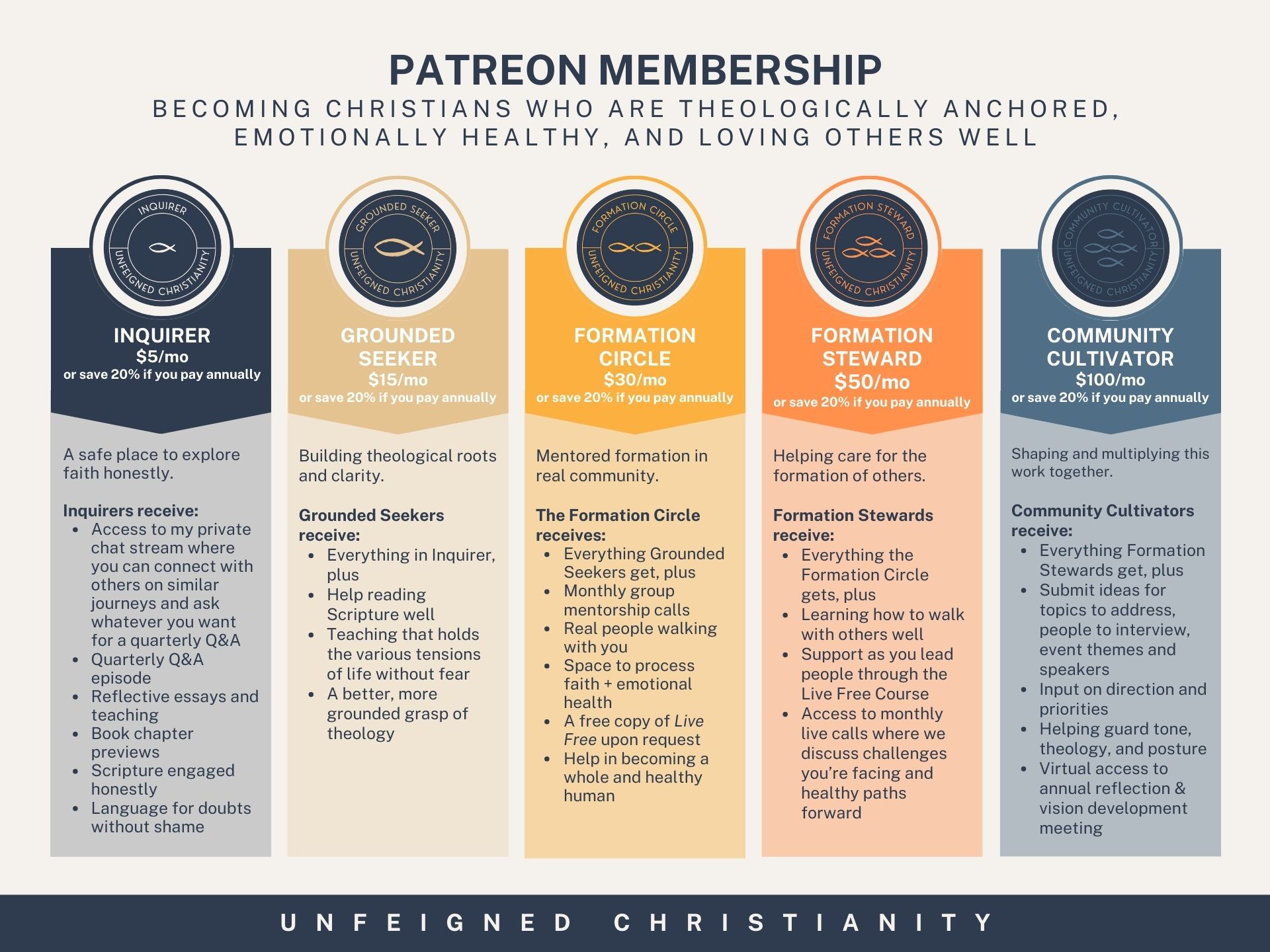
Learn more about the Unfeigned Christianity Membership program at asherwitmer.com/member.
[00:00:00] Speaker A: If. If she would say, okay, I think you must be thinking this or motivated by this on. On any topic, it would be a matter of.
Quite often she was completely believing something that wasn't true in the moment, and it was part of our history, so it made complete sense that that's how she would think.
But then being able to, when there was a point part of it that was true, it might have only been 5% of what her feeling was, was the motivator behind what I was saying or implying or thinking, but owning that, you know, babe, you're right. There was a component of this that is accurate, and I am so sorry for that. Owning that. Then when it was even only a small part of it, was the reestablishment of trust for her that when I said no, that wasn't in my heart, and I'm sorry that you felt that way.
Would you want to hear what actually was my motivator, what I was thinking?
Then she would be open to that. And I could, you know, not defend myself, but just say, this is. This is because two people will look at a traffic accident and come up with completely different ways of seeing it. And it's very true in marriage relationships as well. Your. Your motivation might be completely different from the motivation that she puts on you, but being able to own it when it's even remotely partly true, establish the trust that she knew that I was going to be a truth teller. One of the big things about unwanted behavior and addictions, if you will, is that just tell the truth faster.
You know, it's not a matter of, okay, once in a while you're going to screw up and say something that isn't accurate, but as soon as you know it, own it. And go back and say, I am so sorry. This is what happened here and I was wrong. I lied or I didn't represent it fully and just owning that. So trust is established from our perspective, was established slowly over a period of time.
[00:02:14] Speaker B: Hey, friends, before you listen, I wanted to let you know that the doors to the Live Free mentorship community are still open, but they close tonight. This is the five month gospel centered journey towards sexual wholeness that I've been telling you about. Walked alongside other people instead of alone. If you've been feeling the need to do some deep work to find sexual freedom so that you can look people in the eyes without having anything to hide, and that you're free to be able to fight for others and go and create goodness and beauty in the world around you, then I invite you to join Us Today, I'm about to share with you a conversation I had with my friend Bob Culp, who is also a part of this mentorship community. In this conversation, he shares his own journey towards sexual healing. It's not his theory, it's not a tidy before and after, but rather the transparent story of what it was like for him to move from managing a struggle toward healing that brought about true and genuine freedom. Today, Bob and his wife Laura help others walk that same journey. This is exactly the kind of story that this community is built for. Go ahead and take a listen and then come walk this with us.
All right, Bob, welcome to Unfeigned Christianity. Thanks for coming on.
[00:03:45] Speaker A: Oh, what an honor it is to be here. I sure enjoyed your work. Read your book about six months, four or five, six months ago, something like that, and said, you know, here's a guy that really is.
I think it'd be a delight to get to know. So I'm, I'm delighted to be on and also really honored that you asked me to come on and share. So appreciate that.
[00:04:06] Speaker B: Yeah, well, thank you.
Last fall, I guess it was December till it actually got going, but I started a live free mentorship community and Bob joined.
You've been a part of that. Sorry for. I'm talking for our listeners here.
And your insight is unique in the sense that you've had your own journey. And that's what I want to get into here, is just hearing your story. But you also bring a fatherly, dare I say, even grandfatherly approach to the time. So far, it's still a very small community and many of our mentorship calls have just been you and me and I record a brief lesson and then the design is for them to have discussion and conversation afterward.
But you just kind of share some of your insight from your own journey and your lessons. And I've come to appreciate you and the things that you share in that time. And I just kind of wanted to hear you bring a unique story in the sense that for me and a lot of the guys that I've worked with, we got into pornography and youth and then are trying to find healing and wholeness either before marriage or kind of as marriage and family is starting.
But as I understand your story, the pornography was active through years of family and marriage and intimacy. And you have found a level of freedom and healing.
And you and your wife together now are working with delight yout marriage.
And so basically today I'd love if you introduce yourself, give context for your origin story and then just, yeah, tell Us, the story, what happened and then how you have gotten to where you are now.
[00:06:12] Speaker A: Yeah, no, I appreciate that. Sure. Really, it's good to share in the hopes that someone gets a little bit of something out of it that may encourage them along the way. And you said grandfatherly. I appreciate that. I've got 17 grandkids, seven kids, so we are loving our grandparenting years. And I'm not old enough to be your grandpa, Asher, but certainly old enough to be your dad.
My oldest grandson is 17, 17 and a half. And my youngest is just turned 2 earlier this month. So that's kind of the spread for the 17 grandkids we have.
So, Asher, you and I grew up very similarly in the sense of. With. Our backgrounds are pretty close to the same.
In fact, you know, I knew your family and loved your family and had lots of good interactions with them. So, yeah, I don't know where to start the story. You could start the story with the earliest wounding and I don't think I'll go there because that would be way too much detail and too much from a background perspective. Although I've gotten a lot of help from going back and looking at those early things that shaped my story, starting when I was two and amping up when I was five or six. And then, you know, throughout my teenage years, acting out in ways that were. That were incredibly harmful not only to me, but also to others.
Wasn't actually, this is the, the 1980s, early 1980s, when I was a, you know, 12, 14 year old kid, didn't have access to porn, pornography like we do in these days. I mean, it's, it's so ubiquitous, it's all over the place at this point. For me, that wasn't the experience. It was more a matter of being sexualized way prior to my ability to understand, which is the common experience for a lot of people. They get, they get introduced in a way that is harmful, sinful, secretive, and there's no way, there's typically not a process to sort that out, just in the environment that you're in. Unless you go to a place of, okay, I need counseling, or there's some really dramatic thing that happens.
So I came to the Lord when I was 14, you know, said, jesus, take away my sins. And that was a beautiful moment. I remember walking out under the skies at our church and looking at the stars and seeing just the amazing beauty of it and feeling this great relief and this great, you know, just my heart was new and it was like, wow, this is really good. And then you know, time went along, a year, a couple of years and couldn't figure out most of the acting out. That was before I saw really any porn. Most of my acting out was in, was, was in, in person prior to that. And at that point stopped or essentially stopped because I'm like, okay, I'm a new creation. I'm good. And then along the way started dating my wife Laura when I was 17 and she was 19 and were a number of years where I lived a really a life of not acting out. I still didn't have integrity and wholeness and completeness. Didn't understand things that I do now, 41, 43 years later, I'm much more equipped to know what was happening back then. Back then I didn't have the process. I've just, okay, if I'm not messing up, if I'm not lusting in my mind, if I'm not, you know, being, doing things with, with people, I'm, I'm good, I'm, I'm at a place of, of completeness and, and that is a really good spot to be on one hand. On the other hand, it isn't fully integrating your story and the drivers behind what took me to porn.
So for my dating years, you know, no, no issues morally. And afterward for four or five years until my second daughter was born. And then it was six months of. No physical intimacy with Laura was required because of a medical thing that, that was, precluded her from doing that. And during that time I used that as a, as an excuse to, okay, I wonder what, you know, stumbled across a porn magazine and piece of property that I bought and I kind of secreted in a way and kept it, you know, from anybody really knowing about it, including Laura. And, and then as time went on the, with the advent in the early 90s when I was in my mid or late 20s, early 30s, and you'd have X rated videos on VHS would be available. So I'd start to kind of get into those and did that would hide them in crazy places. And along the way I made a lot of really poor choices with regards to that, but also with regards to, on occasion telling Laura. And I'm not suggesting that you shouldn't have openness with your wife. And I think openness with your wife would be best if you also couple it with something that gets to the root of what's happening rather than just what I did, unfortunately, was, was hurt her again and again and again and again over years. I would not confess every time I would be the guy who, you know, acted out for a couple of weeks or a month. And then I would say, you know, hey, Laura, I'm really struggling with this. And. And in. That was always kind of the implied thing of, if you were more available to me, then I wouldn't have to do this. And it was a disillusionment in my own mind because I thought that, well, when you get married, it's, you know, all the sex you need, and there's no need for it. But the truth of it is, if you have. If. For speaking for me, I had unprocessed emotions, unprocessed understanding of what was happening inside of me.
And what that looked like is I thought that more sex would fix a sex addiction. And I don't know that I was ever. I don't like using words like addicted just loosely, because I think that they can be helpful for some people and some people can find them as an identity. I've kind of gone between, you know, was it a.
An addiction and what level of addiction. None of that really matters to the conversation here. So I'm not going to dig into, you know, where I've landed on that, but got to the point where this was happening more and more. And, you know, and I would. I would reach out and in that time period, reached out to a pastor who. Who tried to give me the encouragement that he had in the moment. And that was just, don't do it. Well, that works about so long. Holding the beach ball under the water and just white knuckling it, or any amount of. Any number of different words that you want to use for that. But that beach ball would always pop back up and it would be like, okay, now I hate myself. I don't know why I'm doing this. I'm a believer in Jesus. I remember that night, walking out, seeing the beauty of the stars. This doesn't make sense.
And just recommitting to doing it better and saying, I'm not good enough because I haven't figured this out, and praying more and beating myself up literally, which is exactly, in retrospect, exactly where the devil wanted me. He wanted me looking at myself as the failure. And rather than looking to God's abundant grace and his healing.
And, you know, healing happens in so many different ways. I was recently just looking at the scriptural thing.
And if I were to ask you, Asher, how many way, how do you heal blindness? Well, Jesus healed blindness six different ways, and each time it was different. So healing looks different for everybody because we're made different for me, I can tell you my story, and maybe if there's something there that is of importance or that is salient to where you or your listeners are at, we can dig into that and I'm prepared to keep on going. On the other hand, I can also filibuster. So I'm willing to let you ask me a question if you have anything clarifying to this point.
[00:14:42] Speaker B: Yeah, no. Thanks for. Thanks for sharing that context in the background, too.
The temptation.
A couple things. First of all, the idea that marriage would solve a lust problem or a sexual drive that you struggle to control.
I think that's.
Maybe it's getting better popularized that that's a fallacy. But there's. There's a lot of young men who do enter into marriage to fix whatever unwanted sexual feelings and behaviors they're wrestling with in their singleness, and then coupling that with the pressure that you gave to your wife if she was more available.
Maybe explore that a little bit. Like what you mentioned, regretting sharing openly with your wife.
How would.
If you're talking to somebody who's married and struggling with porn right now, how would you see the process based from your own story and what you've learn, like how should they share with their spouse and what should be done?
[00:16:16] Speaker A: Yeah, that's a really good question. And again, there's six ways to heal blind people. There's probably a million ways that this can. That this could work out. But what I would recommend and what I recommend to guys that are in the groups of men that I lead is to not overburden their wife with the details, but to find accountability is one part of it. Having a group of guys or a person that you can call up in the middle of the night if you care to. I never did that. I had people who offered that, and it's just really an uncomfortable thing to be doing that. And the truth of it is, I was never curious enough in those moments.
It seemed like I was already within that ritual of working out what I was being tempted by and what I was going to engage in that I didn't do that in the moment.
What I think is important is to actually get some resources around you. You have certainly the resources you have. There are others as well that really can explore with a gentle curiosity what's going on in the mind of a person as they're wanting to do this, and then finding a place that's safe to be able to share and to be able to heal, not just in a don't do this kind of way, but in A way of, of, okay, I want to know what's actually happening, what's driving me to this, why I can't figure this out when the rest of my life is so in order and is so, you know, methodical and regimented. And that was me. I was a. But I didn't have control of that area in my life. And then what I think most wives want is to know that their husband is in a safe place and is being helped and is actually working toward healing rather than an on, off. Watched porn. Didn't watch porn.
More of a. Okay, what's. What's driving you to this? And an exploration of that. So.
And every marriage is different as well. There's. There's. It could be that some women want to know everything about the man. And I'm also aware that porn goes both ways, but oftentimes, since we're talking, since you and I are guys, I'm going to keep it in the, in the men context.
[00:18:33] Speaker B: Yeah.
[00:18:34] Speaker A: But having, having the assurance that there's, that there's something that's happening and working toward healing rather than just a. And especially again, the unfortunate dumping on. Of, Of Laura. And if you were more available, my wife, if you were more available here, this would be not a problem for me. That was that I, I, when I, when I stop and consider that I am so grieved by my actions in doing that again and again over decades. And I've had many opportunities to. Every time it comes up in circle of friends that we are or people groups that we do, I have opportunity again and again to just say to Laura, I am so sorry that that was our experience.
And it grieves me to the core that I put pressure on her. And unfortunately, in typical Christian literature and even in counseling, that message was not only shared on the men's side of this is on guys growing up side of that. You know, when you get married, this is all going to be done. But it was also on the lady's side of that. If they're not providing whatever, then the husband will fail and will stumble. And there is accuracy to the fact that the closer your relationship is with your wife, the less of a chance there is that that happens. But Laura took on way too much responsibility because of my pressure for her to be there and available for me. And, you know, that is just completely unhealthy. So in any case, that's. I don't know if that answered your question directly, but there's.
[00:20:27] Speaker B: Yeah. Yeah, it does. I, I can definitely resonate and have seen The. I mean, even. Even when it comes to accountability groups, they can kind of become this thing of dumping out. Oh, I struggle.
But there's not the structure or even the know how around it to. To explore, okay, why. Why is this continuing?
And that can become actually a roadblock to healing and wholeness either. Either because you're not really getting anywhere, or eventually, guys. I walked with a number of guys who eventually just started being dishonest because they were tired of. Of constantly telling their. Yeah, so tell us. Tell us how that then the journey of.
You had the years of pressuring Laura in this way, the years of struggling. What was the journey then to finding your healing? And then, oh, I'd love to hear kind of how that process, because I'm
[00:21:36] Speaker A: sure
[00:21:39] Speaker B: there was a lot of hurt and trust broken between the two of you. And what did it look like to find healing in that?
[00:21:46] Speaker A: Yeah, a great question. And unfortunately, my journey didn't end with just corn use. I also bought sex, massage parlors, escorts, that type of thing when I was out of town. So I moved over the flesh line. And when I did that, the first time was almost 20 years ago now.
And I recall a conversation where I was trying to bring up with. With Laura a, you know, talking about our sex life because we always thought about that. I wanted. I wanted more, she wanted less. And that was just really where we were for. For the first two decades of our. Of our marriage, at least. And so, you know, she said, no, I'm not. I don't want to talk about this. This is your problem. You figure it out.
And in that.
In that time period, I basically said, okay, I am. So I didn't know who I was. I didn't know what I needed.
And I crossed the flesh line for the first time. And I did that, you know, a dozen times, more or less over.
I'm going to say two dozen over the next ten years or so where I was just not every time I turned around. And of course, then there was the whole struggle of, okay, I was good this time. I didn't actually, you know, masturbate. I didn't actually do this or that or the other thing. But there was my. My heart was.
My heart wanted freedom and it had no clue how to get there. I just assumed that this was how I would have to live for the rest of my life. And I would actually even tell Laura along the way that, you know, I did this and she would be so gracious and forgiving.
And yet we didn't have any tools to take it from there to finding out where we were.
About six or eight years after that conversation, she finally said, okay, I've got to get counseling. I've got to share that she has to get counseling because she has to figure out how to work with me.
So she was in counseling for a year or two prior to.
Prior to her finally deciding that it was time for her to set a boundary.
And I don't know how that first boundary came out, but she basically said, bob, you need to be in counseling with me and outside of me. And so I grudgingly did it.
And the first counselor we had was a young man that probably didn't have just a ton of experience in this arena, in this field. And I didn't get any help from him at all. Basically, he annoyed me because how can a kid that's, you know, in his 20s know anything about anything for a guy who's in his late 40s, early 50s? That doesn't make any sense.
So along the way, we decided that we needed a counselor that. That, as I put it, had gray hair.
And so we got a guy with. That's a couple of years older than me that we still, in retrospect, he's not in the area anymore, but we still just honor and applaud him for his ability to kind of see through and cut through some of the.
Some of the lies and the junk that was in my head and helped me to forge better paths ahead.
And what that looked like was we got into that. That with that gentleman for counseling. And for about six months, I was. I was clean. I hadn't acted out, hadn't done anything. Hadn't really gotten the gentle curiosity of exactly all of what's going underneath the surface. But at least I was starting to understand brain neural pathways and having different approaches to things and getting a little bit curious.
Then I had an epic fail where I went out of town and once again, really dropped the ball. And I came home so full of remorse, I basically said, I do not know what's happening. I need to fix this. I need to figure it out. Told Laura about it the morning after I came home.
This is nine years ago now. And she said, well, she said the divorce has never been on the table for me before. And it is at this point, because she had just simply had enough.
And that shook me to the core. So we went back to the counselor. I don't remember. This might have actually happened prior to that. No, it didn't. It happened after the. Stefan, the counselor, and I was sitting on the couch next to Laura. And the counselor said, I want you to feel her pain. And so in my head, I acknowledged that I had caused her pain, that I had caused her wounding.
And I said, well, I can see that. He says, no, he says, you're not feeling.
And I sat there just really frustrated because, yes, I can acknowledge the pain. And.
And he kept pressing in, as I had told him in the subsequent meetings, that he was like the Nathan to my David, with his bony finger in my chest, saying, get this figured out. And that's what I needed in that moment. He said, no, you're not feeling this. And in that moment, I just prayed, lord, help me to feel what this amazing woman that I'm sitting beside has been feeling.
And it seemed like it was an overwhelming. God just helped me to actually see and sense. And I cried and wept in that moment like I hadn't before for her and for the hurt that I caused.
And that was really the first piece of my coming clean and then subsequent healing was feeling the depth of pain that I caused her.
And I think that's one of the reasons why now, as Laura and I are working with people, I have an acute sense of awareness of what the betrayed partner might be feeling in these moments and also why.
Why I think it's wise to.
To not burden your wife with that on an ongoing basis, but to say, okay, I am getting help. Here's what's happening. Here's what I'm figuring out that I'm needing in this moment rather than what I would often do and Laura's comment about this in the last week or two, what I would often do is confess what I did.
I would feel better.
And also in that moment, my conscience was clear. So I would, you know, because, okay, now I've done what I needed to do.
I would feel better, she would feel worse because now she's bearing this burden. But she said, bob, you always got so nice for a couple of weeks after you confess.
So there was kind of this drawing back. It wasn't. It wasn't manipulation. That was cognitive on my part to be nicer. It was just. I had a more free spirit because I had confess I hadn't gotten to the bottom of it, but I confess.
And that turned me into an even nicer. I'm a fairly nice guy, Laura, with status as well.
As a rule, never have raised my voice in our conversations or with my kids. It's just not how I grew up. It's not how my nature is.
But I would double down on the niceness so that would be attractive to her, to draw her back. So there's a part of her that would say, you know, hey, I don't mind if he confesses, because he'll be nice a couple of months, a couple of weeks, whatever, afterward.
So we danced that dance for way too many years. And then finally, with the counselor, got to a point of. And Laura's boundary is the wisest part of this. That was incredibly painful when it happened. I mean, she said divorce, and she said no sex for 90 days.
And I. I literally did not think I could exist without physical sexual intimacy.
And it was like I. In fact, it was the only time that I've ever been angry enough. I kicked a stainless steel garbage can so hard. It's still dented to this day because of that. And now I look back at that as the wisest, smartest thing that Laura could ever do was to say, stop.
We have to figure this out. You have to heal.
So you look like you've got a half a dozen directions. You want to take this call, and
[00:30:24] Speaker B: I'll let you do that.
Yeah, I mean, you've shared that before, and I've often thought about it, because I think there are a lot of spouses, wives in particular, who live and suffer quietly while their husband is into pornography. And. And just the role of that boundary being there.
I don't. I don't know if it means much, if there's not weight behind it. Like, you guys had been married, what, 40 years at that point?
[00:31:03] Speaker A: No, that would have been about 30. 30, 32 years. But, yeah, we're 41 years coming up in June, so. So now.
[00:31:10] Speaker B: Okay, okay, so 30. 30 year. Over 30 years. So obviously, this isn't being thrown around flippantly like you're five to 10 years into your marriage and something's not going the way you want it to. And I'm not trying to say if. If someone's been living with a spouse struggling with porn for five to ten years, like, that's. That's a big enough issue.
But the fact that your sin and your struggle was continuing, and she decided that was reason enough.
And, I mean, I would see in Scripture that that is reason enough to leave a marriage and to have that. Yeah. Kind of process with me. How did that.
What did it do? You said it was very painful, very hard, and yet you're calling it the wisest thing.
What kept you from just responding out of panic to try to please Laura as opposed to. Okay, getting serious about getting to the bottom of it?
[00:32:24] Speaker A: Well, you know, I think that there's so many different things that. That ultimately can be the gateway into healing for men. And none of them, I think, operate in a silo exclusively by themselves. For me, certainly the panic of. I mean, the last time I acted up and just prior to her setting the boundary, I said, I want to figure it out for me. So there was certainly an internal motivator there. And there was also a good degree of, you know, hey, my marriage is going to be over. I mean, at that point I was. Owned a roofing business, had, you know, a lot of people that were. That were depending on me for employment. They would be shattered, my family would be ruined. I was in the. In the state government. And that would have been not an unlikely scandal because that kind of thing happened all the time with public officials. Have a really tough life. And there's a lot of. It's a grinder for marriages. But I didn't want that to be on me because, you know, for instance, when I got into the state assembly, I remember as I was running, they asked me what's most important to me and I literally opened my mouth. Did not pre think the words, but out of my mouth came most important thing in my life is that I'm glorifying Jesus Christ. And that was in the middle of living in a life that was chaotic and, and did not have it all together. So I don't want to discount the fact that, you know, by any means that you can. You can have a true heart that wants to love and serve God and still not know how to. How to get out of this. That was certainly my experience.
But having that kind of a public image and then have that be, you know, completely devastated, I just. There was a panic. It's absolutely. I don't want to be divorced. I don't want this to happen. And, you know, not even thinking about all the assets and the splitting and how does all that work was certainly a panic and it was an internal driver. I think that if you have only the panic without the internal driver, you probably won't get to a point where you are on an ongoing path of healing, which is, I think the case for most every human being is that they're growing and maturing until the day they die. That would be my hope for myself.
So, yeah, it's not a bad motivator to be under panic. And it's not the complete story. I think that you need to really want that. I needed to want it for myself. Just speaking of myself.
[00:34:58] Speaker B: Yeah, yeah.
How did so you.
That Got you to seek healing and trying to remember. Is that when you started with the counselor, the older gentleman, or had you started before then?
[00:35:18] Speaker A: We had started before actually, a couple of months before that.
Actually, I don't know the exact timeframe, but I think I basically quit watching porn when we started with that counselor. And then I had the epic fail six months later. That kind of put me back into his office where I'm like, okay, I thought I had this dialed in. I was six months clean. That's probably as long a period as I've ever had. And now this happened. Okay, what's going on here?
[00:35:49] Speaker B: Yeah, yeah. So what was that journey like? Then she said, no sex for 90 days.
If this doesn't stop, divorce is an option.
What was that journey like?
Rebuilding trust and even her being physically and emotionally okay with having sex again?
[00:36:16] Speaker A: Yeah, it was a matter of right away. I got a workbook from Faithful and True at that point was out of Minneapolis era.
And here I am, not plugging someone else. Asher, you've got some good stuff, but you weren't in this business then yet.
[00:36:32] Speaker B: So no, plug whoever you want worked through that workbook.
[00:36:36] Speaker A: And it was a really good exercise of digging in and, okay, what am I looking for? What am I thirsty for?
What is my heart longing for in this moment? And starting to open the door to gentle curiosity about what's happening rather than immediate condemnation and listing out the rituals of what, you know, what led me to the act of acting out. So I went through that workbook and did extensive journaling to just kind of, okay, what's happening? What's going on? And I read some of those journals a year or two ago, and it was like, wow, you know, my heart was in a good spot. And I, and I had some really raw feelings and thoughts during those times. So the, the story does include the fact that after 30 days, I was changed enough that Laura basically said, okay, let's reignite here.
And so it was only 30 days of no intimacy rather than 90. And in retrospect, Laura and I both think it probably would have been better to have a 90 day reset than the 30.
I didn't know how to live without that. And so I became, in that 30 days, attracted enough to her because I was doing the work, because I was doing the. The digging in, that it was.
It seemed natural and good to us at that point to get back together.
And then from there, you know, my, my passion for. For understanding what happened just continued. We kind of, you know, kept on with the counselor for a Year or so, every month or so just to. But at that point it was mostly about ironing out the little conflicts that we had always had about household things, not about, you know, about the way we relate.
And one of the really big changes was a couple of years later, about four years after I came clean, she, Laura said, you know, I just really am not into physical intimacy twice a week. That had been kind of our pattern.
And she said, I've got to go to once a week because I haven't completely healed and figured out who I am and where I am.
And that shook me to the core because I'm like, not so much that I needed the twice a week release, but just the fact that it seemed like she was slipping away from me and becoming less and less interesting.
So at that point, you mentioned delight your marriage earlier. I signed up with a course with delight your marriage and got into that and really started to understand what love looked like with Laura at that point. You know, again, clean for four or five years and enjoying that. But I liken it to being the story that Jesus tells of the seven demons who were in the house and they were cast out and the house was swept and garnished, but nothing filled it. And they came back in and were worse than they were at the beginning. And that was what I didn't have the worst than they were at the beginning. I had the house that was empty, swept and garnished, but not really knowing what it looked like to love the amazingly awesome daughter of God that I was entrusted and had committed to. So that was really when over the course of the next couple of years, as I continued to do that work and also, you know, took some leadership positions at, at that organization that I.
That we really. That the healing has continued. And you know, and at this point, Laura and my relationship is, is stronger than it's ever been. It is more deep than it's ever been. We communicate on all levels with calmness and patience. And again, so that that's kind of the.
The end truncated into a short, into a short statement, but it's.
And as I'm going along, I've been doing a lot of some ongoing training with regards to leading groups that are specifically designed for guys that are, that are. That are struggling with unwanted behaviors and also just have a lot of opportunities to reach out in that way with people that are in the groups that I'm in that are more focused on loving their wife rather than being free from something. It's more the free for rather than the free from which is good.
But. Yeah, that's. Anyway, that was kind of a ramble, that last little bit. I thought it was pretty succinct until right now. Then I rambled.
[00:41:28] Speaker B: No, it's good. I love hearing all of it. The ramble, the story, how. What has your. So, I mean, you guys start having intimacy again within 30 days, but that I'm sure there were times along the way where. Well, even you mentioned the. You know, when she wanted to go back to once a week instead of twice a week.
How do you. Or what would you say to a husband who is making tremendous strides and at a place personally where he's never been before, but the wife is still needing time and still needing space to whether that's rebuilding trust even.
Because one of the things that, for me, it's been important to be aware of is how things that, like we as husbands in this case are live out of our story and all sinful behaviors come out as an acting out of whatever wounding story and that we have from early childhood.
And it's easy to kind of think that that's, you know, that's my story and I need to stop this behavior and so forth, and not be aware of the way us hurting our spouses is essentially like they have their story as well, and the hurt is once again putting the finger in that wound from their own journey, childhood. And so they're on their own journey and need the space and the time to process that as well. Yeah. What would you say to husbands who are feeling.
Like there's a level of impatience rising up with somehow their wives should.
Should be adapting faster to their change?
[00:43:44] Speaker A: Yeah, Incredibly good question. And I could probably go five different ways with this, so I'll just try one or two.
One of the ways would be that one of the things that I had for a majority of the first 30 years was an entitlement mentality. I'm entitled to this. I deserve it. The Bible says you need to do it if you want to. I mean, I never said that just explicitly and, and directly. And that was what my mindset said, is that, you know, this is why God designed marriage, so men could. So I could, you know, not struggle. But that wasn't even the question. So it was a matter of changing my mind to actually honor her no.
And to let her know that, you know, your no is your no, and you have autonomy and authority over your own body. And yes, the Bible says that we're not our own. And there is a. An aspect to that. But if you take that to the extreme. That means that you have to do everything I say you do right now and no matter what. So getting, taking, taking that entitlement mentality and allowing her to have her no be, no allowed then for yes to be more emphatically her yes, because she got to choose. So. So a change of heart from my perspective. The other, the other thing is what I see a lot in, in the guys that come into the program that I'm involved with is a wanting to change their wives, wanting to a. Either speed up healing or have them enjoy sexual intimacy for themselves rather than just for. There's so many ways that I, over the years, tried to change my wife to make her different than she was. And Laura would tell you that it's when I. When she sensed in me a celebrating of who she was in every one of her little quirks, as she puts it, and quoting her, not me, because I don't think she's quirky. I think she's the most amazing woman to ever walk the plant it.
And just yesterday I said, if there's 3 billion women walking by me, you're the one that I would pick out. And that. And she feels that it's not just words, it's. She feels that from the core of who I am.
And you know, the things that used to annoy me about her, I started to accept. And once I accepted them, then I'm like, okay, now wait a minute. There's another step here that needs to happen.
I wonder if I can celebrate that. I wonder if I can adore that. I wonder if I can really applaud that and be in support of that. And I've had so many little things that over the years caused me friction, caused us friction that annoyed me.
Accept, move beyond, applaud, adore, just cherish, celebrate those things that make her uniquely her.
Giving her a safe space, not being entitled, not being manipulative, letting my no be no, my yes be yes. The wounding from the past has taken a lot longer to heal because, you know, Laura is.
People are deeply wounded. And so the thing of just owning if, if she would say, okay, I think you must be thinking this or motivated by this on, on any topic, it would be a matter of.
Quite often she was completely believing something that wasn't true in the moment and it was part of our history, so it made complete sense that that's how she would think.
But then being able to. When there was a part of it that was true, it might have only been 5% of what her feeling was, was the Motivator behind what I was saying or implying or thinking, but owning that, you know, babe, you're right. There was a component of this that is accurate, and I am so sorry for that. Owning that. Then when it was even only a small part of it was the re. Establishment of trust for her that when I said no, that wasn't in my heart, and I'm sorry that you felt that way. Would you want to hear what actually was my motivator, what I was thinking then she would be open to that. And I could, you know, not defend myself, but just say, this is. This is because two people will look at a traffic accident and come up with completely different ways of seeing it. And it's very true in marriage relationships as well.
Your motivation might be completely different from the motivation that she puts on you, but being able to own it when it's even remotely partly true established the trust that she knew that I was going to be a truth teller. One of the big things about unwanted behavior and addictions, if you will, is that just tell the truth faster.
You know, it's not a matter of, okay, once in a while you're going to screw up and say something that isn't accurate, but as soon as you know it, own it and go back and say, I am so sorry this is what happened here and I was wrong. I lied or I didn't represent it fully and just owning that. So trust is established from our perspective, was established slowly over a period of time.
Laura, pretty much after I got clean, said, okay, I'm done working on the relationship in an active way for how she got into a business. She read business books, enjoyed that, and just really had it in time of personal growth, but outside of relational growth and really only in the last year or so, after a long track record of being free for the work that God put me to and, and, and seeing my interactive interaction and involvement with the groups of guys I'm with, she started to get curious and say, man, I really, I really want to do something with women who have been betrayed and I want to start putting back into their life. So in the last year now, she's been on a real growth track of, of reading books about how to help people through betrayal. And in doing that, this is to your point of what does healing and regaining trust look like? It hasn't been without its times of a little bit of bumpiness because of, you know, she's actually now, nine years after the fact, processing some of the things that might have been helpful for her to process and walk through, through nine years ago rather than now. That is what, what that's doing is actually deepening our relationship in the current moment. And it's not without its, its, its challenges because it means that I have to continue to stay really connected to Jesus so that there's humility, so that there's grace, so that there's leaning in and loving rather than, you know, goodness. You should have worked through this years ago kind of thing, which has never even crossed my mind because she's, she's an amazing woman and she has her own beautiful story. And seeing how now starting to develop is just I sit here open mouth at how amazed I am at her and her walk and what she's done.
[00:51:48] Speaker B: Yeah, yeah, yeah. That's beautiful. Thanks for sharing, giving us this overview at least of the what the journey has looked like and even the hope for couples who find themselves dealing with this years into marriage, years into life, that it is possible to be changed in a way that is healthier in pursuing healing. Yeah. So you guys are involved in delight your marriage now together, am I right? You're both doing that so people can find that just delightyourmarriage.com is that looking it up now? Yeah, I'll drop a link in the description here. Yeah. Well, thanks for sharing your testimony and I'd love to hear anybody listening to this. Maybe there's questions that people have as you're listening to Bob and thinking of your own story or people you're walking with. Feel free to either drop them in the comments or shoot me an email and we may be able to have the time to do more Q and A or explore things further. But thanks, thanks for taking the time here today.
What Stood Out To You?
If you're walking this road yourself, or walking it beside someone you love, what is one true thing you've been slow to say out loud? You can share in the 0 Comments below.
Join Unfeigned Christianity on Patreon and Take Your Journey to the Next Level.
Become a paying member of Unfeigned Christianity for as little as $5/mo and access article, our community chat stream, and quarterly Q&A episodes.
Already a member? Login