
Two months into our marriage, Teresa felt strongly about something.
I don't remember what it was anymore. What I remember is the thought that surfaced while she talked: Is she a controlling woman?
We'd been married eight weeks.
I look back on that now and almost can't believe it. Because Teresa is not, by any honest measure, a controlling person. If anything, I've learned I have to draw her out. She's quick to comply, quick to read what people seem to need and give it to them, slower to be free with her own thoughts. Some of that, I'm sure, was my temperament in those early days. But there I was, two months in, more concerned about whether my wife was controlling than whether I was understanding her well and living with her in a way that honored her.
That moment is a small thing. But it's a faithful little window into the world I came from. And it's where the story of how I almost became an egalitarian actually starts.
Don't Have Time to Read? Here's the Gist:
I grew up in a hard complementarian, conservative Anabaptist world where women never preached, never led, never sat on a leadership team–they never even had as much as a devotional. Then I went to Bible college, started in Genesis, and ran straight into a view of women in Scripture I had never been shown. By the summer of 2018 I told Teresa I was "all but egalitarian." She's the one who slowed me down, not by pulling me back toward where I'd been, but by pointing out that flipping the hierarchy isn't the same as healing it. I'm still not fully sure where I land. So I'm working through Preston Sprinkle's From Genesis to Junia in public, and inviting you along.
The World I Started In
I grew up in a fairly strong complementarian, conservative Anabaptist environment. I would have told you, back then, that men and women are equal in value and purpose. And I'd have meant it. But underneath that there was a clear, fixed separation of roles, in the home and in the church both.
I'm going to keep most of this focused on roles in church, ministry, and leadership. It's hard to keep that fully separate from roles in the home, so we'll wander into the home now and then. But Preston's book is about women in ministry, so that's where I want to camp.
So, as it pertains to men and women's roles in the church, here's what set the tone in the world I grew up in. Men lead in the church. That's not for women. A woman could teach other women, but not men. So women taught Sunday school classes. They never preached. I never once saw a woman lead worship or share a devotional. I saw women assist the worship leader, sure. But I never saw a woman on a leadership team, neither as a pastor nor as an elder or deacon. If I ever did see a woman speak from the front, she was either speaking to other women, or she was up there with her husband, the two of them sharing their testimony together.
Somewhere in that same stretch, the book Love and Respect made its way through our circles. The piece of it that got lived out, in my experience, was the part about women respecting their husbands. How much men need respect. I don't think that's a fair summary of everything Emerson Eggerichs is trying to say, and I've got my own concerns about that book and its theology, which I've written about elsewhere. But I always struggled, because the way it got absorbed in our community didn't seem to match even what the book was trying to teach.
It got absorbed fast, though. And I think it's because it leans hard into an anti-feminist posture. It leans into the idea that the culture is out to emasculate men. And here's the thing. There is an element of truth in that. But I'd love for us to step back and ask why. Why do feminists want out from under male dominance? Probably because a male dominance hasn't been healthy. Because there have been real problems with men that need addressing. So instead of just firing a reaction back the other way and calling ourselves anti-feminist, what if we put our energy into becoming men worth respecting? Men who actually labor alongside our sisters. Men who actually protect.
And mixed into all of it is something that still bothers me. We have churches that are firmly against women in any kind of leadership, who will turn around and quietly restore a man to leadership after he's fallen, sometimes a man who's been abusive. We'll let him lead worship again, teach again, speak again. Hard against women. Soft on that. It's inconsistent at best.
That's the air I was breathing.
Related Articles
What I Couldn't See in My Own Marriage
It took me longer than it should have to notice what was happening at home.
Early in our marriage, I started to see a pattern. When Teresa thought I was making a bad call, or handling something poorly, she'd hold her tongue. And then it would come out later. In frustration. In a comment that didn't feel respectful. In a snap.
For a while I read that as a respect problem. But the more it happened, the more I realized something that surprised me. I actually felt more respected when she engaged me earlier, even when engaging earlier meant conflict. When she'd say, straight, "No, I don't think we should do this," I'd feel something like gratitude.
Part of that is just how I'm wired. I'm strongly opinionated. But the thing people sometimes miss about me is that I'm very willing to change my mind. Convince me. Engage me. Show me where I'm wrong. Just don't belittle me to get there. Actually walk me through what you're thinking and why it might be better than what I've got. I have deep respect for people who can do that. And learning to receive it, to be an approachable man instead of a defensive one, has been its own long lesson.
Where I stand today, I have enormous respect for Teresa's courage in being willing to be vulnerable with me. Because I didn't always respond well to it. My controlling-woman thought, two months in, kind of foreshadowed that.
And it exposed something in the whole respect framework I'd absorbed. Buried in it is this meta-narrative that you have to approach a man a certain careful way so that he feels respected. But that often comes off passive aggressive. Flowery, sure. But honestly, it can start to feel like a soft form of manipulating your husband into changing his mind. I so much prefer Teresa shoot straight with me than present me one thing while she's feeling another behind it. Straight talk feels like more respect to me, not less.
Learning to Actually Handle the Word
For a season I was teaching school overseas, and I started feeling the need for more training. The question was what kind. Did I need more training as a teacher? Or did I need to study Bible and theology? That's its own story. The short version is I came to realize I'm called to teach Scripture, whether that's through my writing, in a Bible college classroom, in home studies, or preaching in churches. I didn't know the shape of it yet. I just knew the call.
One thing my conservative Anabaptist background did give me was a high regard for God's Word. I wanted to study Scripture well. After all, we talk all the time about "rightly handling the word of God." But here's what nagged at me. We didn't actually spend much energy or money learning how. We did not seem to value establishing a proper theological foundation and providing careful articulation. Instead, we would work full-time, hard, and then slap a message together on a Saturday and stand up a little apologetic about it. I started to wonder whether we really believed Scripture was as important as we said, because if we did, wouldn't we invest in learning to handle it well? Wouldn't reverence for the Word show up as a willingness to learn?
So I chose Bible college. There wasn't much debate about where. Teresa and I had run into Eternity Bible College in Southern California even before I started teaching, and a few things stood out.
One, they're committed to robust theological training at a low cost. So many people come out of a Bible degree buried in debt, and the debt limits what they can do with the degree afterward. Eternity didn't want to price Christians out of training.
Two, they tie study tightly to practice. You're required to be involved in a local church and serving in some form of ministry while you study. There's no on-campus dorm life pulling you off into a heady bubble. Study and practice. Study and practice.
Three, they approach the Bible through biblical theology rather than leading with systematic theology. Biblical theology works to understand the story arc of Scripture, what the authors, and God through them, are actually trying to reveal. It stays close to the text. It spends its time on the questions the biblical authors were answering, instead of mostly importing our questions and hunting for answers. I'm not against systematic theology. Done through the lens of biblical theology, it's an equally important process because plenty of the questions we face today aren't addressed in Scripture directly. But I really believe it is important to learn to do good biblical theology first.
Because of that, we moved back to the States from overseas, and I started in Bible college. And, staying true to that approach, we started in Genesis.
It did not take long.
A View of Women I Had Never Seen
Within the first semester, I started to realize that the Bible holds a view of women significantly different from the one I'd grown up with.
You can't get far into Genesis before you hit it. Male and female, both created in the image of God. In the image of God he created them. And the two of them are commissioned to care for creation together, as a unified partnership. I had never really heard that taught explicitly. I knew, generally, that humans are made in God's image. But the stated maleness and femaleness of that image, the way the text weights both as reflecting Him, that was new.
The closest we ever came was admitting that God carries attributes we'd call both masculine and feminine. But even that made people nervous. When The Shack portrayed God as a woman, the reaction in my circles was that it was awful. Heretical. I'm not here to defend or attack that book. I just want to point out the reflex underneath the reaction, this deep flinch at the idea that femaleness might carry any divine expression at all.
Then there was the emotions piece. One of the reasons I'd often heard for why women shouldn't lead is that they're too emotional, too quick to react out of feeling. But the deeper I got into Scripture, especially the Old Testament, the more I saw God Himself feeling things deeply. Responding out of emotion. Responding to Israel's emotion. A cognitive dissonance started building in me. How can we hold such a critical, negative view of emotions, and of women, when the Word of God itself reads more like a level playing field?
Alongside the Bible, we were studying world history and church history. And I learned that we have women to thank for much of the rise of Christianity in the early church. There's a great book on this, The Rise of Christianity by Rodney Stark. Women played an enormous role. And that maps cleanly onto what we see in the text. Not only do we meet prophetesses and deaconesses, we meet Phoebe, who carries Paul's letter. There's debate about how much authority a letter carrier held, but it's generally accepted that the carrier likely read and presented the letter to the gathered church. Picture that. A woman standing up to deliver the message for the day. That alone reframed what I thought was even possible for a woman in the life of a church.
And remember, I didn't come from a soft complementarian world where some of that happened. I came from a hard one where almost none of it did.
It kept going. Back in the Old Testament, Rahab. Deborah, a judge over Israel. Women who played decisive roles in Israel's redemption and their story with God. And not as cautionary tales. As the godly examples, often standing faithful right when the men weren't. There's complexity there. Those accounts function as a rebuke to men, yes. They challenge to us to actually be righteous and not be the compromised ones. But they also validate women. Both things are true.
What struck me through all of it was simple and a little unsettling. Here was a whole world in Scripture I had never been shown. And we're the ones who say we revere the Word and want to handle it rightly.
"All But Egalitarian"
The summer of 2018, Teresa and I were on a road trip, and I was thinking out loud with her about all of this. I remember saying something close to: I'm all but egalitarian at this point. I couldn't see how you could hold a view of women that prohibits them from functioning in the church when Scripture so plainly uses them and affirms them.
I felt pretty far down the road.

What Teresa Helped Me See
And then Teresa started asking questions of her own.
She raised concerns, including concerns she'd heard from other women, and it slowly dawned on me that she was not necessarily jumping up and down at my newfound position. She wasn't chomping at the bit to become egalitarian.
Her pushback was sharper than I expected, and it was good for me. The way she put it, more or less, was that in some of her observations egalitarians can end up adopting the very same hierarchy they're reacting against. They just flip it, and argue that women should get to be part of it. When she said it, I could see it. I'd been reading and listening to a number of women authors and Bible scholars, and some of them she'd encountered too and just wasn't all that taken with.
Now, I don't want to paint Teresa as a hardened complementarian. She isn't. She's frustrated by the ways women get boxed into homemaking and little else–babies, cleaning, cooking. She's a mother of six. She feels deeply called to motherhood and she loves our kids. But the idea that that's the whole essence of femininity has always chafed her. Women want purpose. Women want a real role in the church too. She resonates, hard, with the frustration of being sidelined, if not silenced. She just wasn't convinced that swinging all the way to egalitarianism was the right answer.
So my conversion slowed. And I kept going, through Bible college, through study, through watching how things actually played out. I never settled cleanly on either side. I still haven't. I've got frustrations with both, and I think I've earned the right to a few of them honestly.
Why I'm Reviewing From Genesis to Junia
This whole question has become a popular one to argue about over the last decade. Somewhere in there, I learned Preston Sprinkle was taking it on with a book.
I'd followed Preston for a while and read a number of his books, and what I appreciate is his willingness to go where the text leads, even when that means changing his mind or doing something uncomfortable. So I was glad to see him wade into this. I haven't studied it nearly as deeply as he has. But it's a topic I keep turning over, reading on when I can, paying attention to what Scripture actually says. The book's been out a few months now. I've read some reviews of it, heard Preston respond to critiques. And I want to take my time walking through it myself, in light of my own journey and the long conversation Teresa and I are still having. We're working through it together.
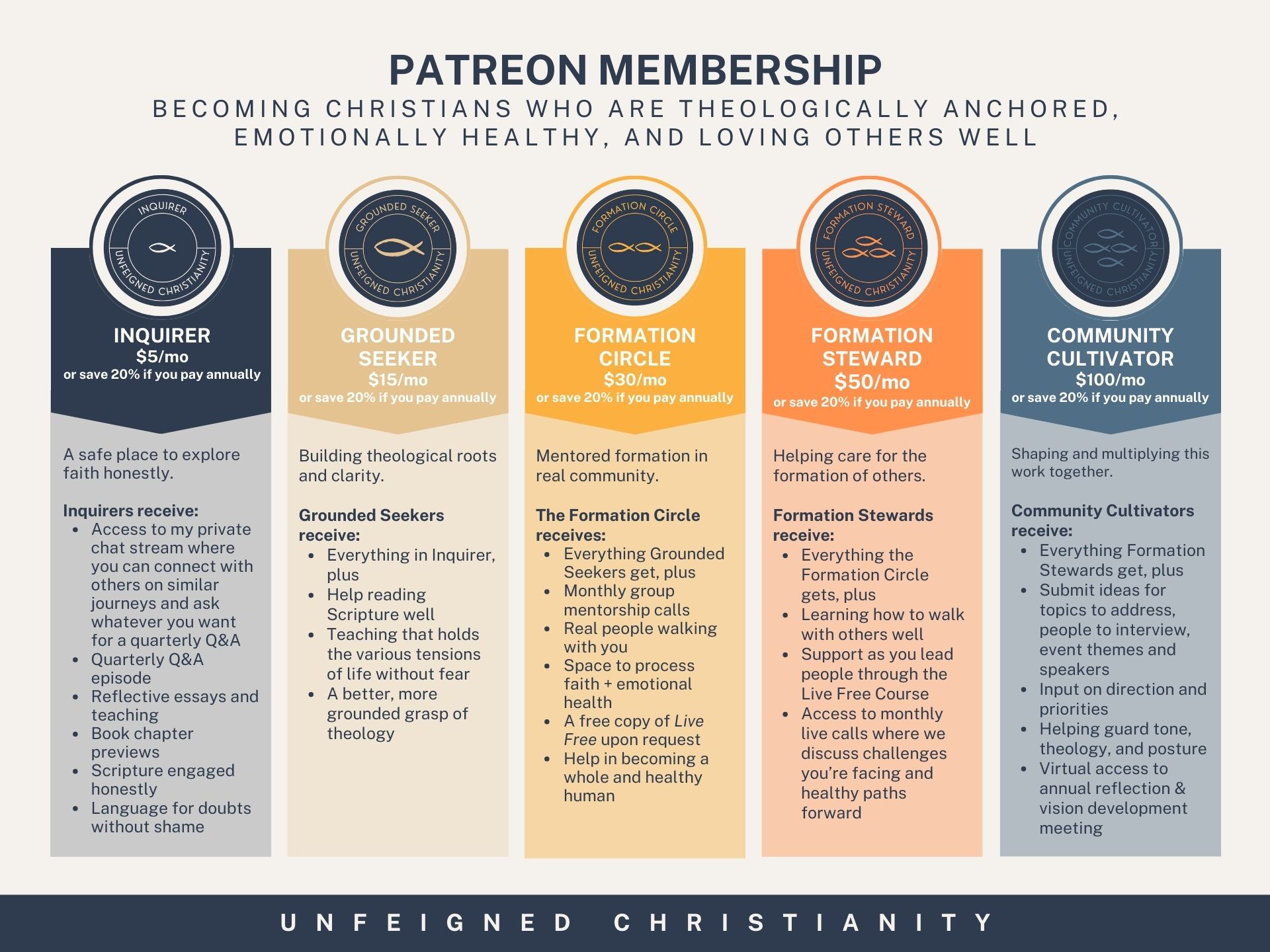
Most of that deeper, ongoing conversation is going to happen inside the Patreon community of Unfeigned Christianity, in the Grounded Seeker tier. That's the level past Inquirer, where we slow down and actually flesh things out, what good theology looks like and what it looks like to be emotionally healthy so we can love and disciple well. I've got a stack of articles already outlined responding to the early chapters, and my commitment is at least one a month. Honestly I'd love to do more. However, because of my current responsibilities, this is probably going to be a years-long study.
I'll keep sharing some of it here on the public blog for free, and some on the podcast. But the sustained discussion lives in Patreon. If you want to walk through From Genesis to Junia with me, the Grounded Seeker tier is fifteen dollars a month, or twenty percent off if you go annual. I'd love to have you along.
The first article in the review proper won't even be about women yet. It'll be about how we read the Bible at all, and how that quietly shapes our posture toward this entire conversation. What is the Bible? The myth of the "plain reading" of Scripture, and why plain reading is almost never as plain as we think. We'll get into the grammatical-historical approach, and what it means to anchor our interpretation in the text itself rather than in our cultural background or our modern assumptions. Because a lot of folks who insist they're just taking the plain reading are reading their culture into the page without knowing it.
That's where we'll start.
For now, I'll leave you where Teresa left me. Not with an answer to defend, but with a few honest questions.
Where did your own view of men and women in the church actually come from? Was it handed to you, or did you go looking? And if you sat down and read Scripture slowly, with an open hand, are you sure it would say what you've always assumed it says? You can share in the 0 Comments below.
Join Unfeigned Christianity on Patreon and Take Your Journey to the Next Level.
Become a paying member of Unfeigned Christianity for as little as $5/mo and access article, our community chat stream, and quarterly Q&A episodes.
Already a member? Login