
Anybody who has tried to help someone stuck in poverty knows how the story goes.
You see the need. You have something to give. So you give it. And for a little while, it works. There's relief on their face and something warm in your chest, and you think, this is what we're supposed to do.
Then you start noticing the habits. The money you gave went somewhere you didn't expect. The progress you were sure was happening turns out to be a step back. You get frustrated. You point at the habits, because they're right there and they're obvious. Maybe you don't even raise your voice. Maybe you're gentle about it. It doesn't matter. Something shifts, and they decide they're done with you.
I've been on that road. Last fall I was mentoring a young man who needed some money to get back on his feet, and I gave it, and I meant it. But I've also been the guy standing in the wreckage of a helping relationship, holding the frustration and wondering what I did wrong.
Don't Have Time to Listen? Here's the Gist:
Giving money is often the fastest way to help and sometimes the only right thing to do. But relief that overstays its welcome starts doing harm. Joe Kuepfer, who spent eleven and a half years with Open Hands, walks through savings and credit groups: small circles of peers who save what little they have and lend it back to each other. What makes them work isn't the capital. It's the peer level. Nobody's above anybody. And that same principle runs straight through our own vocations, which is why business as mission isn't a nice add-on for the church. It's how a local body learns to care for its own.
Learn more about Team Pulse at https://teampulse.us/signup?ref=asher-witmer. If you would like to grab the two months free, use the promo code Z867DH0O at checkout. Learn more about the Unfeigned Christianity Membership program at asherwitmer.com/member.
[00:00:00] Joe: We look back at Jesus life and ministry and teaching when he walked here on Earth, you know, he cared for both the spiritual and the physical needs of people. Like, when he saw a sick person, he had a ton of compassion. He would heal them.
And he taught about giving to the poor, which shows how much he cared for the poor, I think. And he himself was homeless, so he didn't have a lot of his own money that he was giving to the poor, but he taught. He taught to give to the poor.
And then Paul as well follows that up with saying, hey, those of us who can work should work so that we can take care of the poor.
[00:00:43] Asher: Hello and welcome back to Unfeigned Christianity, where we are on a journey of becoming a people who are theologically anchored in Jesus, emotionally and spiritually healthy, so we can love and disciple others. Well, it's good to be back with you guys. It's been a while since I ran the series of Free for Real and then shared some interviews that I had done around sexual wholeness and emotional health. Today I am interviewing a friend and someone I have worked with at a distance. We worked together on some projects for a ministry called Open Hands. His name is Joe Kipfer, and we're specifically talking about helping how do we help the poor throughout the world? And I'm specifically tapping into his experience in working with savings groups and micro financing, even some work that they're doing currently in Detroit. He no longer works with Open Hands, but there's projects that he's a part of in Detroit to help bring about economic stability for people who don't have economic stability. So I'm excited about this conversation. I thoroughly enjoyed it. It's kind of a different turn of topics than what we've been talking about recently, but I'm looking forward to it and I hope you guys enjoy it as well. I'd love to hear your feedback on this challenge and this invitation of how we as disciples of Jesus, can love and disciple well by helping others economically in this way.
As always, if you enjoy this episode and you have feedback you want to leave, subscribe wherever you're listening to this, but then also if you're watching on YouTube, feel free to leave a comment. If you see a clip or something on social media, share it, Share this episode.
And if there's no other way, you can always contact me@podcastsherwitmer.com and give your feedback that way.
Thank you. Without further ado, here's my conversation with Joe Kiffer.
All right, Titus, welcome to Unfeigned Christianity.
It's good to have you on the podcast.
[00:03:05] Joe: It's good to be here. And my brother is Titus. I'm Joe. But still great to be here.
Well, hey, actually, it helps to mess up editing.
People want to hear us mess up, you know, to see that we're human.
[00:03:25] Asher: Yes.
That's embarrassing, though. I knew I was talking to Joe. Yeah, Joe, welcome to the.
I did a podcast with Titus. It's been five years ago, six years ago. Me and my brother and Reagan Schrock did the Third Way podcast together for a while.
[00:03:48] Joe: Okay.
[00:03:51] Asher: But yeah, no, we had scheduled. You and I had scheduled to do a podcast two years ago, I think it was.
I had reached out. You responded very quickly. And then it was right around that time I had some health stuff come up and kind of ghosted you, I think.
Never responded. And.
And so thanks for coming back on.
The thing I want to talk about is how to help. You know, we live in.
This data is probably a number of years old, but if you're able to save a dollar a month, you're in the top 1% of the world's wealthiest people. Something like that.
[00:04:33] Joe: Wow.
[00:04:33] Asher: I don't even remember where I saw that for sure, so people can maybe correct me, but the idea that here in America we have.
Most of us can find a dollar a month to save, if we're not, it's usually because of excess spending.
Most of the world does not have that. And so what does it look like for Christians to participate in fighting poverty, helping the poor?
I like to think of it maybe more recently as helping create sustainable living.
And so that's kind of what I want to talk with you about. You have been involved in missions all your life.
Your family grew up on the mission field, if I'm not mistaken.
And then you and your wife have been involved in missions and now currently involved in a type of business as mission.
So maybe we'll just start out.
Specifically, I'd love to talk about savings groups, but start out by just giving an introduction who you are. For those of you that. For those of my audience that don't know you or your brothers, I think a lot of my listeners probably would.
You guys have your own podcast, Kip for Bros, and have been involved in a number of different missions, all three of you. But yeah, give us an introduction and what your life experience has been and how you've gotten involved in helping the poor through savings groups and business as mission.
[00:06:16] Joe: Yeah, yeah, no, I appreciate this opportunity for sure. And this is something I enjoy talking about. I feel like helping the poor is part of my life's purpose, life's calling really born out of somewhat of what you referred to. The fact that we grew up, my family and I, my. My siblings and I grew up on the mission field in Kenya where my dad was a missionary pastor.
And so we got to really experience Africa, including getting up close to poverty, observing that, you know, just seeing people who didn't have enough food, um, not that that we saw people literally starving from lack of food, but definitely not, you know, three meals a day sometimes.
And then when I was young, you know, it was the 90s in Africa, it was rough. Like, the AIDS epidemic was just like terrible. People like that we knew just dropping like flies from aids.
Super scary. Like, just to see people you knew dying from.
From this disease that was just spreading so fast.
And so, yeah, thinking back to the 90s, like, yeah, a lot of poverty observed that. And so I remember way back then already dreaming about how business could help people.
Business and agriculture really could help people work their own way out of poverty. Because, like, just literally giving stuff to people, it's a band aid, and we need to do that. Like, we need to give food to the hungry person.
But then going beyond that, I think, you know, that's what you're reaching for today. Like, how can we go beyond that and really help long term? And so I'm excited about discussing this today, for sure.
[00:08:23] Asher: Yeah.
I think of a lot of us in the west, and I know there's been a number of books and speakers who have addressed this, so maybe in recent years the tide is starting to shift a little bit, but there is a lot of still kind of ingrained. When we think of helping the poor, we immediately think of giving money. And like you said, there are times we need to do that, especially in the emergencies. I think of a young man that I've been mentoring who last fall just needed some money to get back on his feet. And then obviously other things that needed to come in place so that it could become. So that his life could become sustainable.
But especially when it comes to missions, engaging other cultures, engaging other economic classes.
I don't like to think of humans in different classes, but the reality is some of us do come from means we don't know what it's like to be one meal to the next living that way.
And when someone grew up living that way, for them to just get a bunch of money all at once, it can create a form of dependency. And it's actually not best for them and their Family, their communities.
And so one of the things that I remember learning about early 2000, I think it was before I ever left home, so maybe 2006 to 2008, somewhere in there was the concept, concept of mic micro.
I forget what it was called. Micro savings, something like that.
And then eventually became familiar with groups like Open Hands Ministries and so forth. I know you have worked for them over the years, but where did you first come across savings groups and what are they? Maybe we'll start there as kind of a high level view.
[00:10:46] Joe: Yeah, yeah, sounds good. And just speaking back to something you mentioned there jogged something in my mind as well that I'll mention first and that is that you talked about like if somebody just gets a bunch of money that they're not used to, it can kind of backfire sort of like that concept. And I actually think of that not only for somebody who's really poor, I think of that for like any, anybody to get just something dumped on them, whether it's a bunch of money or just a ton of responsibility or just, you know, I think that I look at it like progress in small steps, sustainable steps is far healthier for anybody, no matter if they're in the US in a foreign country, in a, in a third world or developing country.
Because the person and that you need to become and grow into in order to become a steward of much. You know, the Bible talks about being faithful in the little he will, who is faithful in a little bit, will also be faithful in much. And so that concept is super important even just in thinking, you know, for our kids, for our families, like how can we start them off with a little bit and help them to learn and grow.
So I just wanted to mention that before I get into your question.
So yes, I. As far as, like.
Sure, yeah. As far as like the, the savings groups, yeah. I really think that the first time I recall thinking significantly about that concept was when I was in Nepal with my wife and just one daughter at the time, 2013.
And we're there in Nepal and we're there with a mission. And we were kind of thinking about, you know, what are some of the things we could do. And so we started thinking about discussing salt. Salt, microfinance and open hands.
And so, you know, those are two different things. Microfinance and savings groups.
Salt does mostly savings groups, a little bit of microfinance. I think they're kind of more going towards the savings groups side of things and some other things like agriculture and some, some skills schooling and that type of thing. Open Hands only does savings and credit groups, so more focused and so forth. And my family and I served with Open hands for about 11 and a half years.
And so yeah, really got a chance to learn a lot about savings and credit groups and just see how the impact, the positive impact of that really can make a huge difference for people in poverty.
So I'm a strong believer in the effectiveness of savings and credit groups. I feel like they, it's just a very kind of a low key model. It's not big, flashy, but it requires people to steward the little that God has placed in their hand. It requires people to, rather than looking outside and saying where's a, you know, where can I get like an influx of capital from the outside?
It rather requires a person to say, hey, what is the little bit that God has given me? Because every person has been given something by God.
And when we take that little bit and we prayerfully say what can I do with this? And we go ahead and like the parable of the talents, you know, whatever that talent is, when we actually are faithful with that and we steward. It doesn't matter if you're in Africa, it doesn't matter if you're in the U.S.
there's growth that can come through that. And the savings and credit groups model that Open Hands does, I'm a firm believer in. There's the holistic model where going in and helping to get into savings and credit groups and then also providing spiritual integration. So scripture being taught in the groups. Super important for us not to just say, hey, you know, we're only concerned about the material side. No, that like there are, there are organizations that more just focus on the material side. But when we don't care for the whole person, including the, the spiritual and the emotional or the mental, that all has to come together. And when there's care for the whole person, that's when I believe we see the biggest impact in helping people. So
[00:15:33] Asher: one of, one of the ways we collaborated at least briefly was I was brought into help developing. It was the middle of the project.
I think maybe Dwight Gingrich had been doing some. I forget if he was the connection or Merle Burkholder, one of them had been doing some of the writing for a curriculum Open Hands was developing for the people in the savings group, if I remember correctly.
[00:16:04] Joe: Yep, yep.
[00:16:05] Asher: And it struck me how holistic this. I was working on some booklets focused toward getting started, like starting a business of their own if I remember correctly.
But I think the whole curriculum had started what you were Talking about just the spiritual mental kind of a.
I never got to see it firsthand, so I didn't know exactly what it looked, how it fleshed out in the actual groups, but it seemed like a form of discipleship where maybe the thing that brought people together was the gaining financial stability, but ultimately there was going to be a more holistic discipleship.
[00:16:54] Joe: Yep.
[00:16:56] Asher: I never realized there was a difference between micro financing and savings group. What is the difference between that?
[00:17:05] Joe: So microfinance generally is where you have outside capital being loaned to. To people. So for example, we would. We would take US Capital, take it over to Zambia and. And loan it out to. To people there, and then they would pay it back with interest and that would come back to whatever micro finance organization that would be. Sometimes it's a bank, sometimes it's a nonprofit doing that. Yeah. And then savings groups is just where people really get into a group of, for example, 10 people just come together and they, whatever they can save on their own, they save that together in the group and then they will loan that back out to each other. So really it's like a credit union where they're the owner of it and they save and manage their own resources and loan it out to each other and then all that interest, you know, stays with them, which is really cool. So.
[00:18:11] Asher: Yeah.
Yeah. So they can build it over time together.
Yeah.
What, what would you say?
A couple things. Maybe I'll start with this one. What, what would you say? So someone's listening to this, and I'm going to assume that most of my listeners have a basic understanding of the call to help the poor, to care for the poor among us.
What would you say to someone who's maybe not want. Like, why get involved in this way of helping the poor as opposed to just sending a bunch of money to organization or something?
[00:19:08] Joe: Yep.
Great question. And I would say it comes right back to what is the need on the ground? Because when there's an earthquake, when there's a flood, when there's a severe famine, we literally need to go in with relief and give to the people, just give them to keep, you know, take care of the immediate physical need. But when you stay in the relief mode too long, when you overstay that, that's when you start harming people. And that's what organizations have often done. They've gone in after an earthquake or a flood or something, helped out, and then continued that too long. What? That does it. It actually overstays the relief phase and continues the handouts into the development phase.
So all the types of organizations are needed. So we do need to support the organizations doing relief, but then they need to exit and the organizations doing development, like Salt, Hope International, Open Hands, come in after that to build that next level of development.
And both are. Both are super important. Both need to be funded. So we need to fund both the relief and we need to fund the development. If we fail to fund either one of those, I don't think we're fully caring for the poor.
So I would just say it's more a thing of what's the need on the ground and what phase is the country in, where they're at.
[00:20:44] Asher: Yeah, yeah, that's good. And maybe to step back a little bit.
I said I was assuming everyone understands, but the reality is, it is amazing to me how many of us within the church maybe aren't actively giving or participating in helping the poor.
And so where would.
What motivates you, scripturally, theologically, to be a part of this work? Even in. And maybe we'll get into this next. But even in the concept of business as missions, why should we care about helping others develop sustainable lives beyond our own dreams and aspirations? That might take our own.
Might take a lot of finances for ourselves.
[00:21:47] Joe: Yeah.
And I think it really comes for a lot of us, myself included. It's very personal because it comes to our faith and myself, and for you, too, I'm sure. You know, we're followers of Jesus, and so we look back at Jesus life and ministry and teaching when he walked here on earth, you know, he cared for both the spiritual and the physical needs of people. So he was forgiving sins, he was teaching about spiritual things, but he was also healing a lot of people. Like, when he saw a sick person, he had a ton of compassion. He would heal them.
And he taught about giving to the poor, which shows how much he cared for the poor, I think. And he himself was homeless. Right. So he didn't have a lot of his own money that he was giving to the poor, maybe, but he taught. He taught to give to the poor.
And then Paul as well follows that up with saying, hey, those of us who can work should work so that we can take care of the poor.
And so, you know, I think. I think it comes back to that motivation of we're following Jesus. Jesus cared for the poor. We want to follow his example.
And then, you know, so I think, yeah, that would be kind of the baseline.
And then I think for each of us to just in our walk, like, when we see somebody in need, the love of Christ in our hearts will often kind of naturally generate empathy for people who are not doing well. And a lot of times we don't know what to do, like how do we best help them.
And I think, you know, we're sometimes concerned about will giving a handout to this person harm this person.
And sometimes we don't know when we should do that and when we shouldn't. That's a tough thing.
And I just think that we won't always get it right. But.
And that's okay. But for us to make sure that we have love in our hearts and that we're acting out of that, whether we give a handout or whether we work through more of a long term educational mindset or development type approach, I think both are super important, super necessary.
[00:24:32] Asher: Yeah, that's good. If you are a leader who cares deeply about your people, but you're tired of guessing how your team is really doing until someone burns out or quits, check out Team Pulse. It's a simple 60 second weekly check in that gives you an honest picture of morale, stress, workload and wins. So you can have better wins, catch issues earlier, and build a workplace that heals, not hurts. Team Pulse is designed for small and mid sized organizations, schools and nonprofits that want real conversations, not just another corporate survey. Listeners of unfeigned Christianity get two months free. If you sign up before December 31st.
Just use the link and promo code in the show description below. I think one of the things that I've been kind of processing personally over the last couple of years has been the idea of money as fuel for shalom.
Obviously shalom is not dependent and shalom for those who may not be familiar, is the Hebrew word for peace. But it's so much more like we. Our English word of peace is kind of the absence of conflict, absence of warfare, where shalom embodies more of flourishing and wholeness too. Not just the absence of the conflict or in this case the absence of poverty and using money as a way of helping to establish shalom in throughout creation. For folks who are needing, like you said, depending on the situation, maybe they're needing emergency help.
But ultimately all of us need something sustainable to be able to care for our families well.
And so even as I think about that, because I, I sometimes wrestle with, you know, Jesus was homeless, he didn't have a job, like, does that mean I should be doing that too?
And yet I also, like you said, Paul gives us exhortation, those of us that can work or if we're capable of caring for our family, then we should, or we're worse than an infidel.
But it's helped me kind of understand purpose even for the mundane work when I see that even that it's not just making sure my family has food on the table, but also the very work and money that I'm generating through work can be used for shalom throughout creation.
What does.
When we.
So maybe to walk through this a little bit more, what does savings groups actually look like and what does discipleship in that context look like? Have you seen it?
And maybe maybe a way of walking through that is telling a story of what you've experienced.
Because. And the reason I ask this is anybody who tries to help somebody who's been in, I don't know if you'd say generational poverty or at least like most of their life, been stuck in poverty, you discover there are habits that they have in their life that contribute to their poverty.
At times it is different. It is a little different if we're talking somebody here in the US that has access to so much versus someone in another country where the resources in general are thin. But it's inevitable that we'll bump into habits. And it's easy to point to those like, you're doing those things and that's why you're stuck. And then we get frustrated and they maybe slide back, misuse their funds again in their bad habit. And the progress we thought was being made isn't made. Maybe it's like a step back and then maybe there's some sort of conflict moment where you confront them or you challenge them and then they kind of decide they're done with you and. And then it doesn't. I don't know if that story is familiar at all. It's. Yeah, it's one that I personally have wrestled with. So, like, what does it actually look like to see this through from start to finish?
[00:29:32] Joe: Yeah, yeah, yeah. No, I, I really appreciate how you've framed kind of that. That picture because I think that that for me, it's a very familiar one. And probably for our listeners too, that's a very common thing where you try to help someone and it kind of goes poorly like that.
And I'm not sure what to say as far as really helping someone one on one, how to, to do that, that better.
I don't really have a lot of answers there, but we, I feel like we're still called to do our best with it, but when it comes to the beauty of, of a group like a savings and credit Group or in the US there's something called faith and finances where it's also a group setting where there's financial teaching, you know, being taught and, and so forth to, to low income folks here in the US there's something really very powerful about the group setting because what you end up with is peers. So you have people who are peers and what you can then kind of avoid is a more, I don't know how to describe it other than maybe kind of that paternalistic challenge that you may have otherwise. But if you have a group of peers coming together and they're saving the little bit that they have, learning together and growing together step by step, I think it's just, it's really encouraging for them. And there's also a peer accountability that's super powerful. That works way better than if you have a relationship where you have somebody who is very financially stable and somebody who's very much not. If you have that, it's a lot harder. So I think that's where I'm just going to say savings and credit groups and even faith and finance groups in the US are super powerful because it is just a tool that is practical and a tool that is proven, proven to work and proven to be successful.
So yeah, wherever there's an opportunity for that, I would just highly encourage, you know, savings and credit groups in foreign countries, faith and finance groups in the US and then those more personal interactions and relationships.
You know, I think, I think there's certainly a time to prayerfully walk into those and try to help people as well. But what you just described that is, that is certainly a common challenge.
[00:32:39] Asher: Yeah, no, I do like the idea of the group where you have people dealing with similar challenges and economic states challenging each other and provoking each other on are.
So you, you mentioned salt, Hope International. Is that the one. And Open Hands. Do they, do they each have faith and finance groups here in the US as well, or are those different organizations?
[00:33:13] Joe: Yeah, Faith and Finance is actually done by the Chalmers center.
So I don't know if Hope International actually has activity like that in the U.S. necessarily. Open hands has done a little bit and then SALT has done their own curriculum for the US it might be called Salt and Light, but I'm not quite sure.
And so I think they've done a little bit as well.
A lot of the challenge here in the US is, is oftentimes, you know, we'll have a relationship with one person who, who needs this faith and finance group or yeah, it's kind of hard to get like A complete group of people and to have that many contacts. So it is a little bit tough where like in developing countries there's lots of demand for savings and credit groups. Just a lot like it's, it's easy to get them started as far as like there's just a lot of need.
Um, and then in the US I think the need is there, but it may not be felt as keenly or it just, it just tends to be a little harder to get the groups up and running and going. But in cases where they have, where we've seen them run through a complete cycle with a three month cycle with faith and finance tends to be very positive. So.
[00:34:42] Asher: Yeah. And the other thing here in the US poverty does tend to often accompany for different forms of addiction where as. That's not, that's. I mean it can happen anywhere, but many places of the world probably don't. It's not a matter of addiction, it's just literally limited resources.
And so then here in the US where it is addiction, you have kind of a whole nother.
You know, someone addicted to substance, for instance, is spending their.
What money they could be saving and setting aside on their, their addictive habit.
[00:35:33] Joe: Mm.
[00:35:34] Asher: What.
So I want to talk, dive in a little more at some point about just assumptions about poverty and generosity. We've touched on some of that, but maybe before, maybe we'll do that towards the end.
Before doing that, I'd love to explore business as mission a little bit. Is that.
Well, Maeve, first of all, what are you involved, involved in now? I think you're wearing a sweatshirt of Detroit Junk Busters, which. Yes, yes, I'm a little bit familiar with, but.
[00:36:16] Joe: Yeah, yeah, yeah, yeah. No, I actually worked for Detroit Junkbusters for a little over a year. In 2020, I was on sabbatical from Open Hands and then recently went back to Junkbusters and so I'm back with them again.
Just started full time and yeah, I'm excited about it. So they, they are a very missional business in, in several ways.
And business's mission is something that I'm very passionate about. I believe that churches need business people. And this was always one of the premises that we kind of worked under at Open Hands. Was that okay, you know, in, in foreign countries, a church, in order for it to be stable, it's going to need to have a certain amount of people in the church that are operating businesses who can kind of, you know, give to the offerings. Everybody should be giving to the offerings. But how can we really help churches Be sustainable. Well, you need a business. Community is part of it.
And so I was always excited, you know, with Open Hands under the.
The work of, let's work to help local churches take care of their own widows and their own orphans and actually be faithful to the commands of Christ as a local church.
So turning people from receivers of charity into givers, that was always something that we're working towards there. And we saw that. You know, we saw that at Open Hands. But stepping back into the US here, same thing. Business can be very missional and should be very missional. And a lot of times I think that it can be. We can kind of fall under a.
What to me feels like a faulty line of thinking of, okay, you know, kind of separating the sacred and the secular. I go to church on Sunday, but then on Monday through Friday, I'm at work and it's just business. So I rip off my customer.
I make this unethical move here. I treat my employees. Employees poorly, that type of thing. But it's just business.
And then go to church on Sunday, and I'm separating that. Well, that's really sad. Like, we can't do that. Like, God cares about all aspects of our lives. And so business can and should be very missional. Business should be a place where we care for the hearts of our employees. Business should be a place where we care for our customers.
They're.
That they get a good deal, that it's fair all around. And business should be a good thing. Business should be.
Okay, let's just take, for example, a sale in business should be. If I'm selling you something, Asher, you should want what I'm giving you more than the money you're giving me. And should be a mutually beneficial thing.
I'm providing something to you, and you're providing something of value to me. So we're both benefiting.
And with the money you give me, I'm taking care of my kids, Don, Donating some in my local church. And that whole thing can be just a beautiful thing. But of course, like anything, you know, Satan tries to destroy, and he does that. And money is a big tool of Satan. When people become materialistic and love money and become greedy, wealth can be a real destroying force. Jesus talks a lot about that.
But then for us as believers to.
To be courageous, to step into the business world and say, how can this be missional? How can I take care of my employees? How can I generate funds for nonprofit organizations, for local churches, for missions?
Very important. And then I love that about Detroit Junkbusters. So the company was started by Scott Stauffer, Darryl Schrock back.
I don't know, when was it? 2013, 2015? Somewhere in that timeframe.
And very much as a way, well, to support them as families as they first moved here to the city of Detroit, but then also when their church is called Grace Fellowship and they have a school there, Grace Academy, my kids actually go there.
So when they started the school, Detroit Junkbusters became a business that supported the school and still does to this day. So a large portion of the profits go to supporting school.
So that's a very missional element. And I love that because when I go to work, I know that the work I'm doing, it's doing kingdom work as well. So I think that's a really good example. And I appreciate being in a space where I can learn more about business's mission and be involved in that way and hopefully talk about in a way that gets others inspired to be missional in their business ventures.
And I also hope to start my own business at some point and really want that to be a missional thing as well. So I think it takes being in the space with other leaders who are missional in their businesses because there is always that danger of us just kind of getting sucked into the pursuit of more and. And the pursuit of maybe our lifestyles can kind of expand unintentionally. It's a very kind of those tensions. And so I don't think that we should be ascetic. I think we should take care of our own needs and the needs of our families.
And so I'm not about us trying to go into poverty, but I think that, you know, the principles of.
Of generosity, of, you know, combating selfishness in our lifestyles, I think those are really important things. And so, yeah, I think that, you know, it's important not to live under. Under guilt of, oh, I spent this much on this shirt. I feel like a terrible person.
There's always that tension, and it's okay probably to feel that sometimes.
[00:42:34] Asher: But
[00:42:36] Joe: I think overall, the principles of being generous and generating income so that we can give to those in need, so that we can give to the Kingdom, so that we can further the work of the Kingdom, I think is really important.
[00:42:51] Asher: So, yeah, if today's conversation stirred something in you, if you find yourself wanting to go deeper than just listening, the Unfeigned Christianity membership program might be exactly what you're looking for. For it's a formation community for people who are serious about becoming theologically anchored and emotionally healthy so they can love and disciple others. Well, it's a real space where we do ongoing work together. Members get access to teaching resources and ongoing conversation through monthly mentorship calls. The kind of stuff that doesn't make it into the podcast, but shapes the people who are in it. You can join at WWE www.asherwhitmer.com member and get started for as little as $5 a month, if you purchase an annual membership, you get a 20% discount. The link is in the show notes below. How do you guys When I think of business as mission, which I I love, I in la, I did handyman work. I never had full time employees per se, but I had a number of guys that would work for me here and there and I found if we had stayed there longer I probably would. My intention would have been to develop it out as more of a business, but God led us to move on from that for the time being. But I found doing work together and serving customers together, as you mentioned, there's a profound opportunity to disciple and mentor people in that whole process, but it is.
Not the most efficient. But it may actually be a very unefficient way of running a business.
Have you guys bumped into that and how do you navigate that? Because especially most of my audience is going to come from conservative Anabaptist background. We're known for our work ethic, for efficiency, for, you know, doing good quality work in a timely manner. And, and we have a lot of businesses within the Anabaptist community to, to show for it. And there are lots of of generous, incredibly generous business men and women within Anabaptist circles. I'm not trying to paint that with a broad brush as though it's all negative.
But one of the challenge, some of the challenges that I've often bumped into in some of these conversations is the real challenge of hiring people who you could disciple but who don't yet have the work ethic or even just integrity of in how they engage co workers, let alone customers sometimes. Have you guys bumped into that? How do you navigate that as you do? Or maybe I'm assuming you hire local people that you're that that is also an avenue of discipleship and missions. I think you had mentioned something along that line, but maybe I'm assuming.
[00:46:11] Joe: Yeah, that's a great question. And I started yesterday at Detroit Junkbusters officially. So you know, I mean obviously I worked for them.
[00:46:19] Asher: Oh really?
[00:46:19] Joe: But, but back in 2020 there was just me and another driver. So. But now I'm coming back.
I'll be working mostly in the office, so.
[00:46:28] Asher: Good question.
[00:46:30] Joe: I just met the team there yesterday, a lot of them, some of them I have met before and I would say they seem like strong, strong players as far as able to do their job well and so forth.
But yeah, referring to, you know, do you hire somebody who is still learning work ethic and that type of thing, how will that affect your business?
That's a tough one. I'm not sure that I have a great answer for you.
One thing I would say about that, I think, you know, business is business. It's not a non profit. It's not, you know, you do have to make a profit for it to be, for it to be a business. And so you're going to have to have employees that can do their jobs.
So you're probably. I wouldn't recommend a business, even a business as mission to go out and hire like a drug addict who should be in rehab.
Probably not actually going to be a successful business as mission.
But to be able to get to the point where you can learn, hey, this person isn't quite where they need to be, but I see the potential in them. I can actually coach them if somebody's coachable. Awesome.
I think it really comes down to can people be coached or not? Because the human being is incredible. We can learn all kinds of stuff and we can change and we can grow.
But a person has to be willing. A person has to be willing. And so I think that I would not encourage business owners to go bang their head against a brick wall with, with the people that they're hiring. Like hiring good people is super important.
So you should probably still be trying to hire a players and if you have like a team of a players and then you see somebody who's not there but they're coachable and your other A's on your team can coach that person up.
Do it like that can be a very missional part of your business. I think so.
[00:48:34] Asher: Yeah. That's good.
Good feedback.
Sorry, I've got a runny nose all of a sudden. Okay.
[00:48:45] Joe: Do you have spring out there in Colorado?
[00:48:49] Asher: We have not really had a winter.
[00:48:52] Joe: Oh, wow.
[00:48:52] Asher: Okay.
[00:48:54] Joe: Wow.
[00:48:54] Asher: Yeah, the mountain, the mountains have had very little snow, but yeah, we're, I think yesterday hit 70. We're supposed to get 80 sometime in the next week, so.
[00:49:05] Joe: Nice.
[00:49:06] Asher: Yeah, we're having spring but it feels like we haven't quite had winter either.
Do you guys, are you having spring or is it still very winter there?
[00:49:19] Joe: Yeah, no, it's really nice. Yesterday and today Was, I mean, great temperatures, high 60s, lower 70s yesterday. But I see it's going to dip back down into, you know, below freezing here next week. So not looking forward to that. But we had a super cold winter, like January and the beginning of February were really cold. Like it just stayed below freezing. Some negative temperatures, lots of snow just building up.
So I think we're all pretty excited about warmer weather here.
[00:49:51] Asher: So I miss. I grew up in Minnesota.
I still miss winters.
It would be like. I'm sure I'd feel different about it if I lived through another one again.
We moved away when I was 17, so it was school and then play in the snow, whether that's hockey or snowboarding or snowmobiling.
If I had to work in it, that would be another thing.
[00:50:23] Joe: Yep.
[00:50:26] Asher: Maybe to kind of wind down our times. I'm thinking of just. Yeah. Assumptions that we have about poverty or about generosity.
And were there lessons you learned, whether that's through specifically working with savings groups or just your experiences in developing countries where you bumped into assumptions and then what.
What did you. Because the whole concept of savings group as community and accountability and kind of provoking each other along bearing.
It's a form, I think, of bearing one another's burdens.
You're being vulnerable with each other when you collectively loan to one of the members of the community and you participated in giving that.
What has savings groups taught you about community?
That maybe we in the west, because we tend to be more individually stable, that maybe we're missing in a way.
[00:51:49] Joe: Yeah.
[00:51:50] Asher: I kind of threw several questions at you.
[00:51:52] Joe: No, that's good. That's good. You're making me think. But I think one of the things that a lot of times that we've seen people in developing countries do well at is not separating the spiritual from kind of the material. So in the west, we've kind of, as a society sort of done that.
And so that's where I feel like Christians in some. Some of these developing countries do well at being really prayerful about their. Their material needs and maybe not.
Not separating that as much and then community for sure. Like the generosity that folks have in some of these developing countries is incredible. The generosity, the hospitality and the whole thing of helping one another.
So as far as my assumptions about poverty changing and, you know, did that kind of. Yeah. How did that develop?
I think I would just say for me, it was more of a slow kind of development as I grew up kind of observing and. And seeing what were some of the biggest challenges and what were some of the Greatest solutions to those challenges.
And I'll go back to one of your first questions to me. When did you first hear about savings groups?
And I was thinking, oh, that was in Nepal when I met Merle Burkholder and he told me about open hands. Well, actually, no. I remember back in the 90s being in Kenya and you know, hearing about.
I think it was called a co op, but it was, it was kind of a savings group. And this was way back in the 90s before they were as common as they are today.
But I remember how incredibly excited I was for the guy doing. I think it was like a bicycle taxi driver or something.
And then he would work hard and then put some money into the group. And then I don't know if it was a rotating group or what it was. I don't remember anymore. But just way back then thinking, wow, like that is what people need.
And.
And then my dad did some agricultural projects as well and that type of thing.
So I think that my assumptions about poverty and the solutions to them and how important business is in that, I think kind of grew slowly over time just by observing.
I just think that we as the church need to kind of lean into that and not be afraid of it.
Lean into business as mission, business as a solution to material poverty. And that that business really needs to be integrated with, you know, the word of God and make sure that the spiritual component is very much a part of that in order for it to go well.
[00:55:09] Asher: So, yeah, yeah, that's good.
So if someone's listening and they would like to be a part of this kind of work or help out in some way, where, where should they start or what. What's the best advice that you'd give them?
[00:55:28] Joe: Yeah, that's a great question.
Maybe Riverside will take my out and my paws.
[00:55:36] Asher: But it's. It's pretty nice with stuff like that.
[00:55:41] Joe: Yeah, yeah, yeah. No, I think that.
Yeah. For those listening who would like to get into business as mission, to just prayerfully think through, how can I be missional in my business?
How can I be more prayerful, more caring to my customers, my employees?
And how can I use the profits in a way that expands the kingdom? I think that's one way. And then for those who are interested in working in developing countries, you could give to organizations like Open Hands, Salt Hope International, or serve with those organizations. I think I would vouch for all of them being great, great organizations. And so there would be. That would be another way to help, I think, bring the development piece of it. And then we Talked a little bit about relief being necessary for natural disasters and so forth. And so I think not forgetting to be involved as well when disaster strikes, so. Yeah.
[00:56:51] Asher: Yeah.
Yeah. Well, thanks, Joe, for taking time out of your day to have this conversation, this discussion.
[00:57:00] Joe: My pleasure.
[00:57:03] Asher: I always appreciate. I mean, you and your brothers, all three have been models and examples of not just business as missions. Titus and Tim.
Is that your other brother?
Trying to remember his name. They're both overseas currently.
[00:57:24] Joe: Yes.
[00:57:25] Asher: Having started a business and working. Yeah.
I've admired.
[00:57:32] Joe: I'm excited about what they're doing there with ProSynergy, the bookkeeping business, doing bookkeeping for U.S. companies and then hiring local staff and then they have some development projects and so forth going on in the country there. So. Super excited about that as well. Yeah,
[00:57:51] Asher: Yeah. I, I need to reach out to him as well because we had. He was another one that a couple years ago I had been talking. They were just getting started at the time now. Now they're a couple years into it. But yeah.
But yeah.
Admire the putting feet to discipleship and love and viewing vocation in this way and our resources in this way is not. It certainly doesn't make anything easier. It is easier to go automate some giving online.
And I'm not saying don't do that.
We, my wife and I have some of our giving automated in that way and that makes it very helpful. We can support people, but viewing our vocation through a missional lens and helping people, whether, you know, right now for us, this is us based. But helping those who don't have the stability that people need, that's a messy work. It's not a. It's not an easy work. The savings groups, those kinds of things involve a lot of working with humans and people. And so yeah, just bless you for your.
The efforts you and your wife have given to that and the new phase of life and ministry you're entering now.
[00:59:26] Joe: Thank you.
Yeah, I appreciate that, Asher. And just connecting with you again has been great. You know, we used to work on the curriculum together a couple years ago and so it's been. Been fun to reconnect here and. Yeah. Wish you and your family the best as well as you continue your work.
[00:59:46] Asher: So thank you, Sam.
What Stood Out To You?
Where have you tried to help someone and watched it go sideways? And what would change if you stopped asking how much you should give, and started asking what phase they're actually in? You can share in the 0 Comments below.
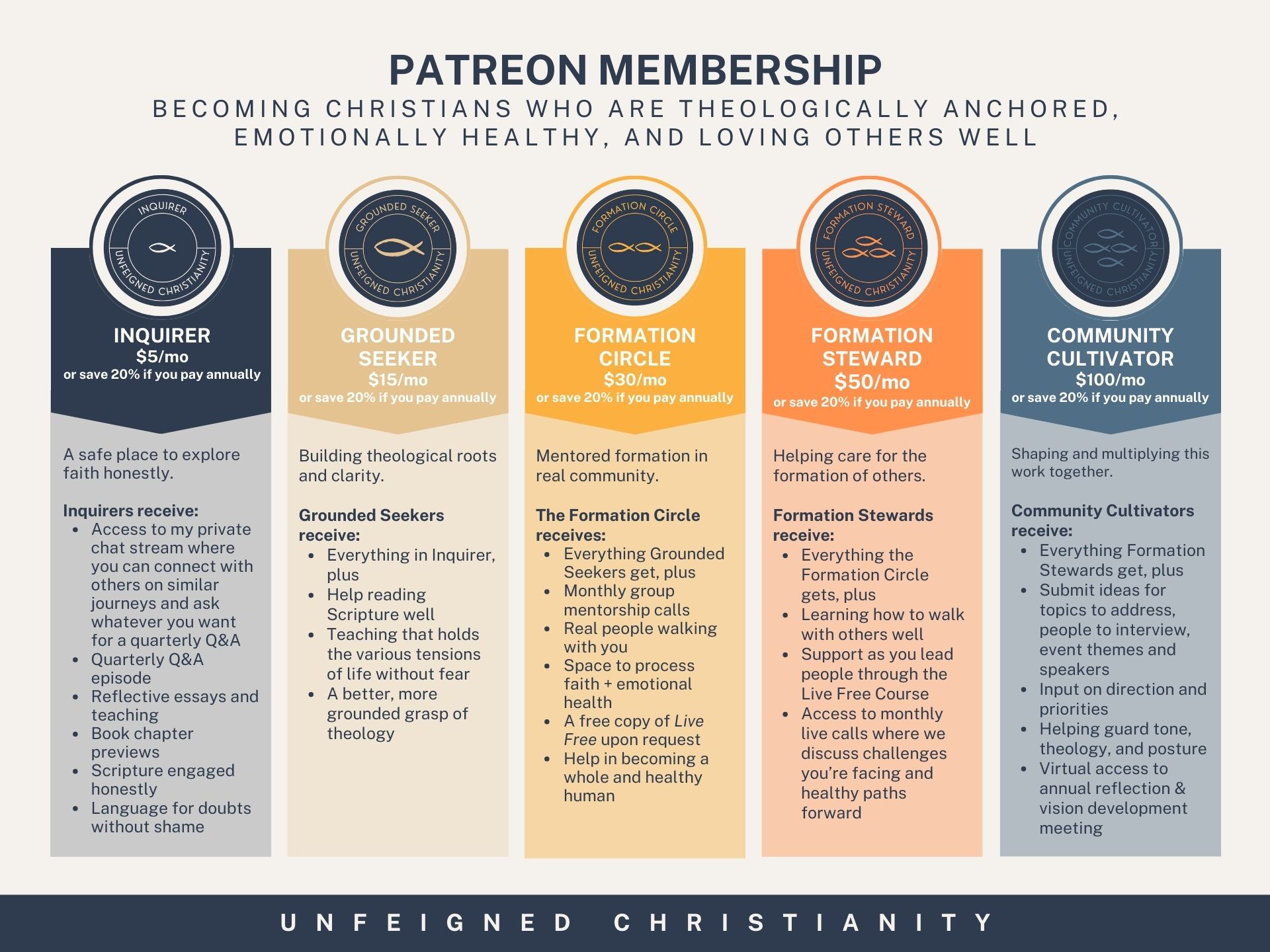
Join Unfeigned Christianity on Patreon and Take Your Journey to the Next Level.
Become a paying member of Unfeigned Christianity for as little as $5/mo and access article, our community chat stream, and quarterly Q&A episodes.
Already a member? Login