
How much of what I call my faith is actually just the culture I grew up in?
That's the question Karen Swallow Prior spent years turning over as an English professor — sitting in classrooms at Liberty University, watching students encounter Victorian literature and say, that's exactly what I was taught in church. Which raised an obvious follow-up: is that idea actually biblical? Or is it just Victorian?
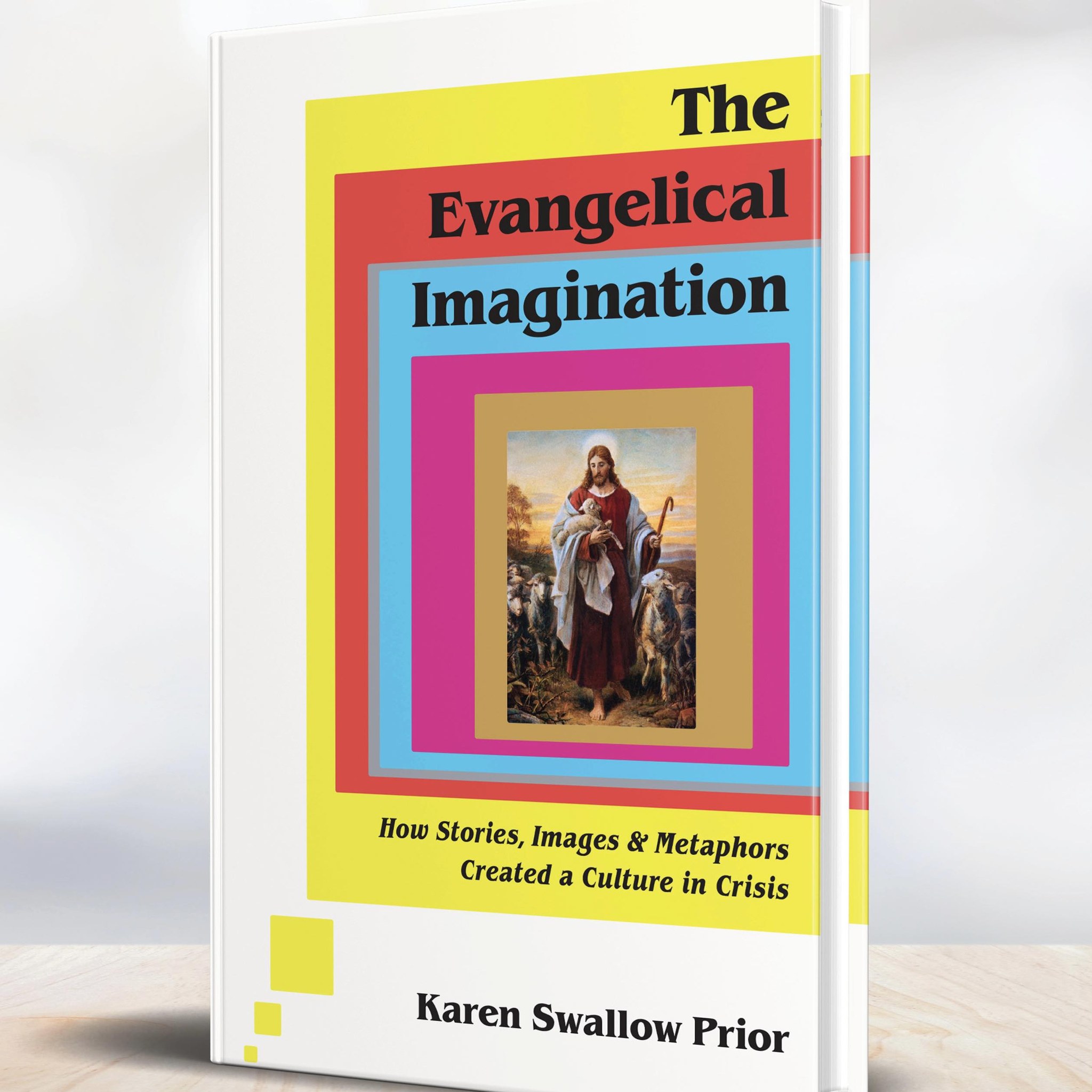
The book that came out of those classroom moments is The Evangelical Imagination: How Stories, Images, and Metaphors Create a Culture in Crisis. And I've been chewing on it ever since I read it.
Don't Have Time to Read? Here's the Gist:
Karen Swallow Prior argues that much of what evangelicals treat as biblical truth is actually Victorian-era cultural baggage — from how we talk about conversion to gender roles, sentimentality in worship, and self-improvement culture. The fix isn't deconstruction for its own sake. It's learning to tell the difference between what's essential to the faith and what's just cultural — so we can hold the first one tightly and hold the second one loosely.
What's a Social Imaginary — and Why Should You Care?
Karen borrows a concept from philosopher Charles Taylor called social imaginaries. The idea is simple but powerful: every community lives inside a set of stories, images, and metaphors that shape what they expect, what they value, and how they understand the world — often without ever consciously examining them.
A helpful example that Karen doesn't actually use in the book but fits well: the American Dream. Nobody hands you a pamphlet explaining the American Dream when you're born. You just absorb it. It shapes your work ethic, your definition of success, your sense of what you're entitled to. It's in the water.
Evangelicals have one of those too. Karen's book is an attempt to name it — to surface the underlying stories and metaphors that have shaped what it means to be an evangelical for the last 300 years, for better and worse.
Related Articles
Conversion: The Gift That Got Distorted
One of the most clarifying chapters in the book is on conversion. Karen is careful here: she's not saying conversion isn't real or isn't important. She believes in it. She's an evangelical.
But here's the problem.
When we emphasize conversion as a singular, dramatic, past-tense event — the prayer you prayed, the moment you walked the aisle, the year you can point to — we subtly communicate that that's the thing that matters most. And everything after it is secondary.
The result? Millions of people who checked a box, answered the poll, said I'm born again, and never really took the next step. A kind of spiritual adolescence that never matures into anything.
Karen told me something in our conversation that I found quietly devastating: she came to faith so early, raised in a Christian home, that she doesn't actually remember the moment. And that created a crisis for her — because the evangelical imagination told her the moment was the evidence. So she kept going forward at altar calls just to make sure it stuck.
That's a distortion. Not of conversion itself, but of what we've turned it into.
What the Bible actually talks about — fruit of the Spirit, perseverance of faith, the long road of sanctification — is a life, not a moment. Conversion starts something. It doesn't finish it.
Victorian Culture Wearing a Bible Verse
This is probably the most provocative part of the book, and Karen handles it with more care than most would.
The argument: evangelicalism and the Victorian era grew up together. They shaped each other. And a lot of what we've handed down as biblical is actually Victorian cultural assumption dressed in scripture.
A clear example: gender roles at home.
Where did the idea come from that it's more Christian for a woman to stay home and a man to go to work? Karen traces it directly to the Industrial Revolution. When factories appeared and work became dangerous and separated from the home, it created practical conditions that pushed men and women into different spheres. That was a technological development — not a theological one.
But over time, it got baptized. It got called biblical. And now questioning it in some circles feels like questioning God.
Karen isn't saying the arrangement is wrong. She's saying we need to know where it came from. Because if it's cultural wisdom for a particular time and place, we should hold it loosely — not turn it into dogma and use it to judge everyone who organizes their family differently.
Her test is straightforward: if it's not true for Christians in every time and every place, it's not essential. It might be wise or good or even beautiful in a specific context. But it's not essential.
The Sentimentality Problem
Sentimentality, Karen says, is emotion elevated beyond the reality behind it. It's not that emotion is bad — emotions are part of being human, made in God's image. But when the feeling becomes the point — when we evaluate the strength of our faith by how high we felt at the worship service — we've drifted into dangerous territory.
She traces this back to the cult of sensibility in 18th century literature — a movement where people would intentionally seek out emotional experiences through art as a measure of their own virtue. If I feel sad about this, I must be a good person.
Sound familiar?
The evangelical version shows up in a lot of places:
- Worship songs that are emotionally overwhelming but doctrinally thin
- Conference experiences that feel like a breakthrough but don't produce any lasting change
- Christian movies and novels that put us in the role of righteous martyrs against cartoonish villains — which feels stirring, but leaves us unprepared for the complexity of actual people
That last one is worth sitting with. If our imagination of faith is shaped by oversimplified stories where the Christians are good and the world is hostile, we're going to be genuinely terrible at loving complicated people. Because all people are complicated. Including us.
Self-Improvement vs. Sanctification
Karen traces the idea of improvement as a cultural concept — something that only becomes thinkable when the world starts actually changing. In ancient cultures, your station in life was largely fixed. Improvement wasn't really a concept because things didn't move.
The modern age changed that. And improvement — which is not inherently bad — got layered onto Christianity. Conferences, self-help books, tips and tricks for becoming a better you. Much of Christian media today is essentially a spiritualized version of the same self-improvement content you'd find on any wellness account.
The problem isn't wanting to grow. The problem is confusing growth produced by the Holy Spirit with growth produced by the right habits, the right content, the right steps. One is sanctification. The other is self-optimization. And they don't look the same.
I asked Karen about this personally — because I'm an author. I want to write books. And I'm aware that at some level, writing about personal growth for an audience requires me to participate in this ecosystem. She didn't give me a clean answer. But she said the line gets crossed when we start selling something for the sake of selling it rather than actually helping people. And that creep happens gradually — which means you have to keep looking.
Why She's Still Evangelical
I asked Karen why she stays. Given everything she's named, everything she's seen, including being outspoken about what was happening at Liberty University under Jerry Falwell Jr. — why stay?
Her answer was simple and worth repeating.
"I still believe what I always believed. The fact that others practiced differently or didn't really believe what they said they believed means that they left. I'm still here."
She's not naive about the crisis. She thinks it might be something like the Reformation — a rupture that's painful and disorienting for everyone living through it, but that leaves a legacy for those who come after.
She wants to be found faithful so the generation behind her has something worth inheriting.
That's the kind of staying I respect. Not staying out of habit or fear or tribal loyalty. Staying because the thing at the center — Jesus, the cross, the resurrection, the life of faith — is still worth everything.
The Question Worth Sitting With
Making a cultural assumption into a dogma is where things start to break.
That's the sentence I keep coming back to from my conversation with Karen. Most of what she's describing in The Evangelical Imagination isn't about throwing things out. It's about knowing where they came from — so you can hold the essentials tightly and the cultural additions loosely.
That's not deconstruction. That's maturity.
And honestly, it's exactly what genuine discipleship looks like. Not inheriting a set of unexamined assumptions and passing them down unchanged. But doing the slow, honest work of figuring out what's actually true — and then living from that, no matter what it costs.
What Stood Out To You?
Listen to the full episode on the Unfeigned Christianity Podcast.
Have you been following this scandal? What stands out to you about how Bethel is handling all of this? You can share in the 0 Comments below.
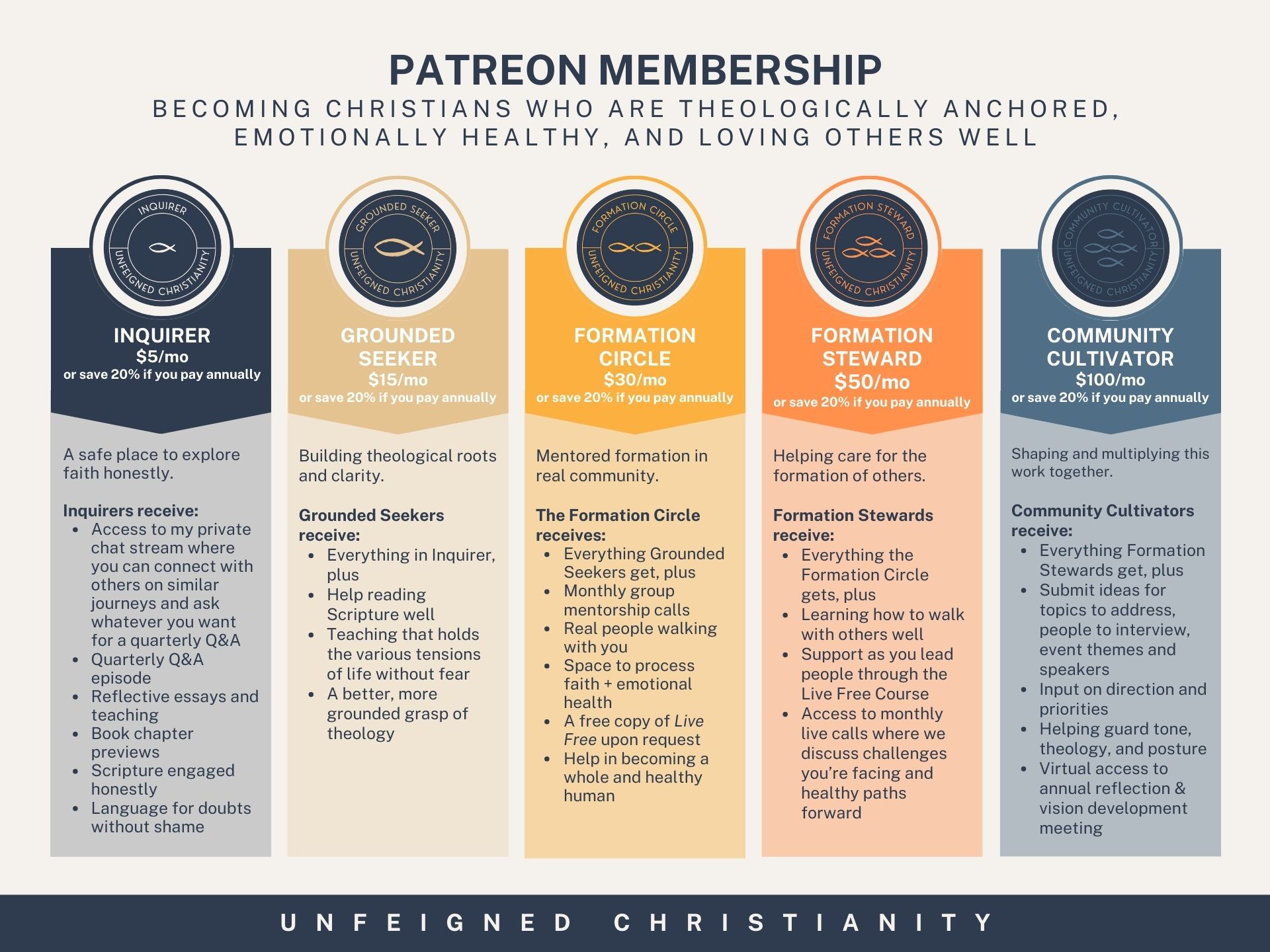
Join Unfeigned Christianity on Patreon and Take Your Journey to the Next Level.
Become a paying member of Unfeigned Christianity for as little as $5/mo and access article, our community chat stream, and quarterly Q&A episodes.
Already a member? Login