
For a long stretch of years, I rarely felt tempted toward pornography. I'd done a lot of work. I'd written a book about it. I was helping other men find their way out of it. And honestly, the lack of temptation made me feel like I had arrived, even though I would never say that. Man, I'm really free indeed, I'd think.
Only, then it came back.
Not all at once. But the old familiar pull showed up again one season, and my first reaction was something close to panic. What's going on? Why am I feeling this again? I thought I was past this.
What I've come to understand since then is that freedom was never the absence of the struggle. That old friend is going to show back up. He knows where you live. Freedom is that now you know what to do when he knocks. You have a way of navigating through what you feel when you bump into that old environment again. You're not standing there empty-handed, white-knuckling your way through, hoping it passes.
That's what I want to show you in this piece. Not a system. A way of being. And I'm going to do it by telling you about peaches.
Don't Have Time to Read? Here's the Gist:
A simple comment from my wife about picking peaches set off an old soundtrack I thought I'd dealt with years ago: "You don't have anything of value to bring." I want to show you what it looks like to process a moment like that in real time, why our old wounds resurface in new seasons, and why freedom from porn was never about never being tempted again. It's about knowing where to take our whole selves when the temptation shows up. Failure, when we let it, becomes information. And the goal isn't a clean life with no pain. The goal is becoming whole.
The Message I Didn't I Carried Subconsciously
At a very young age, I absorbed a message about myself: Your work isn’t good enough. I’m not impressed. I write about it in Live Free. In fact, I found genuine healing and forgiveness for that message. But over time, without me realizing it, that sountrack shifted into something slightly different, but still very much the same:
I don't have anything of value to bring.
The initial message originated from a specific event with my Dad. That message morphed into this one as I had other challenging experiences in life and it began playing low and steadily under everything else.
I didn't realize -- even when I wrote Live Free -- how many different ways that one message would keep showing up across my life. You don't deal with a thing like that once and move on. It finds new doors.
One of those doors opened during a major health crisis a couple of years ago. I had to step back from almost everything I was doing. And in those months, not many people checked in. It ended up being some of the loneliest stretch of my life. I don't say that to lay blame on anyone. The way I see it now, it was a hard and important reminder of how much we need community, friendship, and real intimacy. But in the quiet of it, I slowly started absorbing a new version of the old message. I'm not needed. Nobody really notices whether I'm here. I don't have anything of value to add.
Same soundtrack. New verse.
And then it walked right into my marriage, through a box of peaches.
The Peaches
We have fruit trees. One apple and four peach trees, to be specific. One early fall the peaches were ripe, and I grabbed a box and headed out the door with my kids to pick some.
On my way out, my wife called after me, "Be sure not to pick any green ones."
Now, I know how that sounds. As I write it, even I want to roll my eyes at myself. That's what set you off? A reminder not to pick green peaches? I get it. It's trivial. There's no version of that sentence that's an attack.
Only, that's not how it landed.
It landed like a jab. Like one more person reminding me that Asher doesn't really know what he's doing. That I don't have anything of value to bring. That I'm a little incompetent and need to be managed. I didn't have language for all of it in the moment. I just felt small. Unimportant. Vaguely angry. What do you think I am, an idiot?
I'd love to tell you I responded with grace. I didn't slam the door, but I wanted to. What I really did was go quiet and shut my wife out in my heart while I walked to the trees.
But let's pause here a moment, because I think we tell the story wrong. It's never clean. It's not like she said that, and I felt the sting, and the next thing I knew I was looking at porn. That's not how temptation operates in my life. I'm guessing the same is true for you. Rather, it's far quieter and slower than that. Mostly I just stuff it. I grit my way through. I tell myself I'm not going to respond in anger, and I don't. I look generally fine on the outside.
Underneath, a self-shaming voice starts up. You know better. You're a church leader. You're an author. You teach this stuff. All true, and yet all completely unhelpful. Knowing better tells me what I should feel. It does absolutely nothing to help me know what to do with what I actually do feel.
Related Articles
Meet the Two Parts of Me
It just so happened that this little peach standoff landed right in the middle of a season where I was doing some deep story work with my counselor. And that work gave me something to do with the moment besides stuff it.
So while I was out there picking, I started paying attention to what was going on inside of me. Let me walk you through it slowly, because this is the heart of the whole thing.
I noticed there was a young, wounded part of me that had flared up. The part that carries that ancient message, I have nothing of value to bring. When my wife said her thing about the green peaches, that part of me heard a familiar accusation and felt the old shame all over again. It's the part I tend to keep hidden, even from myself.
And then I noticed there was another part of me that wanted to rush in and manage the whole situation. To smooth it over, to grit, to get back to feeling competent. I know exactly how that managing part of me prefers to operate: he goes inside, closes his office door, and does more work.
Even though I've never called myself a workaholic, that's what I learned to do. I was aware enough to know that the younger version of myself would have numbed everything out with pornography. I genuinely didn't want to or feel like doing that. But instead, I leaned hard into the thing that made me feel useful and purposeful: my work. And it worked, for a while. My work even happened to be helping people overcome porn and discover the story of God, which made it feel especially meaningful. But it still a way of managing shame instead of healing it, and as life through more shameful experiences at me I did just that. Even without realizing it.
Then came the season where I had to step back even from work. And that's when I bumped into something I would have nodded along to at twenty-five but didn't truly understand until it was taken from me.
Our purpose does not come from what we do. It comes from Whose we are.
That old message in my life attacked my sense of value, and so it attacked my sense of purpose, and so it drove me to find purpose in work, in the next task, in the thing I knew how to do. But identity that's built on what I do is a house built on sand. The moment the work goes away, so does the security. Real identity comes from being God's. The work is supposed to flow out of that, as an expression of it, even an act of worship. Not as the thing holding me together.
Bringing the Whole Mess to Jesus
So there I am, picking peaches, sorting through all of this. I can feel the pull toward the managing move, the quiet drift toward the office to go be useful instead of staying present with my wife and kids who are right there with me.
Thankfully, though, instead of just letting the managing part take over and run the crisis, I was able to notice the wounded part, notice the managing part, and bring the whole self and all the mess to Jesus.
I'll be honest. I wasn't even sure what that looked like in the moment. It was a couple of weeks later, sitting with my counselor, that I really got to explore it. We invited Jesus into the question of what is actually true of Asher. And then, almost as an afterthought, we got curious about my wife.
What was she really trying to say with the green peaches?
I knew she wasn't putting me down at all. She was trying to be part of it. We were both still learning how to tell when a peach is ready, when's the right time to pick. She wanted in on the project. That's all. The accusation I heard was never in her words. It was in my old soundtrack, and I'd handed her lines she never spoke.
That's why this work matters so much. It lets you begin, in real time, to tell the difference between what's actually being said to you and what your wounds are translating it into.
When You Get It Wrong Anyway
I want to be careful here, because I'm not describing a man who has it all together.
There are still plenty of times I respond out of my flesh. Times the managing part wins before I ever catch it. Times I'm short with my wife or my kids and only realize later what was really going on under the hood.
In those moments, repentance is crucial, and repair is the right next step. Not as a way to get the guilt off my chest. Not as a way to excuse what I did. But because my actions caused real damage and real pain, and love takes responsibility for that.
Repair is its own kind of work. It's sitting with the people I hurt and letting them tell me what was hurtful. Letting them say what they see in me. Owning it without flinching, and also, if appropriate, getting to share what was happening inside of me when I did it. And here's the thing we might not expect: all of that deepens intimacy. The repair makes the connection stronger than it was before the rupture. Which is what we were all longing for in the first place.
This is also why I've stopped seeing failure as a setback. I've come to see it as information.
When somoene fails, it's telling us something. There's another thread of our stories we get to learn about. Another place where we tend to lean on ourselves instead of bringing it to Jesus. The more we can name those places ahead of time, the more we can hand them over before they turn into something that wounds the people we love.
You Can't Wait for Everyone Else to Get Healthy
You are going to move through life surrounded by people who are not doing this work. People who don't share your value for emotional health. They're going to respond out of their own brokenness, and their brokenness is going to bump right into yours.
We can't make our health depend on theirs. The question isn't whether everyone around you gets healthy. The question is whether you care enough about being a whole human to do your own work and invest in your own healing, regardless of what anyone else does.
And you don't always have to talk it through with the other person, by the way. With a spouse, yes, eventually. But with a sibling, a parent, a coworker, you can't always sit them down and explain how they hurt you. People don't always need to know. What you need is the capacity to process it yourself. To ask, Was that hurtful? What is it tapping into in me? And how do I want to respond as a whole person, not a wounded one?
Because the truth is, when we're not emotionally healthy, we push people away. And it's in that isolation that all kinds of sin grow. Especially sexual sin, which is so often a hunger for connection wearing a counterfeit. Getting healthy is what lets us actually connect. It's what lets us walk in freedom, yes, but also in unity with people who are very different from us, who see the world nothing like we do.
That's bigger than porn. That's the whole body of Christ learning to be whole together.
Start Your Journey Toward Wholeness Today
This is the work we're after at Unfeigned Christianity. We hold a simple, stubborn conviction: you cannot love and disciple others well unless you are theologically anchored in Jesus and emotionally healthy. The two go together.
So we've built a place to go deeper. Inside our Formation Circle there's something we call the Live Free Mentorship Community, where you get access to the Live Free Course and walk through the slow, real work of understanding why you go where you go. I'm not a professional counselor, and I'll never pretend to be. But I can mentor you in beginning this journey, and help you discern when it's time to find a good therapist for the deeper places.
It's a five-month journey we take as a group, at a pace you can actually keep, with monthly mentorship calls where we process emotional health and theology together and bring the real questions we're carrying. I'm opening the next cohort soon. If you want to be notified as soon as it's open, please subscribe below and I'll send you the details.
If any of this stirred something in you, I'd love to have you with us.

A Few Questions to Sit With
For now, I just want to leave you with a few questions. Don't rush them.
Where in your life does a small comment land far heavier than it should? What old message might it be tapping into?
When you feel that flare, what's your version of closing the office door? Where do you go to feel useful or in control instead of staying present?
And what would it look like, the next time it happens, to bring the whole of yourself, the wounded part and the managing part both, to Jesus?
You can share your thoughts or questions in the 0 Comments below.
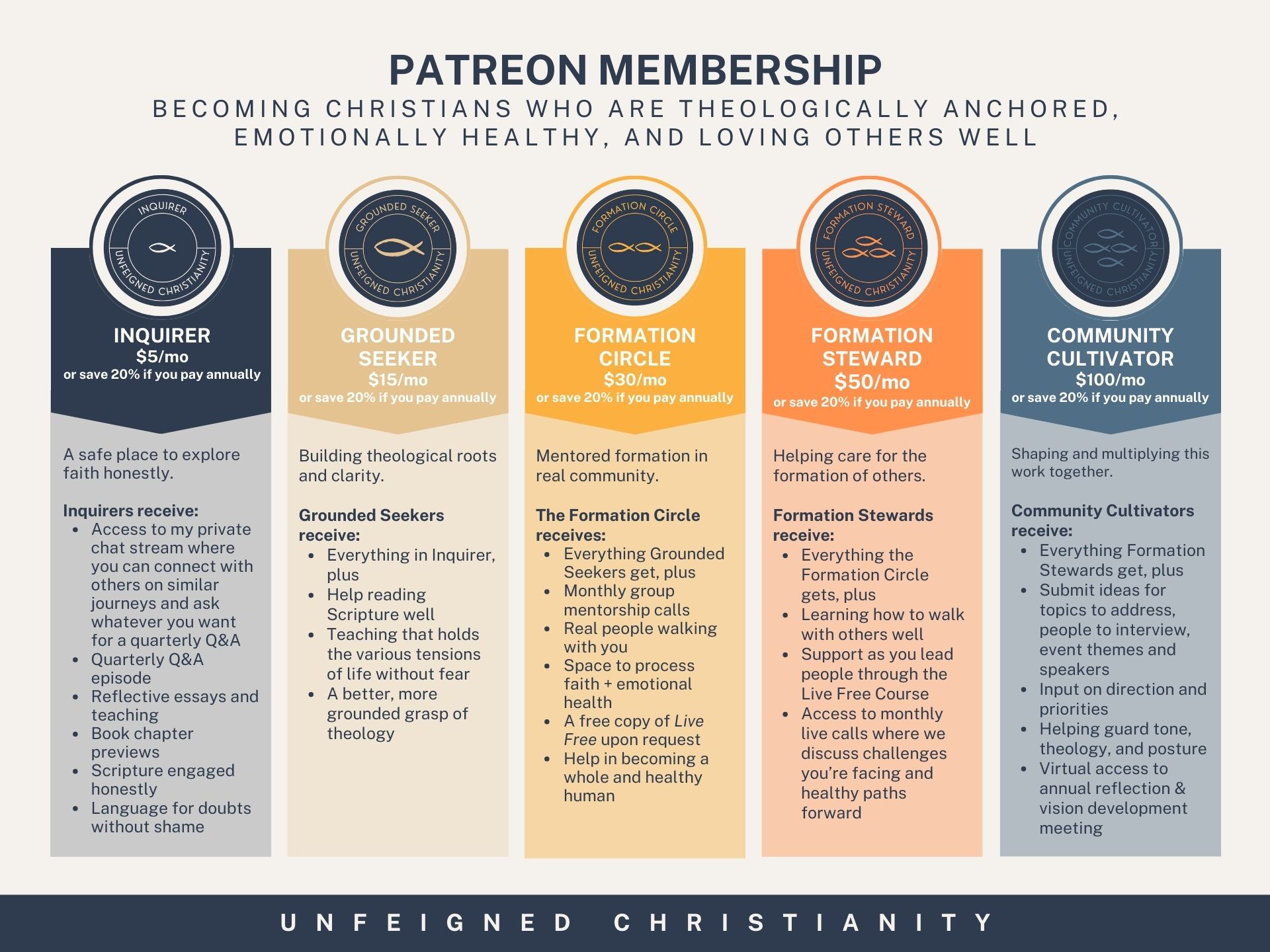
Join Unfeigned Christianity on Patreon and Take Your Journey to the Next Level.
Become a paying member of Unfeigned Christianity for as little as $5/mo and access article, our community chat stream, and quarterly Q&A episodes.
Already a member? Login