
I used to think that if I loved God enough, I would no longer struggle with porn.
Like, if I just prayed harder, memorized more scripture, practiced remembering His presence throughout my daily life — I’d be fine. Along with that, I sought out accountability partners and software and made promises to stay off my phone after certain hours of the day.
And to be sure, those practices are important in the journey toward sexual health. But when that is the first place we start after failing in unwanted sexual behaviors, we don’t ever get clear on what is causing us to “not love God enough” in the first place.
“Sin!” You might shout.
And the rest of us might respond, “No, duh!”
But how do you overcome sin? Blaming bad behavior on sin is like giving a vague excuse for why you were late to work. Obviously, there’s a reason you’re late to work. But what are you going to do to make sure it doesn’t happen again?
Don't Have Time to Read? Here's the Gist:
Confession matters, but it only removes the weight of secrecy — it doesn't heal the underlying emotional wounds driving unwanted sexual behavior. Until you do the deeper work of understanding your story (the shame you're hiding, how you manage it, and what you run to when managing fails), you'll stay stuck in the same cycle. Real freedom requires emotional health, not just spiritual discipline.
Table of Contents
- The Problem Was Never Really the Porn
- Why Willpower Keeps Failing You
- Confession Is the Beginning, Not the Whole Journey
- Something Causes us to be willing to violate our deepest values
- The Cycle That Doesn't Resolve
- What I Learned About My Own Story
- Learning to Read the Symptoms
- You Cannot Find Emotional Healing Alone
- A Framework That Has Helped Me
- Three Questions to Help Your Start Exploring Your Story
- How to Find deeper support
The Problem Was Never Really the Porn
You can determine to get to bed on time, ask a friend to give you a wake up call, or punish yourself in some way if you leave the house later than you need to in order to arrive at work in a timely manner. Developing habits that help you meet your goal is always valuable.
But there will also always be times when you blow the habit.
A night out goes later than you anticipated. You wake up with a back ache and find it harder to get going. Your kid keeps you up half the night and you desperately want to sleep in.
How are you going to make sure you get to work on time when that happens?
In the same way, when life gets dark and the old friend returns and offers intimacy, what’s going to keep you from just giving in again?
You see, being late to work is merely a symptom of something deeper going on. In the same way, viewing porn is merely a symptom of deeper things at work in your soul.
The problem inside of you was never really the porn.
Rather, porn use indicates something underneath that is hurting and not yet dealt with.
Which brings me to the most important — and often skipped — question in porn recovery:
What's actually going on inside me?
Why Willpower Keeps Failing You
Here's a picture that might help.
Imagine your car's "check engine" light comes on. You've got two options:
- Pull over and figure out what's wrong under the hood
- Pop out the light bulb so you can't see it anymore
A lot of porn recovery strategies are basically option 2. Remove the trigger. Install the filter. Avoid the situation.
Those things aren't bad — they just don’t actually heal. Because the engine problem is still there, running quietly, getting worse.
Porn is the light on the dashboard. It's annoying and embarrassing and you want it gone. But it's telling you something.
Jay Stringer puts it plainly in his book Unwanted — your sexual behavior isn't random. The things that pull you toward porn are connected to real, specific wounds, unmet longings, and patterns you've probably been carrying since before you knew what porn even was.
In other words: there's a story underneath the struggle.
And until you start reading that story, you'll keep fighting the symptoms while the real problem keeps growing.
Related Articles
Confession Is the Beginning, Not the Whole Journey
Have you ever experienced what felt like a real break through only to fail again later on?
Maybe it happened at a conference. Maybe Bible school. Maybe just a late night conversation that went somewhere unexpected. You found yourself finally confessing out loud that you struggle with pornography, that you keep going back to it, that you hate it and yet you keep choosing it. And something shifted. The shame lightened. The secrecy broke. People came around you. You felt, maybe for the first time in a long time, like you could actually breathe.
And then, a few months later, it came back.
There's a reason that happens.
My father-in-law likes to say that secrecy is almost the worst part of lust and pornography. When it's hidden, that's where the hold is strongest. And he was right. Most men I've walked with discover that the simple act of telling someone — bringing it out of the dark — releases something. The pull diminishes. Community forms around you. People are praying with you, checking in on you, walking with you. That's not nothing. That's actually essential.
I had a friend years ago who would tell guys whenever they felt tempted to look at porn to call him up and invite him over so he could watch it with them. Provocative thing to say. But his point was that nobody ever actually wanted to take him up on it. It's the secrecy that captivates. Once you start keeping things in the light, there's real hope.
I'd go as far as to say that confession and bringing things into community is probably eighty percent of the victory.
But here's what often happens, especially in church environments: we mistake the beginning of healing for the whole of it.
Because when you confess and the burden lifts and the temptation quiets and life feels clean again — it genuinely does feel like you're healed. And for a while, you are freer. But what we don't realize in that moment is that we're also not currently inside the emotional environment that drove us to pornography in the first place. The conditions that made it feel necessary haven't shown up again yet.
They will.
Something Causes us to be willing to violate our deepest values
What makes someone keep giving in to something they ultimately don't want?
And I don't mean that rhetorically. This question sits at the center of everything when it comes to healing from unwanted sexual behavior. You know, heading in, that it doesn't lead anywhere good. You feel the shame before, during, and after. It doesn't deliver what it promises. So why does it keep working on you?
Scripture says that sexual immorality is different from other sin — that it consumes the whole body (1Co. 6:18). I've come to understand that what the text is pointing at is this: sexual immorality is often the ultimate physical manifestation of things that have been left unaddressed in our inner life. It's not a standalone problem that can be fixed with sufficient willpower. It's a symptom.
At some point in your story, there was an emotional environment — a particular state of your soul — and in that environment, pornography or some other unwanted sexual behavior presented itself as a solution. Not a good solution. Not a solution you'd have chosen in a clear moment. But a solution nonetheless.
Maybe the environment was pain. You were carrying a wound you didn't know what to do with, and the neurological hit of sexual arousal offered a moment of relief from the ache.
Maybe it was emptiness or boredom. The erotic felt like adventure, and adventure awakens a sense of purpose and meaning — things your soul was genuinely hungry for.
Maybe it was isolation. No one really knew you. No one was vouching for you or delighting in you. And for a moment, the experience made you feel seen, wanted, cared for.
I've noticed that men who are particularly drawn to interactive or chat-based pornography are often men who are tired of feeling like a burden to the people around them. In that space, someone actually wants their input. For a moment, they're not a problem. They're wanted.
Again, to reference Stringer, the type of unwanted sexual behavior we get pulled toward is telling us something. It's pointing to the emotional soil we were standing in when we first gave it access.
The Cycle That Doesn't Resolve
Pete Scazzero writes in Emotional Healthy Spirituality that it is impossible to be spiritually mature while remaining emotionally immature. I've found that to be one of the most clarifying things I've ever read about this particular struggle.
What I see in so many men is a cycle: confess, find freedom, stumble again, confess again, find freedom, stumble again. And the reason it keeps repeating is that they're trying to address an emotional problem with purely spiritual tools. Confession matters. Community matters. Prayer matters deeply. But they are the beginning of healing, not the essence of it.
Because here's what will happen: life will eventually return you to something that resembles the emotional environment that first opened the door. Maybe it's another season of isolation. Another stretch of feeling invisible or purposeless. Another run of stress and chaos with no outlet. And when that environment shows up again, the old friend shows up at the door.
If you haven't done the work to become more emotionally healthy, the temptation will feel nearly as strong as it ever did. The spiritual activity alone — the prayer, the confession, the accountability — will not be enough to walk in victory.
What I Learned About My Own Story
Let me illustrate what I mean.
I wrote Live Free in 2018. And if I'm honest, the unraveling I wrote about in the first piece of this series started not long after the book came out. Looking back, I can trace it clearly.
In 2019, we were going through something genuinely hard in ministry. Real trauma — not anything sexual, nothing dramatic in that way, just a prolonged season of confusion and pain that I didn't fully know how to process. And during that time, I developed significant insomnia. I'm talking two-thirty in the morning, mind racing, replaying conversations I couldn't resolve. I'd get out of bed and read. I'd spend hours praying, casting my cares on the Lord. I genuinely brought myself to God during those times.
But I also started binge-watching a TV show during the Christmas break that year. And I remember knowing something was off, because I couldn't stop watching even when it was late at night. It wasn't the content that was the problem — it was the pull. There was something inside me that recognized even then: this is escape. This is what you're reaching for when the chaos gets too loud.
And I didn't stop to ask why.
I just kept going. I poured myself into work. I found ways to lean into things that gave me a sense of purpose and hold whatever I was feeling at bay. I built little string bridges across the darkness and told myself they were sturdy enough.
A few years later, when I went through an even harder season the old friend showed back up. Because I had found myself in an emotional environment that was similar to the when I had first opened the door as a kid. And while I had experienced a lot of healing from those early years, I hadn't learned how to navigate new, but similar experiences, in an emotionally healthy way. Instead, I just managed around it.
There is a difference between healing and managing.
Learning to Read the Symptoms
One of the things I've had to learn is how to notice what's happening inside me before I've already made the bad decision.
Have you sat in a meeting where your chest got tight and your heart rate spiked? That's information. Have you been in a conversation — perhaps with a spouse, a friend, or even one of your children — where you suddenly wanted to walk out or you just went completely silent? That's information too. Have you found yourself pulling up your phone to scroll, or sinking into a YouTube rabbit hole, or sitting in the back of church playing a game while a sermon is being preached?
None of those are necessarily sinful. But they're all symptoms. They're your inner world trying to tell you that something is awry in your soul and you're looking for a way to quiet the noise, numb the pain, escape the chaos, feel something or feel nothing.
And if we don't learn to read those symptoms and bring them to Jesus for healing, we will keep building string bridges and hoping they hold.
You Cannot Do This Alone
I don't think you can pursue emotional health by yourself.
Humans are resilient, and there's a lot you can learn from books and resources and communities like The Live Free Mentorship program. But what you actually need — what does the deepest work — is someone who knows your story. Someone with the context and history to speak into what they're seeing in you. Someone trauma informed and trained to help you understand what's actually going on beneath the surface.
That's why I advocate for pursuing professional therapy. I know some people in church circles worry that seeking professional counseling is somehow bypassing what the church is meant to do. But consider this: most people's deepest wounds came from relationships inside the church. It's hard to feel safe processing them in the same environment where they happened. And most churches, honestly, don't have professional therapists on staff. So go find one. Find a professional counselor who holds a Christian worldview and understands that true healing is ultimately anchored in Jesus. But go.
Personally, I've discovered that having a professional counselor hasn't made me less vulnerable with my local community. It's actually helped me be more vulnerable in appropriate ways with people who are at different places in their own emotional journeys. It's made me a better member of our community, not a worse one.
A Framework That Has Helped Me
One of the things my counselor introduced me to is a framework called Internal Family Systems — IFS. I want to give you a simplified version because it has genuinely changed the way I understand myself.
The basic idea is that we're not one monolithic, unified self. We're made up of parts. And a healthy, whole person is one whose true self is present and connected — someone who can be wounded and bring that wound to Jesus and experience real healing.
But all of us carry wounds. And IFS describes what happens when those wounds get triggered. It calls that wounded part the exile. This is the part of us that feels shame, pain, loneliness, the sense of being unwanted or unseen. Those wounds almost always originate early in life, often before age five. Someone we were looking to for belonging and delight — a parent, a teacher, someone significant — communicated rejection instead. And that moment got lodged inside us.
Justin Whitmel Earley writes about how a baby who wakes up in its crib is looking around, cooing, desperately searching for someone to notice and express delight. I've seen this up close lately. We recently had our sixth child, and when I walk into the room and she looks up and finds my face, she breaks into this enormous grin. That's all of us. We wake up each day looking for someone to delight in us. And when people fail to give us that — as they inevitably will — the exile is born.
So we develop a manager. The manager is the part of us that learns how to keep the exile from feeling that pain. Maybe it's through achievement and hard work. Maybe it's through reputation management, always presenting the polished version of yourself. Maybe it's through being the most knowledgeable person in the room. Whatever it is, we build systems to stay ahead of the shame.
But those systems eventually fail. And when they do, and the exile threatens to overwhelm us, the firefighter arrives — the part of us that will do anything to put out the fire. And that's where the pornography, the compulsive and harmful behavior, the unwanted sexual acting out shows up. The firefighter doesn't care about your values. It cares about surviving the moment.
The brutal irony is that the firefighter's solution always makes it worse. Because the behavior awakens more shame, which re-triggers the exile, which overwhelms the manager, which calls the firefighter back in. And so the cycle runs.
Three Questions to Help Your Start Exploring Your Story
So let me leave you with three questions. They're not meant to be answered quickly. Spend time on them.
First: The last time you gave in to the unwanted behavior — what were you feeling in that moment? Not what were you thinking. What were you feeling? Were you lonely? Afraid? Hurt? Bored? Invisible? Purposeless?
Second: What's the way you typically try to manage those feelings? For me it was achievement. I found that being the best at something, accomplishing a lot, or building a reputation helped me avoid the fear that I don't have anything of value to bring. But it also showed up as media and noise and just drowning out whatever was going on inside me. What's your pattern?
Third — and this is the most important one: Where was the first time you remember encountering those feelings? How old were you? What was happening? When did you first learn to cope, and what were you coping with?
As you begin to trace that, you'll start to see something about your story that you may never have looked at directly before. You'll start to see the exile — the wound that's been there since before you ever found pornography. And you'll start to understand the difference between managing that wound and healing it.
In the next piece, I'm going to walk you through what that healing has actually looked like for me — what changed when I stopped building string bridges and started letting Jesus into the cavern itself.
That's where we're going. If you don’t want to miss it… subscribe using the form below (or follow along wherever you read my work).

if you want deeper support
If you’re tired of a “try harder” or “pray more” approach, and you want a space that helps you grow in being:
- theologically anchored
- emotionally healthy
- able to love others well
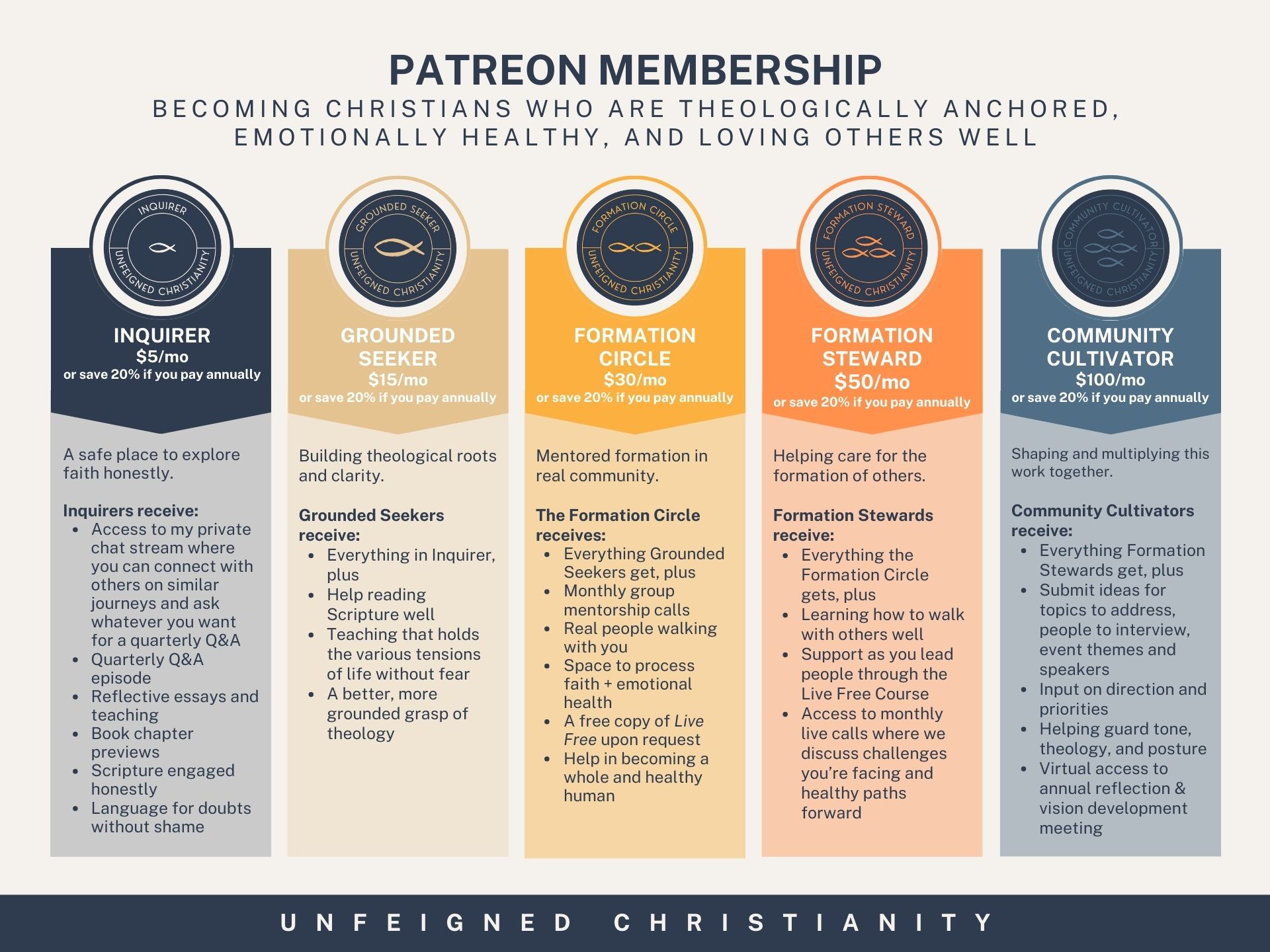
…that’s why I built the Formation Circle, an online mentorship community that helps you walk-out becoming a whole and healthy human. This community is nothing fancy. But it helps ordinary people practice honesty, connection, and healing—one choice at a time.
You’re not disqualified because the old friend came back. In fact, you’re invited to learn a new response. That’s where real freedom starts. You can share your thoughts or questions in the 0 Comments below.
Join Unfeigned Christianity on Patreon and Take Your Journey to the Next Level.
Become a paying member of Unfeigned Christianity for as little as $5/mo and access article, our community chat stream, and quarterly Q&A episodes.
Already a member? Login